
CNA Staff, Dec 10, 2025 /
09:30 am
With the rollout of a novel online safety law that prevents children under 16 from accessing social media, Catholics in Australia are hoping for freer childhoods for children there.
Social media companies are responsible for enforcing the age restrictions and may receive fines of tens of millions of dollars if they fail to adequately verify these age limits, according to the law.
The parents behind the social media law
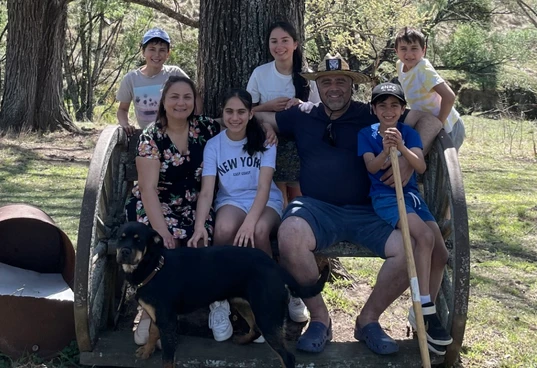
“There are a thousand and one reasons to delay social media for children,” said Dany Elachi, a Catholic father of five who helped get the law passed.
Elachi’s passion for phone-free childhoods comes from his experience with his family.
When Elachi and his wife gave their then 10-year-old daughter a phone, they instantly “saw very quickly how that device transformed her childhood,” Elachi said.
“It left her with little time to play, to connect with siblings and us, her parents, to read and to rest. It even intruded on her sleep time,” Elachi recalled.
But when he and his wife took the phone away, their daughter struggled “greatly,” Elachi said.
“She cried herself to sleep for many nights,” he said. “That was hard for us, but we knew we had to hold firm. We preferred a few nights of tears now, than potentially a lifetime of tears later.”
Elachi and his wife decided to reach out to other parents in their Catholic school community “to form an alliance of families delaying smartphones and social media.”
Elachi went on to co-founded the Heads Up Alliance, a grassroots movement of parents advocating for social media-free childhoods.
“The idea was to create a community, so that our daughter didn’t feel totally isolated, and we, the parents, had support too,” Elachi said.
A childhood free of digital rule
“We want to give our children the space and freedom to ponder the bigger questions of life,” Elachi said.
“As Catholics in particular, we wish to raise our children in the values of our family and the faith — not the values of TikTok,” Elachi continued. “Social media is so consuming, that scrolling now replaces bedtime prayer.”
“Instagram and similar apps are designed to overwhelm our children’s lives, leaving little opportunity for connection with others — and God!” he said.
(Story continues below)
Subscribe to our daily newsletter
Michael Hanby, a Catholic University of America professor, said that children deserve “to grow up in freedom.”
“The brave new digital world is not ultimately liberating but enslaving,” Hanby told CNA. “But children, who deserve to grow up in freedom, need someone to fight for them.”
Hanby, who is an associate professor of religion and philosophy of science at the Pontifical John Paul II Institute for Marriage and Family Studies, said that social media and digital technologies “have transformed every aspect of how we live.”
“They profoundly shape how we think, what we think about, and how we relate to one another,” he continued.
“They are slowly sapping away at the foundations of our humanity: our embodied relationships with one another in common places, our capacity to remember or to sustain an act of attention, which are basic ingredients in our ability to love and to pray and to live and act coherently,” Hanby said.
A new line in the sand
Archbishop Peter Comensoli of Melbourne said he hopes the new law will help parents protect their children from isolation and disconnection
“Social media has brought many great benefits to the world. When used well, it can connect people and help us to share things that bring life to the world,” the archbishop told CNA. “Unfortunately, it can also be used in ways that create disconnection and isolation.”
“Young minds need time to develop and mature to ensure they can use social media safely and well,” Comensoli continued.
“I hope the new laws will be a help for parents who are trying hard to protect their children from the potential harms of social media and that as children grow and mature they will be able to engage with social media in positive ways that contribute to the common good,” he said.
Elachi described the law as “pro-parent,” saying it “gives parents the strength” to hold off on letting their children sign up for social media.
“This new law draws a line in the sand regarding the safety of social media for children,” Elachi said. “It sets a new standard, and we hope it is the first step in effecting a cultural change.”
Withdrawal symptoms?
The transition will come with its own challenges, Elachi admits.
He noted that “a lot of psychologists are also warning that some children will suffer withdrawal symptoms” after the law goes into effect.
These symptoms may mirror his own daughter’s struggles after her parents took away her phone — but Elachi hopes that parents will support their kids in this challenge.
“We hope that children have the support of their families through that initial period and find a fuller childhood on the other side,” Elachi said.
“It will also help children, because when everybody misses out, nobody misses out,” Elachi said of the law.
The law requires extensive age verification, meaning that many users will potentially be required to hand over identification to social media companies to prove they are of age.
Elachi said this dilemma “is a concern to us.”
“This information is supposed to be deleted immediately, and we hope that tech companies comply with their obligations,” he continued.
Hanby, however, expressed uncertainty about the effectiveness of the new law, though he commended its intentions.
“I don’t know how effective the new Australian law will be,” Hanby said, “but as the expression of the aspiration for children to experience a human upbringing, it seems like a good idea.”
Elachi said he is “proud” that the law is going into effect.
“Everybody has seen the damage that it’s done to childhood, and I’m proud that Australia is the first country in the world taking serious steps to roll it back,” Elachi said.

Kate Quiñones is a staff writer for Catholic News Agency and a fellow of the College Fix. She has been published by the Wall Street Journal, the Denver Catholic Register, and CatholicVote, and she graduated from Hillsdale College. She lives in Colorado with her husband.