Catholic organizations in the Middle East are helping provide aid, food, and shelter to people in Lebanon who are displaced by the ongoing military conflict, and some people remain concerned that a possible full-scale invasion by Israel could exacerbate the crisis.
Lebanon was pulled into the regional conflict when Iranian-backed Hezbollah fighters launched missiles into northern Israel and Israel Defense Forces (IDF) returned fire in their strongholds, primarily southern Lebanon.
Monalisa Freiha, associate editor and deputy editor-in-chief at An-Nahar Al Arabi, spoke to “EWTN News Nightly” on March 26 with concerns for Lebanese people, saying they “did not choose this war” and “are not part of the decisions that led to this war.”
“[We] are paying the price every single day, living under bombardment, fear, and uncertainty,” she said.
Israeli forces launched incursions into southern Lebanon to establish a security zone near the border, and Israeli Prime Minister Benjamin Netanyahu said on March 25 it will move deeper into Lebanon to expand this zone. Hezbollah fighters are scattered throughout the region, but most of their attacks still come from rockets and drones, while ground clashes are limited.
Israeli officials ordered evacuations for areas south of the Litani River, which is primarily Shia Muslim but also home to Catholic, Eastern Orthodox, and Sunni Muslim minorities. Hezbollah and Iranian leadership are Shia.
More than 1,000 people in Lebanon have been killed. More than 1 million people have been displaced, and tens of thousands of civilians have remained in conflict zones despite evacuation orders.
Situation on the ground
Cedric Choukeir, Catholic Relief Services (CRS) country representative for Lebanon, told EWTN News the evacuations were “very challenging” for people and said the process was “very chaotic” because people did not have “a lot of choice or clarity around when they needed to evacuate, what timeline they were allowed to leave, [or] which routes they should be taking.”
During the initial attacks, he said people “found themselves stuck in traffic with airstrikes around them.” He said people were ordered to leave villages, but then “you’ll find yourself in the next village which was also ordered to evacuate,” and said travel to Beirut was taking anywhere between 14 to 24 hours.
The Lebanese government and humanitarian organizations are providing shelter, food, medical services, and other forms of aid to those affected. Some organizations involved include CRS, Jesuit Refugee Service (JRS), and Caritas Lebanon.
Choukeir, working out of Lebanon’s capital Beirut, told EWTN News that CRS and Caritas have assisted 145,000 people who have been affected by the conflict so far.
He said CRS is working closely with Caritas and other faith-based partners to provide food kits, medicine, mattresses, blankets, pillows, and other forms of medical assistance to those housed in shelters. As the conflict continues, CRS is also working to make shelters “more dignified” by improving sanitation, access to hot water, and providing supplies “so people can prepare their own meals,” he said.
With many children displaced during the school year, Choukeir said CRS is helping children deal with the trauma of the conflict.
In conjunction with Caritas, he said CRS is also working to provide assistance to the war zones: “We have a stock available of lifesaving assistance and commodities that we are sending to these areas.”
Choukeir noted that some people who evacuated their villages remain stuck in southern cities, such as Tyre. Others chose not to evacuate, he said, because “they don’t have anywhere to go, they don’t have money to go, and they’d rather stay even if it means they’re risking their lives.”
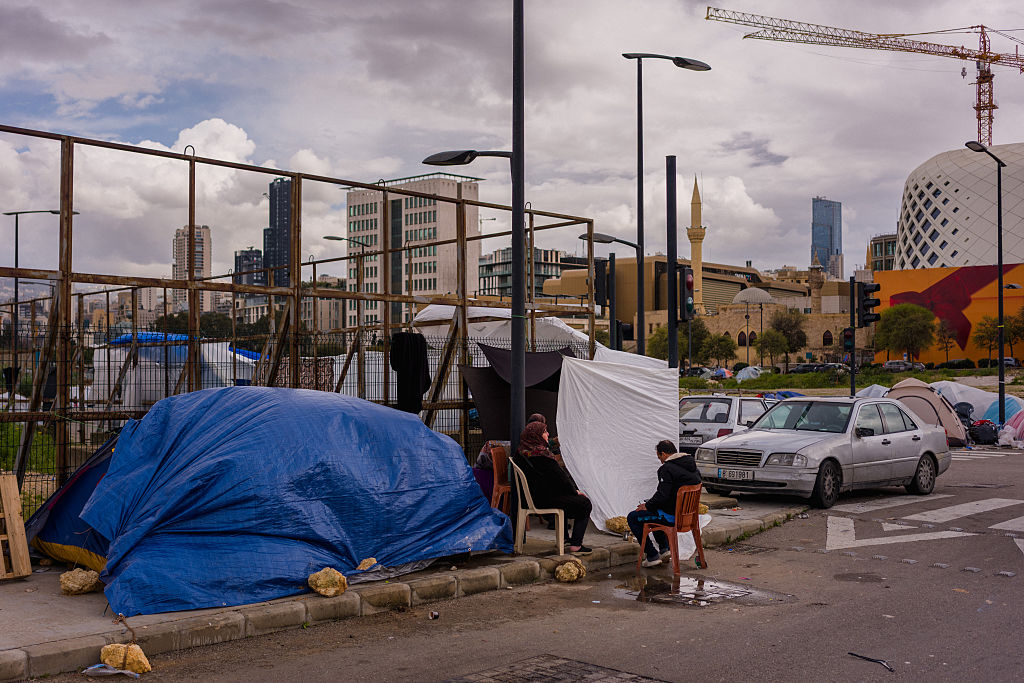
Although 130,000 people are housed in shelters, Choukeir said most people must find “other solutions,” such as staying with relatives, which can mean cramming dozens of people into homes. Many others are “staying in their cars [and] laying out tents in the streets,” he said.
“There aren’t enough collective shelters to host everyone who is displaced,” Choukeir explained.
He said the displacement of people “is very visible around central Beirut,” on the sea front, and in any neighborhood with a large Shia population.
Jesuit Father Daniel Corrou, the Middle East and North Africa regional director for JRS, is also based in Beirut, near Choukeir. He told EWTN News that he opened up his parish, St. Joseph, for migrant workers and ethnic minorities who need shelter during the attacks. The building holds about 200 people.
As he spoke about a recent Israeli attack that destroyed a building just 300 meters from the parish, he said: ”I can hear Israeli drones flying overhead” during the phone interview, which he described as an everyday occurrence for people living in the city.
In addition to housing primarily migrant workers as a shelter, he said that population makes up most of the congregation and most of the volunteers helping refugees.
Corrou said many of the workers “make very little money,” much of which they send back to their families. When speaking about the generosity of the volunteers, he said: “That’s where I just stand back in awe.”
Concerns about escalation
Choukeir expressed concern about a potential large-scale ground offensive from Israel in southern Lebanon, noting “there’s still a significant amount of people there.”
He said he is also concerned about Israel’s destruction of bridges out of the region, stating that “if they want to evacuate,” there needs to be “a way for them to be able to do so.” He is worried about “further waves of people being displaced — not for the first time, but for the second time.”
Corrou also expressed concerns and some pessimism, saying there’s a “general fear” that even if the United States and Iran reach a peace agreement, it “would not end the conflict that’s going on here [because] … Israel has different desires in Lebanon.”
He said he has concerns for Shia Muslims because some shelters won’t house them out of a fear they could “become targets.” He also expressed concern for Catholics in the south, some of whom remain in the war zone out of fear “they wouldn’t be able to get their land back” if they leave and Israel begins a lengthy occupation.
Corrou attended a security briefing for nongovernmental organizations and said it appears that Israel is not “targeting Christian areas” but that “Christian areas have been hit.” He warned: “It’s hard to say that they’re safe, even if they remained in their Christian village.”
He echoed the calls for peace that came from Pope Leo XIV and said “war is not going to solve this.”
“This has to be about coming to some sort of conversation — a compromise,” Corrou said. “This has to [have] a diplomatic solution.”
Choukeir similarly invoked the Holy Father’s call for peace and said “we would like to see the violence end and things to be resolved through diplomatic channels.”
“We want to make sure that civilians are protected, we want to make sure that humanitarian workers are protected in this conflict, including health care workers and paramedics and unfortunately, I think more can be done on this front,” he said.