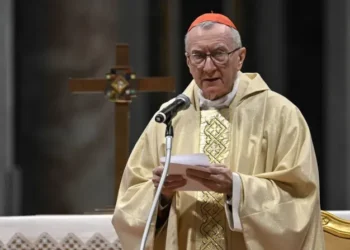
In a world where “the notion of ‘freedom’ has become contentious in public discourse,” Christians must be clear about what freedom means in the light of faith, Bishop Erik Varden told Pope Leo XIV and members of the Roman Curia during the Lenten retreat.
“Freedom is a good to which we all aspire; we rise up against anything which threatens to curtail or confine our freedom. As a result, the vocabulary of freedom is an effective rhetorical tool,” Varden said in the fourth meditation of the retreat, delivered on Feb. 24.
“Suggestions that the freedom of a particular group is at risk will call forth instant responses of outrage on the internet,” he continued, noting that “a variety of political causes in Europe now harness the jargon of freedom. Tensions result. What one segment of society perceives as ‘liberating’ is found oppressive by others.”
“Opposing fronts are raised, with the banner of ‘freedom’ held high on all sides,” Varden said. “Bitter conflicts arise from incompatible agendas of purported liberation. This state of affairs poses a challenge for Christians.”
Varden, a Norwegian Cistercian and bishop-prelate of Trondheim, grounded his reflection in St. Bernard of Clairvaux’s teaching on freedom, insisting that for Christians, true freedom is inseparable from the Son’s loving obedience to the Father.
“Rooting his understanding of freedom in the Son’s Yes! to the Father’s will, Bernard works a revolution in our grasp of what it means to be free,” he said. “Christian freedom is not about seizing the world with force; it is about loving the world with a crucified love magnanimous enough to make us freely wish, one with Christ, to give our lives for it, that it may be set free.”
Varden also warned against the way “freedom,” when detached from the person and from truth, can be exploited to justify oppression.
“Caution is called for when freedom, held hostage by force, is manipulated as a means to legitimate the doings of impersonal subjects like ‘the Party’, ‘the Economy’, or even ‘History’,” he said. “In a Christian way of thinking, no oppressive policy can be redeemed by invocations of ideological ‘freedom’. The only meaningful freedom is personal; and one person’s freedom cannot cancel another’s.”
“To subscribe to a Christian idea of freedom is to consent to pain,” Varden added. When Christ says, “Resist not evil,” he explained, “he does not ask us to countenance injustice. He lets us see that justice’s cause is sometimes best served by suffering for it, refusing to meet force with force.”
“Our emblem of freedom remains the Son of God who ‘emptied himself’,” he concluded.
In the fifth meditation, delivered later that day in the Pauline Chapel, Varden turned again to St. Bernard, focusing on ambition as a distortion of the soul’s relationship to truth.
“Ambition represents a particular form of capitulation to untruth,” he said. “Ambition is a not very subtly sublimated form of cupidity.” Citing Bernard, he described ambition as “a subtle ill, a secret virus, an occult pest, an artisan of deceit,” adding that it “springs from an ‘alienation of the mind’.”
“It is a madness that comes about when truth is forgotten,” Varden said. “The fact that ambition is a form of insanity makes it ridiculous in any instantiation, but especially so when it occurs in persons given to a state of selfless service.”
Varden then took up Pilate’s question — “What is truth?” — saying it must not be left unanswered amid today’s confusion and fear.
“People of our time ask this question earnestly, often with remarkable good will, notwithstanding their confusion, fear, and the rush they are always in. We cannot let it go unanswered,” he said. “We need our best resources to uphold substantial, essential, freeing truth against more or less plausibly shining, more or less fiendish substitutes.”
“In our predicament, rich in opportunity, it is imperative to see and articulate the world in Christ’s light,” Varden continued. “Christ, who is truth, not only shields us; he renews us, impatient to reveal himself through us to a creation increasingly aware of being subject to futility.”
Pointing to the Second Vatican Council’s emphasis on sanctity, Varden said the Church’s claim to truth convinces most when it is embodied personally.
“Was not the universal call to holiness, the call, that is, to embody truth, the strongest note struck by the Second Vatican Council?” he asked. “It resounded splendidly like a gong throughout its deliberations. The Christian claim to truth becomes compelling when its splendor is made personally evident with sacrificial love in sanctity, cleansed of temptations to temporize.”
This story was first published by ACI Stampa, the Italian-language sister service of EWTN News, and has been translated and adapted by EWTN News English.