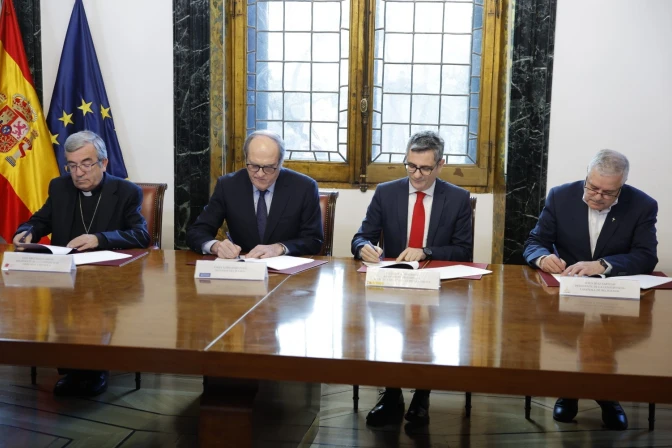
The Catholic Church, the Spanish government, and the people’s ombudsman have agreed upon a protocol for compensating abuse victims following arduous negotiations that began last January.
The agreement does not establish specific parameters for financial compensation — neither minimums nor maximums — because it is not intended to be the sole avenue for reparation. Furthermore, as agreed upon by the signatories, the aim is to address each case on an individualized basis.
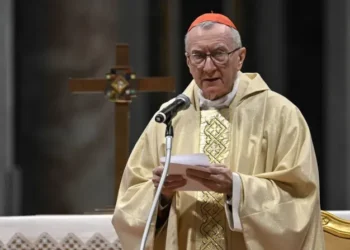
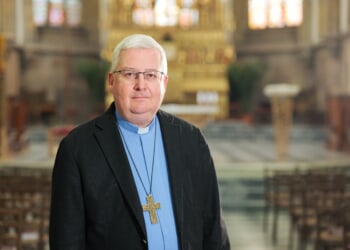
The signing of the new protocol, which will enter into force on April 15, took place at the ombudsman’s office on March 30. Present at the ceremony were the president of the Spanish Bishops’ Conference (CEE, by its Spanish acronym), Archbishop Luis Argüello; the president of the Spanish Confederation of Religious (CONFER, by its Spanish acronym), Dominican Father Jesús Díaz Sariego; the minister of the Presidency, Justice, and Relations with the Cortes (legislature), Félix Bolaños; and the people’s ombudsman, Ángel Gabilondo.
Alluding to the liturgical season, Argüello expressed at the beginning of his remarks the hope that the agreement would serve to “alleviate the passion (suffering) of so many victims of abuse,” specifically those whose cases have passed the statute of limitations or whose abusers have died.
The prelate underscored that this new system is an extension of the efforts undertaken for years by ecclesiastical institutions, efforts that more than a year ago took concrete form in the PRIVA plan for the comprehensive reparation of abuse victims. This plan has already resolved over a hundred cases, offering, among other measures, financial compensation to more than 80 individuals, totaling 2.5 million euros ($2.86 million).
Under this new protocol, the system implemented by the Catholic Church “is never replaced; rather, it is complemented by collaboration with the public authorities,” an arrangement whose concrete realization has been delayed beyond initial expectations, yet which Argüello views as “an opportunity for collaboration, while naturally respecting the scope and jurisdiction” of each signatory institution.
Sariego remarked that “an agreement — even an imperfect one — is preferable to no agreement at all” and expressed the hope that this day would “serve to alleviate that pain and suffering which we know is immense and runs deep.”
Bolaños noted that this constitutes a model “that involves the victims,” in which “comprehensive reparation is guaranteed” and which is structured as “a collaborative effort”; however, he underscored that “the final say will rest with the state” in the event of a disagreement between the experts from the Catholic Church’s PRIVA Plan and the team appointed by the people’s ombudsman.
Bolaños also commended and acknowledged the work of the experts appointed by the Catholic Church, “even though the PRIVA Plan contained an ‘original sin,’” namely, that it was the Church itself that determined what compensation victims of abuse within its own ranks would receive, a factor that led “many victims to lack confidence” in the system.
During his remarks, Gabilondo stated that the signatories had debated “every comma” of the 14-page protocol. “I cannot recall anything that was not complicated, nor anything that proved insurmountable,” he stated when asked about the difficulties encountered during this process.
End of a phase
The signing of the protocol marks the conclusion of a phase that began in March 2022, when the legislature tasked the ombudsman with investigating abuses within the Catholic Church. In October 2023, the ombudsman presented his report, which included a recommendation to establish a state-run reparations system.
In April 2024, the executive branch approved an implementation plan for measures proposed by the ombudsman, a plan that the CEE rejected on the grounds that it was based on “a condemnatory judgment of the entire Church, rendered without any form of legal safeguards,” and amounted to “the state publicly targeting the Church in a discriminatory manner.”
Despite this rejection, a preliminary agreement was reached in January 2026, an agreement in which the Vatican secretariat of state was reportedly involved, as acknowledged by both Argüello and Bolaños. The minister confirmed on March 30 that on March 20 he held a further meeting at the Vatican Secretariat of State while in Rome accompanying the king and queen of Spain, who were received by Pope Leo XIV.
How the system will work
Effective April 15, any victim of abuse within the Church may contact an office established for this purpose within the Ministry of the Presidency, Justice, and Relations with the Cortes, which will forward the information to the ombudsman.
The Ombudsman’s Victims Unit will review the case within a maximum period of three months — extendable by one additional month if necessary. If the case is accepted, the Ombudsman’s Victims Unit will submit a proposal for redress to the PRIVA Plan Advisory Commission, which will have a maximum of two months to evaluate and respond to it.
The ombudsman will then have 15 days to convey these assessments to the victim.
If all parties are in agreement, the decision shall be deemed final. Otherwise, the dispute is referred to a joint body comprising representatives from the ombudsman, the CEE, and CONFER as well as associations of abuse victims, which will have an additional 15 days to reach a resolution.
If an agreement is still not reached, “the ombudsman and the representatives of the ecclesiastical institutions will make a final attempt to reach a consensus within a maximum period of one month.”
Ultimately, it would be the Ombudsman’s Victims Unit that makes the decision, which the Catholic Church must abide by.
This story was first published by ACI Prensa, the Spanish-language sister service of EWTN News. It has been translated and adapted by EWTN News English.