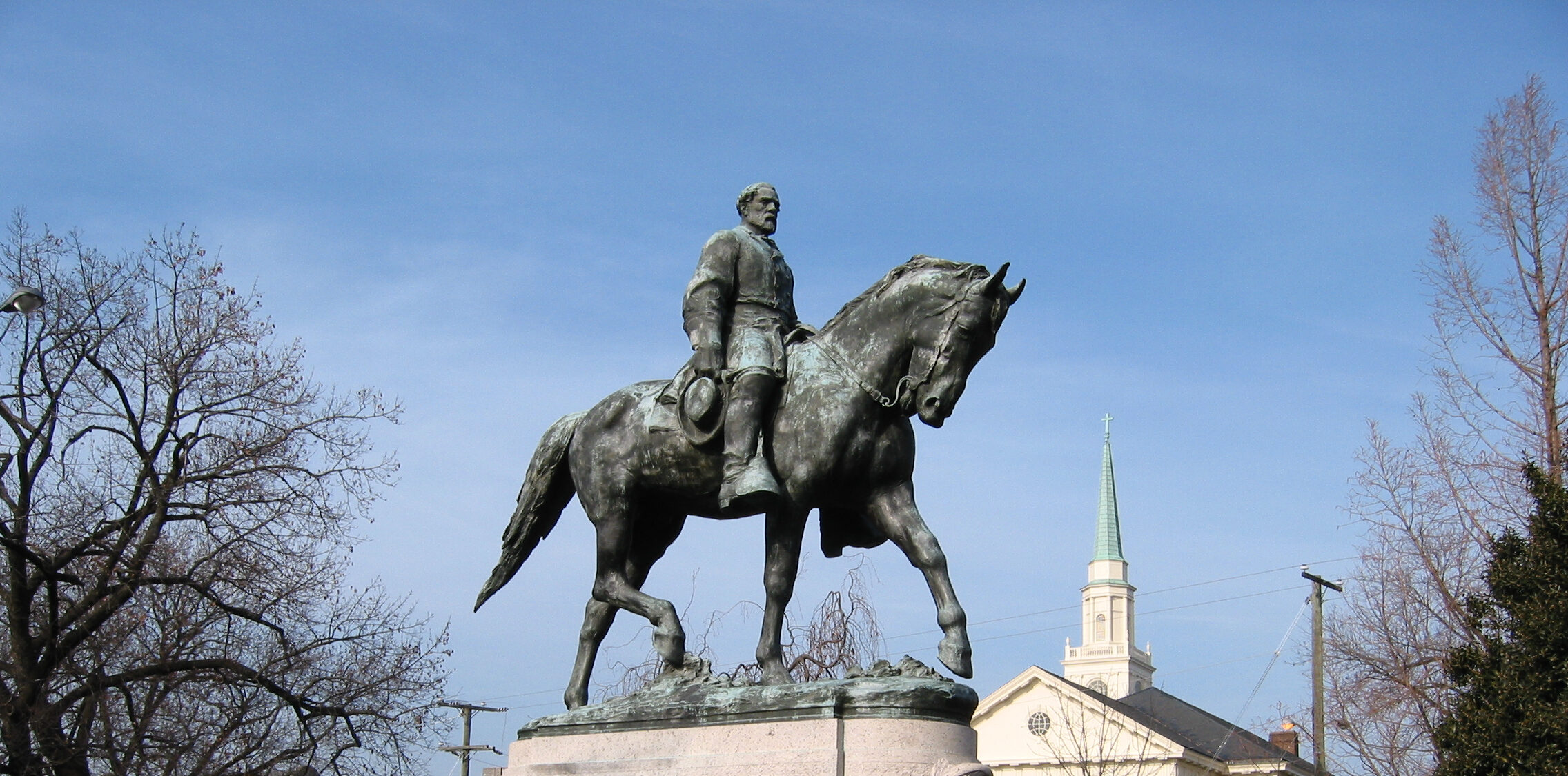
After whom should one name a school? The United States faces enormous economic, political, and international challenges. However, that isn’t what captured public attention in Harrisonburg, Virginia, during a trial that ended shortly before Christmas. Residents fought over the Shenandoah County School Board decision to restore the names of Confederate generals Robert E. Lee and Thomas “Stonewall” Jackson to two local schools. The battle has been as emotional and bitter as any sectarian struggle abroad.
Good men and women sometimes fight for bad causes. Such was the case of Lee and Jackson.
Reported the New York Times, “On a crisp, cold morning in the Shenandoah Valley in Virginia this month, a federal judge listened as lawyers argued over racism, the Confederacy, and who deserves to be honored through historical memory.” Judge Michael Urbanski said he was not likely to render a quick decision. The losers will undoubtedly appeal. And the bruised feelings will persist much longer.
In recent years Confederate figures have become the Devil-du jour, with a concerted campaign to down statues, rewrite battlefield descriptions, redesign flags, eliminate historical mentions, and rename schools, streets, and bases. Lee, who more than any other figure came to represent the famed “Lost Cause,” may have suffered the most. His childhood home in Alexandria, Virginia, went on the market in 2021 with no mention of its historical significance.
West Point, from which Lee graduated with distinction and of which he served as superintendent, eradicated mentions of his distinguished tenure. Washington and Lee College, which would not have survived had he not rejected opportunities to profit from his fame and instead devoted himself to education, faced demands to drop his name. Moreover, his statue in Charlottesville, which triggered violent demonstrations in 2017, was not just lowered, but destroyed. One of the protestors celebrated: “It feels like witnessing a public execution.”
Lee would likely view the controversy as justifying his opposition to commemorating Confederate heroics during the Civil War. He responded to a request to join a group planning monuments for the Gettysburg battlefield: “I think it wiser, moreover, not to keep open the sores of war but to follow the examples of those nations who endeavored to obliterate the marks of civil strife, to commit to oblivion the feelings engendered.” The campaign to essentially deify him was led by his former subordinate Jubal Early only after his death.
However, Lee is not the only historical target. Even Union commander Ulysses S. Grant, whose battlefield victories ensured abolition, has been targeted for being a slaveholder. It is increasingly difficult to name much of anything after any historical figure. After all, the process of history is rather like the making of laws and sausages, which famed German Chancellor Otto von Bismarck once compared. Who in the past, at least until very recently, can withstand modern scrutiny?
Bismarck is an obvious case. He was a massive historical figure, but, alas, no liberal. However, in treating human beings across Europe and beyond as lifeless pieces in an oversize game of Risk or Diplomacy he was no different than other European statesmen, including those from allegedly liberal democracies, who were no less nationalistic and militaristic, as well as callous and even cruel.
Consider the figures represented in busts and statues, memorialized in books and films, and bestowed upon organizations and buildings across Europe. Visualize nation builders, victorious statesmen, military conquerors, and patriotic exemplars. How many of them would pass muster today? France’s famed military museum, Les Invalides, features Napoleon Bonaparte’s sarcophagus, surrounded by celebrations of his victories, which consigned tens or hundreds of thousands to death. In 2021 French President Emmanuel Macron visited to lay a wreath commemorating the late emperor’s death.
Then there is American history. Many revolutionary leaders, including George Washington, Thomas Jefferson, James Madison, Alexander Hamilton, Patrick Henry, and John Marshall were slaveholders. What seems monstrous to us today was commonplace then. Even the sainted Woodrow Wilson and Franklin Delano Roosevelt had feet of clay or worse. Wilson was a racist and white supremacist. He reestablished segregation in the federal government. He also took the U.S. into World War I, a terrible conflict in which the country had no legitimate role, needlessly sacrificing 117,000 American lives.
FDR established concentration (though not death) camps for Japanese-Americans and rejected Jewish refugees as war clouds gathered in Europe. As the war raced to its hideous conclusion he agreed at Yalta for the return of all Soviet citizens to Joseph Stalin’s tender mercies, which turned into “Operation Keelhaul” that ensnared even Russians who had fled the Bolshevik Revolution decades before. Nor was Roosevelt a model of personal or political virtue.
In contrast, two figures featured in the Harrisonburg battle, Lee and Jackson, seem almost minor in comparison. By the end of the Civil War Lee, not President Jefferson Davis, symbolized the Confederacy and offered a hope for victory. However, Lee never sought such a role. Like the vast majority of Americans in both North and South he was a racist who expected rule by whites. He criticized slavery but, again, like most Americans, could not imagine freeing slaves and making them equal citizens. His impoverished family never owned slaves. His only direct experience with the institution was unhappy, coming as executor to his father-in-law’s estate. The latter’s slaves were property and could be freed only after the estate’s debts were paid, which Lee did. (His management has become a matter of controversy, but criticisms of him have never been corroborated.)
Lee opposed secession. He took up arms for Virginia, not the Confederacy, and only after his state seceded and was threatened with invasion. In rejecting command of the Union army he wrote Gen. Winfield Scott: “Save in the defense of my native State, I never desire again to draw my sword.” He was not alone in feeling greater loyalty to his state than country. Lee made the very sensible argument that political relations should be voluntary: “I can anticipate no greater calamity for the country than a dissolution of the Union.… Still, a Union that can only be maintained by swords and bayonets, and in which strife and civil war are to take the place of brotherly love and kindness, has no charm for me.” Notably, Unionist Horace Greeley, editor of the New York Tribune, expressed similar views.
Recent scholarship concludes that the Civil War resulted in a death toll of around 750,000, more than eight million as a proportion of today’s population. How can that be justified to coerce one’s countrymen to remain in the same political compact? Tragically, most Unionists never imagined the price to be paid. After the brutal and bloody 1864 Overland Campaign, Sen. Henry Wilson of Massachusetts stated: “If that scene could have been presented to me before the war, anxious as I was for the preservation of the Union, I should have said: ‘The cost is too great; erring sisters, go in peace’.”
Lee proved to be a fine soldier, the greatest of the conflict in my view, though the so-called “Marble Man” has come under his share of criticism of late. As the war neared its end he recommended that the Confederate government arm — and emancipate — slaves. That would have destroyed the institution. He rejected advice to disperse his army and inaugurate guerrilla war, surrendering instead. He urged southerners to take a loyalty oath to and seek a pardon from the Union authorities. He consistently worked to restore national comity.
The great irony of Lee’s military stewardship is that it was his success, more than that of any Northern commander, that made emancipation inevitable. Abraham Lincoln and the Republican Party were devoted to containment, not abolition, even after combat began. They sought to bar slavery from the territories, halting its expansion, but planned to preserve it where it remained, expecting its ultimate extinction in time. Indeed, President Abraham Lincoln reversed early emancipation endeavors by the likes of Gen. John Fremont in Missouri.
Such a position became untenable, however, as the war dragged on. Had Gen. Joseph E. Johnston not been wounded at the Battle of Seven Pines, which led to Lee’s appointment to command what became the celebrated Army of Northern Virginia, Johnston probably would have yielded Richmond to Gen. George B. McClellan’s forces, with a devastating impact on the Confederacy’s war effort and morale. Instead, Lee fought off multiple Union commanders. The cost in blood and treasure rose to staggering heights as the war proceeded, radicalizing Northerners, who came to believe, thankfully, that the institution had to be totally destroyed. Especially since slave labor freed up white Southerners to fight. Hence abolition became a war aim.
There is much to admire about Lee beyond his Civil War stewardship. Nevertheless, it is understandable that blacks in the U.S., in particular, focus on his defense of a slave republic. Unfortunately, what we see clearly today most Americans, in both South and North, saw only through a glass darkly then.
Necessary is mutual understanding. First, no figure’s memory need be treated as immutable and inevitable. As America evolves and history develops, there is nothing wrong with choosing new names or erecting new statues. Better, however, that the process be conducted with a positive focus, on what today best represents America, Virginia, or the city of Quicksburg, where the controversial schools are located, rather than negative, such as charging Lee and Jackson defenders with racism.
Second, local communities should be left to make their own decisions. Allow Charlottesville to tear down a Lee statue while Quicksburg names a school after him. It pained me to see the end of Richmond’s famed Monument Avenue, with its dramatic statues of Lee, Jackson, Davis, and J.E.B. Stuart — which offered a highlight when I ran the Richmond marathon years ago — but it was within the city’s right to remove them (other than the Lee statue, which was owned by the state).
Third, circumstance matters. A state flag should be a symbol of unity and represent all residents, avoiding division. Historical connections, such as Arlington Cemetery, on property left to the Lee family, should be preserved and explained. Battlefields belong to Americans who fought on both sides; their respective stories, good and bad, should be presented without bias or malice.
Fourth, common sense is essential. De minimis connections to ugly historical events are inevitable since history is littered with ugly events. For instance, the Audubon Society is named after the celebrated birder and painter, John James Audubon. He was, like so many other Americans, a slaveholder, but not a particularly important or malicious one. Demands that the organization change its name in response make little sense.
Fifth, compromise is possible. A little goodwill among combatants in the ongoing history wars would go a long way. There are reasonable, often powerful, arguments for reconsidering historical symbols. However, as TAS’s Scott McKay pointed out, there also has been plenty of ill will, ideological cant, and mob mentality in the revisionist campaign, especially during its height in 2020. For instance, though Washington and Lee College retained Lee’s name, the school took some steps to downplay the Confederate symbols. Charlottesville could have sold or gifted the downed Lee statue to a heritage group, to host on private property. Destroying it was a calculated and hostile political act.
Good men and women sometimes fight for bad causes. Such was the case of Lee and Jackson. However, history is filled with flawed people backing flawed causes, who nevertheless have much to teach us. In a world that constantly seems on the brink, we must seek to better understand the past so that we do not repeat it.
READ MORE from Doug Bandow:
Hong Kong, Once Free, Now Suppresses Any Dissent
Hindu Nationalists Trash JD Vance for Wanting His Wife to Share His Christian Faith
America Shouldn’t Fight for the Saudi Throne
Doug Bandow is a former Special Assistant to President Ronald Reagan and author of several books, including The Politics of Envy: Statism as Theology and The Politics of Plunder: Misgovernment in Washington.



![Donald Trump Slams Chicago Leaders After Train Attack Leaves Woman Critically Burned [WATCH]](https://www.right2024.com/wp-content/uploads/2025/11/Trump-Torches-Powell-at-Investment-Forum-Presses-Scott-Bessent-to-350x250.jpg)