This content was produced via a partnership with Pacific Media Asia. The views and opinions expressed in this commentary are those of the author and do not reflect the official position of the Daily Caller.
A History of Survival
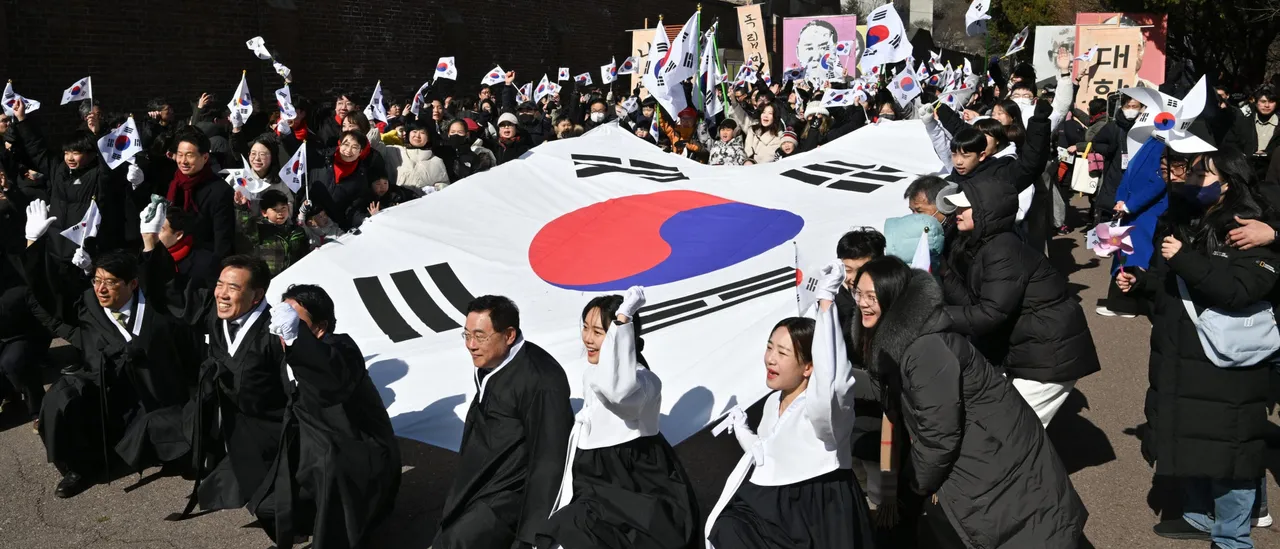
March First is not merely a national holiday in South Korea. On March 1, 1919, a nation stripped of sovereignty took to the streets and declared before the world: ‘We are an independent people.’
Unarmed civilians stood against imperial authority because they believed one unshakable truth: the sovereignty and identity of a nation must ultimately be defended by its citizens. One hundred and seven years later, South Korea again faces a moment of decision.
March First is a reminder that liberty survives only when citizens visibly defend it. It is much more than a historical commemoration.
The Quiet Erosion of Constitutional Order
This is not a question of ordinary partisan rivalry. It is a question about the durability of the liberal democratic order itself.
Liberal democracy rests upon foundational principles: popular sovereignty, protection of fundamental rights, separation of powers, parliamentary governance, multi-party competition, free and fair elections, a market-based economic structure, private property and judicial independence. When even one of these pillars weakens, the integrity of the entire system begins to break down. (RELATED: A Holy War Declared: The Grave Threat To South Korea’s Constitutional Liberty)
Today, many citizens are asking difficult but necessary questions. Is the balance of power being strained? Is the rule of law becoming politicized? Is judicial independence secure? Is the market foundation of the economy being preserved? These are not mere partisan complaints. They are constitutional concerns.
The Lesson of March First
History teaches a sobering lesson: freedom does not preserve itself. After World War I, President Woodrow Wilson proclaimed the principle of national self-determination. Yet Korea, then under Japanese colonial rule, was excluded from that doctrine.
No external power came to guarantee Korean sovereignty. Korean leaders understood that before the world would act, the people themselves had to demonstrate unmistakable resolve.
Syngman Rhee (1875-1965), who served as the first South Korean President from 1948 to 1960, understood that unless Koreans visibly affirmed their will for independence then international recognition would not follow. The March First Movement was not only a domestic protest but also sent a profound signal to the international community. The same principle applies today.
Silence Is Not Neutrality
If South Korea is to remain firmly rooted in liberal democracy, that commitment must be visible. Democratic legitimacy cannot rest solely on institutions; it must be reinforced by civic vigilance. Silence is not neutrality. Silence cedes the direction of the nation to others.
Unity matters in such moments. When those who value constitutional order fracture over minor differences, the defense of fundamental principles weakens. (RELATED: The Hypocrisy Of Hate)
This is not primarily about personalities or electoral cycles. It is about whether the Republic’s constitutional identity remains intact.
Peaceful, constitutional civic participation, even by a small but meaningful percentage of the population, can send a powerful message. It affirms that citizens remain the ultimate guardians of their system. It reassures allies. It signals to adversaries that democratic drift will not go uncontested.
Authoritarian Adversaries Are Watching
And adversaries are watching.
South Korea stands at the center of intensifying geopolitical competition. China has demonstrated its willingness to apply economic pressure to influence Seoul’s strategic decisions. North Korea continues to advance missile and nuclear capabilities while probing alliance cohesion.
Authoritarian regimes do not need open conflict to weaken democracies; internal division often suffices. Political mistrust, judicial controversy, election disputes and economic uncertainty create openings. When internal cohesion erodes, external leverage increases. And some regimes are committing to destabilizing existing democracies.
A strong South Korea, constitutionally balanced, politically confident and institutionally stable, strengthens deterrence and alliance credibility. A divided or destabilized Korea complicates regional security and emboldens authoritarian competitors.
The lesson of March First is therefore not nostalgia. It is vigilance. In 1919, the cry was “Long live Korean independence.” In 2026, the call must be “Defend Liberal Democracy.”
Finding Answers and Taking Decisions
The answer is not violence. It is not illegality. It is not destruction.
It is peaceful, constitutional civic action, a clear affirmation of liberal democratic values, defense of separation of powers and rule of law, insistence on transparency and fairness and protection of market principles and private property. (RELATED: Restoring Election Integrity In South Korea: Stopping The Digital Dictatorship)
March First is not confined to just the history textbooks. It is a timely reminder that constitutional systems endure only when citizens consciously choose to sustain them. The direction of the Republic will ultimately be decided not by slogans, but by whether its people are willing to stand peacefully, lawfully and united for the principles that define it.





![CNN's Kaitlan Collins Fact-Checks Rep. Jasmine Crockett Over False Trump Ballroom Claim [WATCH]](https://www.right2024.com/wp-content/uploads/2025/10/1761954330_CNNs-Kaitlan-Collins-Fact-Checks-Rep-Jasmine-Crockett-Over-False-Trump-350x250.jpg)
![Two Dead, 14 Injured After Gunfire Erupts Following College Football Game in Alabama [WATCH]](https://www.right2024.com/wp-content/uploads/2025/10/Two-Dead-14-Injured-After-Gunfire-Erupts-Following-College-Football-350x250.jpg)