Authorities with the Paris cyber-crime unit raided the offices of Elon Musk’s X as part of an investigation into suspected criminal activity linked to his AI tool, Grok, including unlawful data extraction as well as the generation and possession of child pornography.
Additionally, the French prosecutor’s office announced both Musk and his former chief executive, Linda Yaccarino, have been ordered to appear at hearings in April, according to the BBC.
While Musk called the raid a “political attack,” the operation followed the release of an analysis from the U.K.-based Internet Watch Foundation (IWF) that found a 26,000% spike in AI-generated videos and images depicting child sexual abuse material (CSAM).
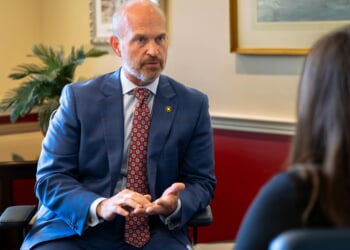
Speaking with CBN News, Benjamin Bull, general counsel for the National Center on Sexual Exploitation (NCOSE), offered a bold characterization of Musk’s handling of CSAM on X, formerly Twitter.
When Musk first purchased Twitter, he pledged to tackle the rampant child pornography on the social media platform, even writing in 2022, “Removing child exploitation is priority #1.” And yet, it has remained a rampant issue on the site — one seemingly now made worse by Grok.
“He’ll say whatever’s necessary to get through the moment,” Bull said of Musk. “If it suits his purpose and he’s being examined toughly, he’ll say whatever it takes to present a winning position. He’s done nothing to eliminate the CSAM on his platform. In fact, if anything, the problem’s gotten much worse.”
Bull went on to argue addressing the problem of child abuse online is heavily clouded by the on-again-off-again relationship between Musk and President Donald Trump, as well as multi-billion-dollar investments by big tech companies like Meta, the parent company of Facebook and Instagram.
In 2024, after successfully passing the Senate, House Speaker Mike Johnson stalled the Kids Online Safety Act (KOSA) in the House of Representatives. The bill, cosponsored by Sens. Marsha Blackburn (R-Tenn.) and Richard Blumenthal (D-Conn.), faced scrutiny from some conservatives — including Johnson and House Majority Leader Steve Scalise (R-La.) — worried the proposal could inadvertently lead to internet censorship and government overreach. They argued the law could strong-arm tech companies into over-moderating content to avoid litigation and may result in future government authorities interpreting “harmful content” through ideological lenses.
Bull sees it differently.
Johnson’s decision to block a vote on KOSA came around the same time Meta announced plans to build a $10 billion data center in Louisiana. It should be noted the speaker was pressed on the suggestion of a quid pro quo deal on Fox News’ “Fox & Friends,” and he denied it.
Bull said that, while Johnson “wants to do the right thing,” he is forced to play “hardball politics.”
One of the most alarming concerns regarding CSAM or revenge pornography — especially that which is made out of whole cloth using artificial intelligence — is its permanence: once it’s on the internet, it is there forever. In fact, author and activist Laila Mickelwait told CBN News pornography sites like Pornhub are virtual crime scenes housing images and videos of CSAM, sextortion, and non-consent victims.
“Once it’s online,” Bull explained, “it can be downloaded and then re-uploaded. … Once it’s on the internet, there’s a very high likelihood that it’ll never come down.”
Calling the matter “profoundly dangerous,” Bull urged the Federal Trade Commission and law enforcement agencies in the U.S. to take similar actions to the Paris’ cyber-crime unit.
Donna Rice Hughes, CEO of Enough Is Enough, similarly sounded the alarm during an interview with CBN News, saying that — with the evolution of AI — “you don’t need anything,” other than a person’s image or likeness, to victimize that individual.
“You can take a picture of anyone’s child in a Christmas photo, and you can deep-fake it, which means you can actually remove that child’s clothes, you can age that child, you can have that child do anything you want [him or her] to do sexually,” she warned. “And that’s what’s happening with AI.”
In addition to the moral problems and sinfulness of pornography — especially illicit material victimizing children — Hughes pointed out that, even artificially generated CSAM could very well lead to the abuse of real children as predators’ desires escalate.
“All it’s doing is fueling that desire,” she said. “The data and the research shows that, when someone uses child abuse material, they get hooked on it, then it increases their desire to act out against a real child. That’s just the facts. It’s all fueling it.”
Both Hughes and Bull urged Americans to call their lawmakers to push for legislation on these issues.
Bull, for his part, also urged parents to proactively protect their children from the dangers that accompany access to smart devices, suggesting kids really should not be using smartphones until they are at least in their late teens.
You can watch our full conversations with both Hughes and Bull in the videos above.
As the number of voices facing big-tech censorship continues to grow, please sign up for Faithwire’s daily newsletter and download the CBN News app, created by our parent company, to stay up-to-date with the latest news from a distinctly Christian perspective.







![Donald Trump Slams Chicago Leaders After Train Attack Leaves Woman Critically Burned [WATCH]](https://www.right2024.com/wp-content/uploads/2025/11/Trump-Torches-Powell-at-Investment-Forum-Presses-Scott-Bessent-to-350x250.jpg)

![CNN's Kaitlan Collins Fact-Checks Rep. Jasmine Crockett Over False Trump Ballroom Claim [WATCH]](https://www.right2024.com/wp-content/uploads/2025/10/1761954330_CNNs-Kaitlan-Collins-Fact-Checks-Rep-Jasmine-Crockett-Over-False-Trump-350x250.jpg)