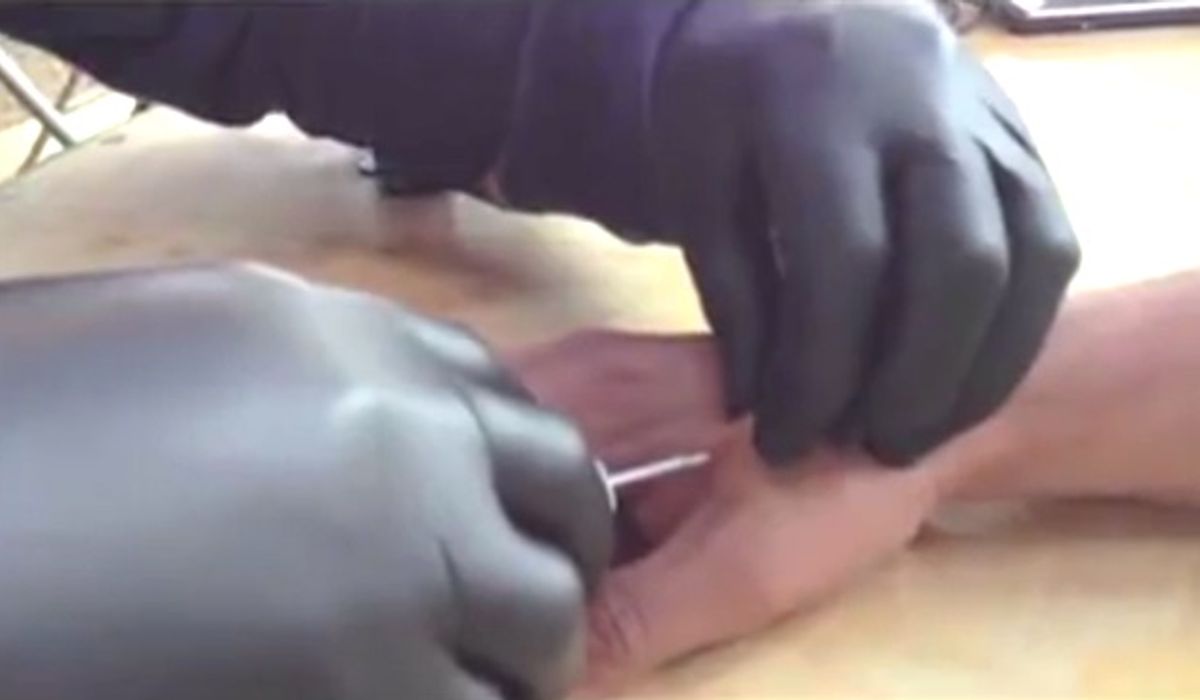
Never mind microchipping your dog. Some companies are giving employees microchip implants that give them access to facilities, company accounts and vending machines with the wave of a hand.
The new technology sounds convenient and cool, but it alarms privacy rights advocates and some states have moved to ban the practice.
In March, Washington Gov. Bob Ferguson signed House Bill 2303 into law. It prohibits employers from requiring, coercing or even requesting employees to get a microchip implanted for any reason.
“Microchips may seem like science fiction, but the technology is here,” said state Rep. Brianna Thomas, a Democrat and sponsor of the bill. “It creates an opportunity for employers to track employees during work hours and at home. That is scary.”
At least 13 additional states have banned employer-mandated human microchips, and some have imposed stricter regulations as concerns grow over technology’s increasing encroachment on privacy rights.
Nevada banned microchip programs, even for voluntary recipients, in 2019.
In addition to concerns about bosses tracking employees, the new technology could be vulnerable to hacking, which would leave microchip wearers’ personal, health and work information exposed.
Some medical studies found that the rice-sized chips can injure tissues and tendons in the human hand and have been associated with tumors in laboratory mice.
“From my point of view, there is nothing beneficial that can come from this,” Nevada Assemblyman Skip Daly, who sponsored the bill banning the practice. “We have insurance companies, credit reporting, monitoring locations, tracking transactions, and employers having access to personal information, et cetera, which some of you may see as having potentially beneficial applications, all of which are overshadowed by, in my opinion, the negative applications and potential for abuse and infringement upon our freedoms.”
States moved to set limits on microchipping in response to the Wisconsin-based software company Three Square Market, which in 2017 made headlines by offering employees the option of having a grain-sized microchip implanted under the skin, between the thumb and forefinger.
Dozens of employees signed up for the program, and according to company officials, more than 80 people got the implant. The chips opened doors, unlocked computers, made payments on proprietary self-checkout software and more.
Company officials also acknowledged facing “serious backlash from groups citing privacy and religious concerns,” and said they had “zero interest in tracking anyone,” and turned down requests to develop tracking technology.
Three Square Market was purchased by Cantaloupe in 2022. The Washington Times reached out to the Cantaloupe to see if the microchipping program is still up and running.
Since Three Square Market made a splash with its microchipping program, no major U.S. company has announced plans to offer or require employees to wear similar implants.
Two companies in Sweden offer employee microchipping, and thousands have signed up for the implants that not only unlock doors, access computers and pay for things, but also carry health data, including vaccine records.
In the U.S., biohacking technology is here to stay and advancing in new ways.
The FDA approved implantable chip access to medical records in 2004. Since then, the technology has advanced to much more sophisticated uses in the medical field and is being tested to help patients with neurological conditions and even paralysis.
It’s also advancing commercially for people who simply want the convenience and technological advancements that come with microchipping.
The Seattle-based tech company Dangerous Things allows consumers to purchase a microchip and have it installed by a professional body piercing or body modification business that partners with the company.
An injectable chip that works with a smartphone can be purchased for as little as $25.
The company offers a package of three chips that include both high and low radio-frequency identification technology and short-range wireless technology. The kit works with smartphones, door locks, USB contactless readers and key fobs. It does not allow GPS location tracking.
The $211.96 price includes a sterile injector assembly, antiseptic wipes, gauze pads, bandages and a pair of latex gloves.
During a recent Reddit forum chat, Dangerous Things CEO Amal Graafstra said injectable microchips are safer than body piercings because they are not exposed outside of the skin and protect a user’s privacy more than smartphones, which are subject to snooping by Big Tech and hackers.
“I want you to own your digital identity and keep it literally inside you and as a consequence, turn your phone into a data pipe, an interchangeable interface with no actual authority, just connectivity,” Mr. Graafstra said.
In November, the brain-computer interface technology company Paradromics received FDA approval for human testing of a brain implant to help restore speech in people who are disabled.
Elon Musk’s brain-computer interface, Neuralink, allows users to control computers and robotic arms with their thoughts.
The technology promises to “restore autonomy to those with unmet medical needs and unlock new dimensions of human potential.”
Three Square Market’s microchips utilize radio-frequency identification and do not track employee location.
Todd Westby, who was CEO of Three Square Market when the microchipping program launched, told CNBC at the time that he could log into his phone, his computer and pay for items, in addition to gaining access to the company building.
“The vast majority of our employees absolutely love the conveniences this chip brings to them,” he said. “It’s really a huge convenience factor the employees seem to like with it.”





![Two Dead, 14 Injured After Gunfire Erupts Following College Football Game in Alabama [WATCH]](https://www.right2024.com/wp-content/uploads/2025/10/Two-Dead-14-Injured-After-Gunfire-Erupts-Following-College-Football-350x250.jpg)
![CNN's Kaitlan Collins Fact-Checks Rep. Jasmine Crockett Over False Trump Ballroom Claim [WATCH]](https://www.right2024.com/wp-content/uploads/2025/10/1761954330_CNNs-Kaitlan-Collins-Fact-Checks-Rep-Jasmine-Crockett-Over-False-Trump-350x250.jpg)