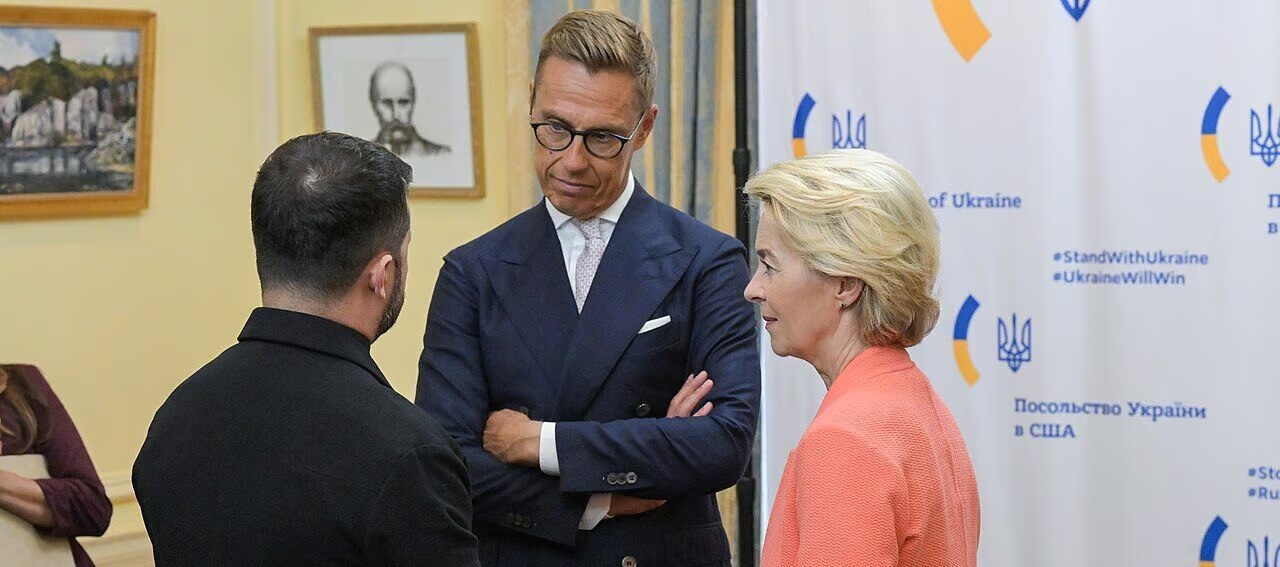
Like an Ivy League university professor, Alexander Stubb, the president of Finland, takes to the pages of Foreign Affairs to lecture the United States about his preferred new world order. He calls it “values-based realism,” and describes it as a “new symmetry of power among the global West, East and South” where countries would cooperate in tackling the “most pressing global challenges,” like climate change, under the auspices of a reformed United Nations. The professor-president of Finland wants his country and other “small states” to have an outsized role in this new world order. Judging by his Foreign Affairs essay, the professor-president could use a “new” education on realism.
President Stubb’s first sentence foreshadows the nonsense that follows. “The world,” he writes, “has changed more in the past four years than in the previous 30.” His evidence for that claim: “Our news feeds brim with strife and tragedy. Russia bombards Ukraine, the Middle East seethes, and wars rage in Africa.” Did he miss the Global War on Terror, the wars in Iraq and Afghanistan, Russia’s invasion of Crimea, the so-called Arab Spring chaos, tribal fighting in Africa (Rwanda, Yemen, Ethiopia)? Strife and tragedy were not absent before 2021. (RELATED: How Sweden’s Demographic Winter Turned It Into Europe’s Rape Capital)
“We live in a new world of disorder,” he writes. Like many professors and readers of Foreign Affairs, President Stubb believes that since the end of World War II, the world has been living under a “rules-based international order.” That “rules-based international order” witnessed wars in Korea and Vietnam; crises in the South China Sea, Suez, Lebanon, Berlin, and Cuba; Arab-Israeli wars; Sino-Indian conflicts; Khmer Rouge genocide; Vietnamese boat people; Islamic terrorism; and many other instances of strife, tragedy, and disorder. Perhaps I can recommend additions to the professor-president’s reading list: Robert Kaplan’s Waste Land and The Tragic Mind might help here.
The professor-president predicts that “the next five to ten years will determine the world order for decades to come.” Or, more likely, strife, tragedy, and disorder will continue to occur. Kaplan in Waste Land describes the current state of world affairs as a “global Weimar.” We do not live in “a world governed by a rules-based order, as polite gatherings of the global elite like to define it,” Kaplan writes. It is, instead, Kaplan continues, “a world of broad, overlapping areas of tension, raw intimidation, and military standoffs.” And as for President Stubb’s cherished United Nations, Kaplan calls it a “talk shop more important to the global elite itself than to the world at large.” (RELATED: From Orwell to Brussels: The EU’s ‘Ministry of Truth’ Arrives)
In world affairs, nations pursue interests, which may or may not be consistent with their values.
The professor-president also suffers from the Ivy Leaguers’ tendency for self-flagellation. “After the 9/11 terrorist attacks in 2001,” he writes, “the West turned its back on the values that it claimed to uphold. Its commitment to international law was questioned.” One can acknowledge that the nature and extent of the interventions in Afghanistan and Iraq were the result of failed policies, but where did the West violate international law? By striking back at the terrorists and their allies who attacked New York and Washington, D.C., killing more than two thousand Americans? By enforcing the professor-president’s cherished United Nations resolutions in Iraq?
President Stubb writes that “values-based realism” is not a contradiction in terms. But it is. In world affairs, nations pursue interests, which may or may not be consistent with their values. In a clash between interests and values, interests should always prevail — not “interests” defined by a reformed United Nations, but interests based on a country’s geography, customs, traditions, and economic and political needs.
President Stubb’s proposed new world order envisions a situation where “countries could deal with the most pressing global challenges through cooperation and dialogue among equals.” Unsurprisingly, he is critical of America’s withdrawal from the World Health Organization and the Paris climate agreement, while deriding President Trump’s “mercantilist approach to cross-border trade.” (RELATED: The Hedge-Fund Arsonist Now Campaigning as California’s Savior)
President Stubb is a globalist — part of that global elite that Robert Kaplan describes in Waste Land. Globalism and a reformed U.N. would heighten Finland’s importance and role in the world. “Small states such as mine are not bystanders in the story,” he writes. But, judging by President Stubb’s Foreign Affairs essay, the world is much better off when Finland’s role equals its size and population. And President Stubb is a better fit for an Ivy League professor than the political leader of a country.
READ MORE from Francis P. Sempa:
Hugh Sidey: The Last Honest Chronicler of the White House
![Donald Trump Slams Chicago Leaders After Train Attack Leaves Woman Critically Burned [WATCH]](https://www.right2024.com/wp-content/uploads/2025/11/Trump-Torches-Powell-at-Investment-Forum-Presses-Scott-Bessent-to-350x250.jpg)


![CNN's Kaitlan Collins Fact-Checks Rep. Jasmine Crockett Over False Trump Ballroom Claim [WATCH]](https://www.right2024.com/wp-content/uploads/2025/10/1761954330_CNNs-Kaitlan-Collins-Fact-Checks-Rep-Jasmine-Crockett-Over-False-Trump-350x250.jpg)