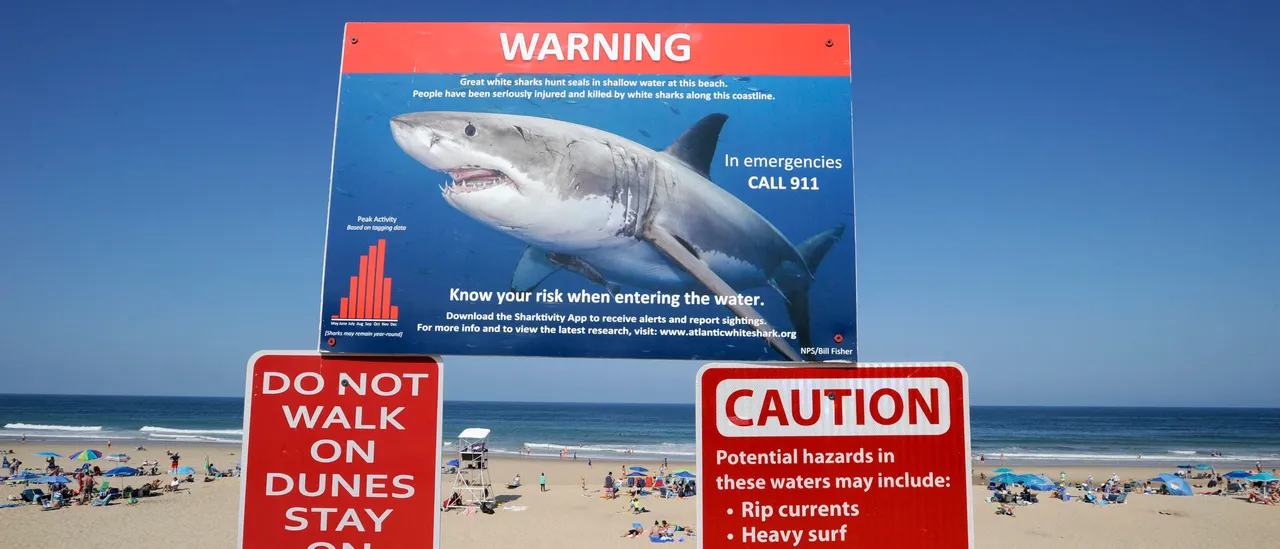
With spring break beginning and thousands of college students making the trip down to Florida, four great white sharks have shifted to the South as well, pinging in the Gulf of America off the Sunshine State’s coast.
The pings aren’t just an alignment with spring breakers and other vacationers going south in an attempt to escape winter weather, but also points out that the Gulf is a crucial habitat for great white sharks.
Published in Wildlife Research, a recent study shows that researchers discovered that the marine animals have high activity in terms of migration, relocating lengthy distances on a seasonal basis due to pray being available and the conditions of the water. It’s common that great white sharks are in the Gulf for the winter.
A worldwide nonprofit organization that has the mission of researching sharks and providing them protection, as well as whales, sea turtles and other life in the ocean, OCEARCH is putting tags on the sea creatures for tracking purposes and studying behaviors and habits of migration from a long stretch away.
From the waters of Canada, down towards the United States’ eastern seaboard and through the Gulf of America, having a grasp of the seasonal movement of great white sharks assists scientists with identifying key habitats for shielding, informing conservation policy and improving overall management of this recovering yet still at risk species.
A comprehensive shark tracker is maintained by OCEARCH after the shifts of multiple shark species while roaming throughout the world’s oceans. (RELATED: Heartland Prepares For Another Wave Of Tornado, Hail, Wind Threats Only Days Following Deadly Storms)
Recently, four great white sharks were pinged off Florida’s West Coast, with the sea creatures residing in the Gulf of America over the last few weeks.
Like a lot of great whites, Ripple, Bella, Penny and Ernst head to the South across the East Coast in the winter season as they look for waters on the warmer side.
Ernst is a subadult female great white shark that comes in at 12 feet and 1,009 pounds. She pinged 23 miles from the Florida Panhandle’s Cape San Bias towards its south Feb. 20.
Mar. 2 saw Ernst’s most recent Z-ping, which happens as a result of the shark being at the surface for just a small amount of time. This transmits a signal to a satellite that lacks sufficient strength to allow for a precise location fix.
Ernst was originally tagged in October, only days prior to a lengthy trip from the Gulf of Maine’s cold waters to the Gulf of America in pursuit of warmth. Ever since then, she’s been living there.
In only 139 days, Ernst has swam 3,633 miles, even going westward towards Mississippi.
WHITE SHARKS PINGING IN THE GULF 👀
🦈 Ernst (SA female)–23 miles south of Cape San Blas
🦈 Bella (juv. female)–recently moved west through the Straits of FL, now NW of Key West
🦈 Penny (juv. female)–NW of Key West
🦈 Ripple (SA male)–now closer to the FL Panhandle pic.twitter.com/lhrOtnZX5X— OCEARCH (@OCEARCH) March 4, 2026
Bella was pinged Mar. 4 to Key West’s northwest following a shift into the Straits of Florida.
A juvenile female great white shark that’s 10 feet and approximately 729 pounds, Bella was given a tag and then set free in Mahone Bay, Nova Scotia.
Translating to “beautiful” in the Italian language, the name of Bella is considered to be special.
The name was given to her to show tribute to one of the biggest supporters of OCEARCH, who is located in Florida. It represents the worldwide community who is enthusiastic and assists in fueling their work.
“Her story is a testament to the power of collaboration—from world-class scientists and fishermen to everyday ocean lovers,” reads the OCEARCH profile of Bella.
Coming in at 10 feet and around 522 pounds, the juvenile great white shark known as Penny was pinged off Key West’s coast around the end of February. (RELATED: Person Dead After Entering Restricted Area Of Kilauea At Hawaiʻi Volcanoes National Park)
Back in Apr. 2023, Penny was given a tag by OCEARCH near Ocracoke, North Carolina.
During the more than 1,000 days of Penny being tracked, she’s traveled over 12,000 miles, returning to the Gulf of America multiple times prior to going back to the Northwestern Atlantic in the months of summer and fall.
Ripple, a subadult male great white shark who sizes in at 11 feet and 778 pounds, was pinged Mar. 3 around the Florida Panhandle.
OCEARCH has followed Ripple’s remarkable journey in the past, tracking the shark from Mahone Bay southward across the southeastern U.S. coastline, as well as around Florida towards New Orleans.
Ripple went back to the Gulf of America multiple times to seek warmer oceans.
In real time, all of the great white sharks can be tracked using the OCEARCH Global Shark Tracker app, which is free and includes 400 other marine animals.







![Donald Trump Slams Chicago Leaders After Train Attack Leaves Woman Critically Burned [WATCH]](https://www.right2024.com/wp-content/uploads/2025/11/Trump-Torches-Powell-at-Investment-Forum-Presses-Scott-Bessent-to-350x250.jpg)