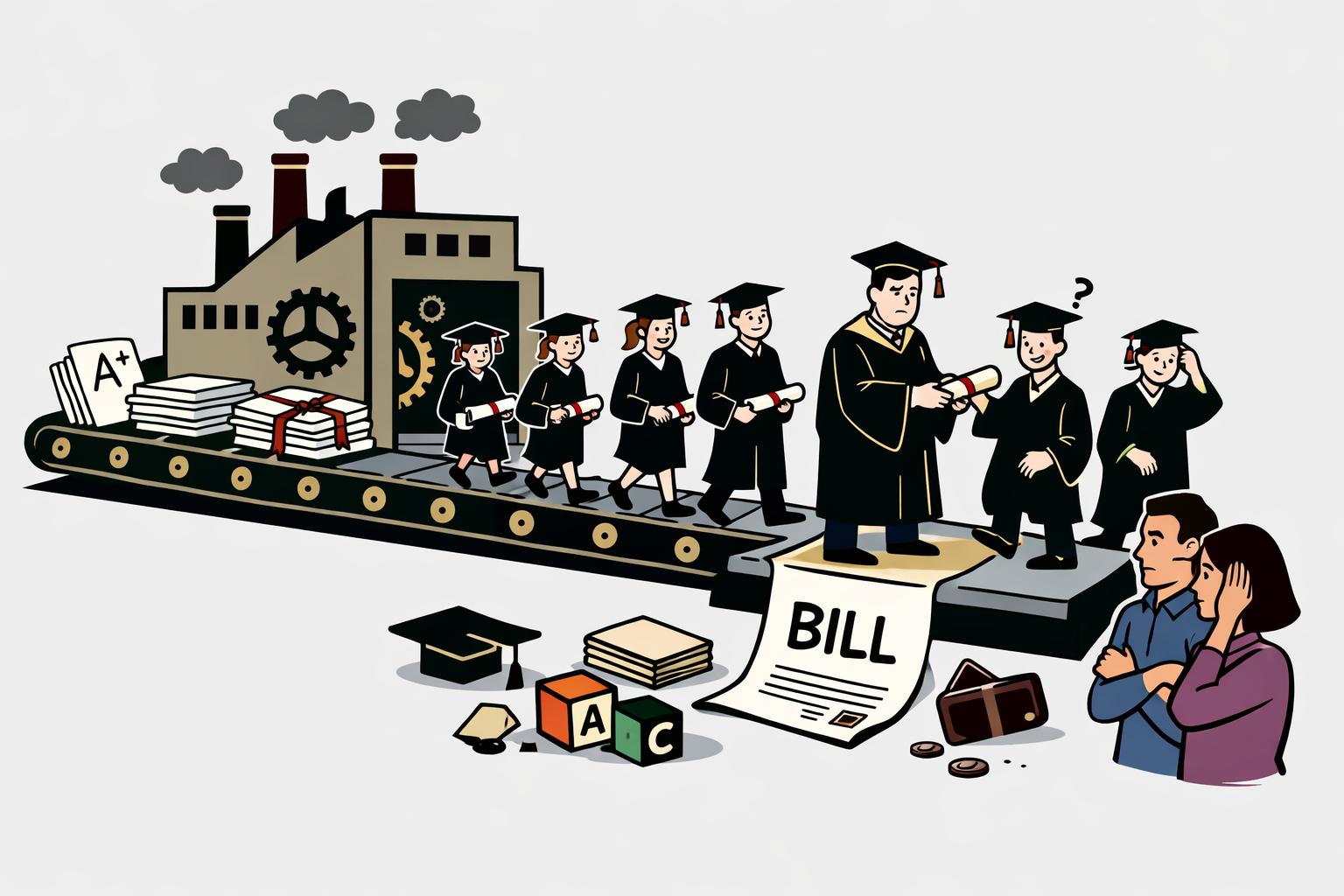
American education is broken; this isn’t a secret. But parents are starting to fight back with lawyers—not because their kids aren’t getting into Harvard, but because schools are failing to deliver any semblance of effectiveness and to make even the most basic promise of education itself.
Consider the recent case in Washington State. Makena Simonsen, a student in the Edmonds School District, graduated with a 3.87 GPA. As a parent, you’d be saying, “Great job, nice work.” That is precisely what the administration wants — to keep parents off their backs. Yet, according to attorney Lara Hruska of Seattle’s Cedar Law, this student was reading at an elementary level.
This “empathy” diploma, her attorney asserts, did not open doors — it “shut the door” on further support.
According to the lawsuit, the district effectively passed her along without ensuring she had mastered basic skills. This “empathy” diploma, her attorney asserts, did not open doors — it “shut the door” on further support. By receiving a standard diploma, she was disqualified from a transition program that could have helped her develop basic life and vocational skills. In turn, this cost the student and her parents money. She had planned to enroll in the district’s free vocational program, which helps transition special-needs students into independent life, but discovered she was ineligible because she received a regular high school diploma. Instead, she enrolled in Bellevue College’s Occupational and Life Skills program at a cost of more than $40,000 annually. (RELATED: How the Classical Education Movement Is Rescuing a Lost Generation)
For the Simonsen family, what was presented as an achievement became, in practice, a financial barrier.
The lawsuit goes further, alleging what has been described as “benevolent discrimination” — a system that, in an effort to avoid difficult truths, lowers expectations while maintaining the appearance of progress. The result is not compassion. It is educational malpractice.
“By letting her kind of pass along, giving her these grades and then giving her this diploma — which shut the door on her transition services access — they actually caused her harm,” Hruska states. “Her diploma was more of a participation trophy.”
This should be a tipping point. School systems must be forced to prove measurable, not superficial, progress — rather than the status quo: ‘wink-wink’ submit the assignments, get the grade, accumulate the credits, and we’ll award the diploma. Grades assigned, credits accumulated, diplomas handed out willy-nilly — and when the bill comes due, it will be the taxpayers who pay it.
This dishonesty is not limited to one district; unfortunately, this is commonplace. The incentives are clear: graduation rates trump literacy; optics replace outcomes. Careerist administrators are not judged by what students know, but by whether they are pushed through the system with the least possible resistance; symbols and funding — not substance — are the coin of the realm.
This hollowing-by-design extends into higher education, where a similar pattern continues. Colleges increasingly serve as holding-pattern institutions, delaying maturity and placating underprepared students. (RELATED: Buyer Beware: The College Edition)
The real danger is that this breakdown will not stay confined to schools, but will extend into the decisions families make every day.
For generations, one path to prosperity was clear: study hard, go to college, succeed. That path justified real financial sacrifice. Parents saved to support their children’s education, believing it was a smart bet on a better future.
But that path is eroding.
Parents are not naïve, especially when it comes to their finances. They see the flaws — not because they have lost faith in education itself, but because they are losing confidence in the metrics used to measure it.
Families may begin to reconsider the assumption that college is the best investment. Savings that once flowed into 529 plans may be diverted. New pathways — the trades, apprenticeships, direct entry into the workforce, entrepreneurial efforts — may begin to look far more attractive than a $300K comparative literature degree. (RELATED: A Bag of Rocks for $400,000?)
If that shift occurs at scale, the economic implications will be significant. Higher education depends on a steady influx of students and the financial commitments — backed, of course, by the government — that accompany them. A loss of confidence, even gradual, could force a reckoning — one that colleges and universities have long feared.
In that regard, the failure of K–12 education is even more damaging because parents are not being provided with accurate information to make decisions for their children.
The solution is not complex. It is simply ignored.
Yet individuals in the free market can make choices — and in doing so, disrupt the system.
As Friedrich Hayek wrote in The Use of Knowledge in Society, economic knowledge “never exists in concentrated or integrated form.” Markets succeed because they harness that dispersed knowledge, allowing individuals to coordinate in ways no central planner could replicate.
For good or ill, we live in a litigious society. These lawsuits, combined with the market’s quiet discipline, may prove to be the force that finally disrupts the “central planners” of the education industrial complex. A system that cannot gauge knowledge will eventually be measured by the market — and the market is far less forgiving than school administrators.
READ MORE from Pete Connolly:
The Radicalization of American Politics
The Inevitable Result of Government’s Addiction to Spending Other People’s Money





![Donald Trump Slams Chicago Leaders After Train Attack Leaves Woman Critically Burned [WATCH]](https://www.right2024.com/wp-content/uploads/2025/11/Trump-Torches-Powell-at-Investment-Forum-Presses-Scott-Bessent-to-350x250.jpg)
![Kamala Comes Unglued, Makes Bogus Claim About Her Landslide Loss to Trump [WATCH]](https://www.right2024.com/wp-content/uploads/2025/10/Kamala-Comes-Unglued-Makes-Bogus-Claim-About-Her-Landslide-Loss-350x250.jpg)