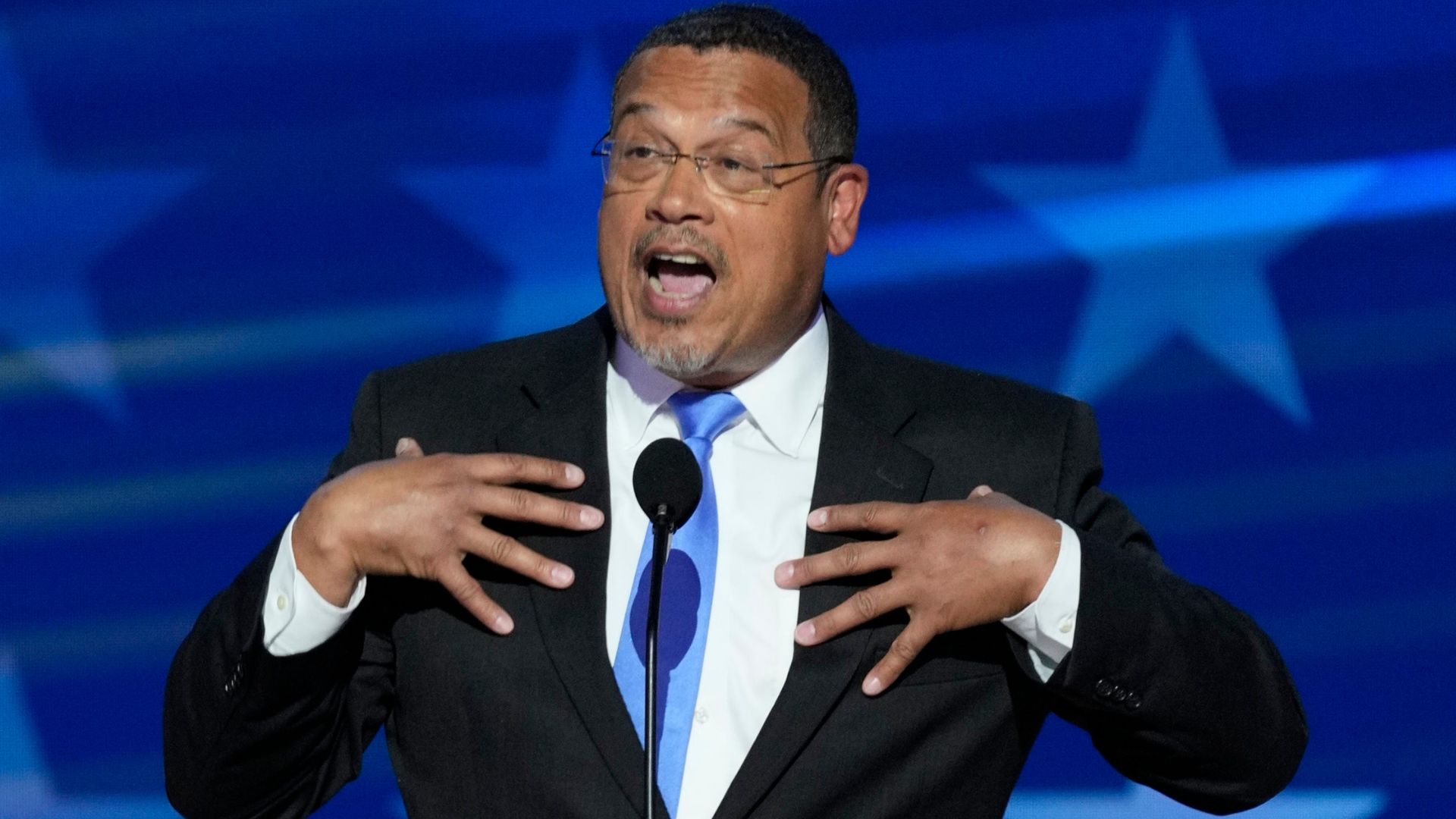
Minnesota Attorney General Keith Ellison appeared Monday on a livestream hosted by Don Lemon, where the two discussed the disruption of Sunday services at Cities Church in St. Paul, Minnesota, by a group of anti-ICE protesters.
The incident involved demonstrators entering the church during worship services, an event that drew national attention and prompted legal and political commentary.
Ellison, a Democrat and the state’s top law enforcement officer, addressed the incident during his conversation with Lemon by focusing on constitutional protections related to protest and expression.
During the livestream, Ellison stated that public officials are subject to public expression and protest, even when that expression is disruptive.
“None of us are immune from the voice of the public,” Ellison said during the broadcast.
This Could Be the Most Important Video Gun Owners Watch All Year
Ellison elaborated further when asked directly about the protest and its impact on the church service. In a longer statement during the livestream, he said:
“The protest is fundamental to American society. This country started in a protest. It’s freedom of expression. People have a right to lift up their voices and make their peace. And none of us are immune from the voice of the public. So I, quite honestly, I think that you’ve got the First Amendment freedom of religion and First Amendment freedom of expression – and I think it’s just something you’ve just gotta live with in a society.”
The remarks came amid broader scrutiny of the protest and of Lemon’s role in covering the event.
Lemon, a former CNN host who now operates independently, streamed from Minnesota during the aftermath of the church disruption. His presence at the scene has drawn attention from legal officials.
On Monday, Assistant Attorney General for Civil Rights Harmeet Dhillon addressed the matter publicly and raised the possibility of federal legal exposure related to the incident.
Dhillon said Lemon’s actions could potentially fall outside the protections typically associated with journalism if they involved participation in or coordination with unlawful activity.
“He went into the facility, and then he began ‘committing journalism,’” Dhillon said.
“As if that is a shield from being an embedded part of a criminal conspiracy. It isn’t.”
Dhillon also referenced federal statutes that could apply to the actions of those who disrupted the church service.
She stated that both the Freedom of Access to Clinic Entrances Act and the Ku Klux Klan Act contain provisions that allow prosecution of individuals who interfere with the exercise of constitutional rights through threats, intimidation, or force.
According to Dhillon, those statutes could be used to prosecute individuals who “threaten[ed], hurt, or intimidate[d] people to prevent them from exercising their God-given rights.”
The protest took place during a Sunday service at Cities Church, a private religious facility in St. Paul.
The demonstrators entered the church while congregants were present, interrupting worship.
The incident has since become part of a broader debate in Minnesota over the limits of protest activity and the enforcement of laws protecting religious gatherings.
Ellison’s comments during the livestream framed the disruption as part of a longstanding tradition of protest in American society, while critics have argued that entering a private place of worship during services crosses legal and constitutional boundaries.
The attorney general did not dispute that the church is private property during his remarks but emphasized the broader concept of public expression.
The discussion also revived attention to activist tactics associated with political organizer Saul Alinsky, whose “Rules for Radicals” were cited by commentators in response to the incident.
Several of Alinsky’s rules, including “Power is not only what you have but what the enemy thinks you have,” “A good tactic is one your people enjoy,” and “Keep the pressure on. Never let up,” were referenced in commentary surrounding the protest and its aftermath.
Following the livestream, commentary on social media continued to focus on Lemon’s involvement and the legal questions raised by the incident.
One widely shared post came from Emily Jashinsky on X, who wrote:
“Hi friends, this is my Uncle Don. He is unemployed but spends most days talking into his computer, where he says people pay him to comment on the news. We believe he thinks he’s some sort of television anchor. A few days ago, he left his home in NYC then appeared on social media in Minnesota. If you see him, please let me know, the family is worried for his safety. This is his only jacket.”
Hi friends, this is my Uncle Don. He is unemployed but spends most days talking into his computer, where he says people pay him to comment on the news. We believe he thinks he’s some sort of television anchor. A few days ago, he left his home in NYC then appeared on social media… pic.twitter.com/KNLPdXj23e
— Emily Jashinsky (@emilyjashinsky) January 19, 2026
The incident at Cities Church, Ellison’s comments, and the legal statements from federal officials remain part of an ongoing public discussion in Minnesota regarding protest activity, religious freedom, and the application of federal civil rights laws.
![Donald Trump Slams Chicago Leaders After Train Attack Leaves Woman Critically Burned [WATCH]](https://www.right2024.com/wp-content/uploads/2025/11/Trump-Torches-Powell-at-Investment-Forum-Presses-Scott-Bessent-to-350x250.jpg)

![Texas Trucker Busted with 23 Illegals Stuffed into the Cab of His Big Rig [WATCH]](https://www.right2024.com/wp-content/uploads/2025/12/Texas-Trucker-Busted-with-23-Illegals-Stuffed-into-the-Cab-350x250.jpg)