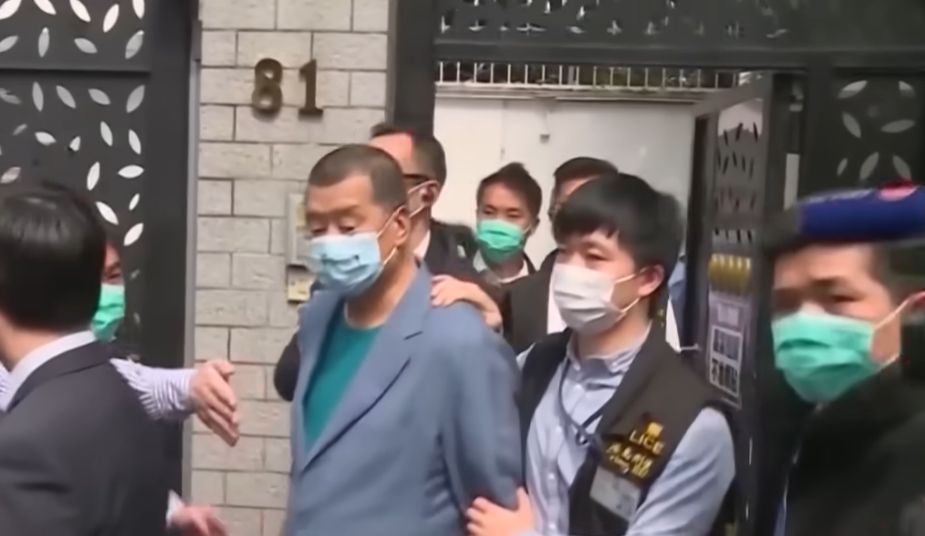
As expected, Beijing’s Hong Kong enforcers have convicted former publisher Jimmy Lai of violating China’s National Security Law. Standing up for the territory’s traditional liberties led to charges of sedition and collusion with foreign enemies. The 78-year-old Lai, who chose not to flee the so-called Special Administrative Region, faces a possible life sentence, a sentence he,now appears likely to serve.
Lai’s conviction offers further evidence, as if any more was needed, to Taiwan that the “two systems, one country” model inevitably means only one, very authoritarian system.
Hong Kong was once the freest territory with a majority ethnic Chinese population. Although the British colony was undemocratic, it protected civil liberties, provided for the rule of law, and enjoyed economic freedom. The territory became refuge for refugees from the People’s Republic of China.
In 1997 the United Kingdom returned Hong Kong, most of which had been coercively “leased” from the decrepit Chinese Empire. The PRC promised to maintain the SAR’s distinctive character for a half century, and for a time lived up to its bargain. However, that began to change a decade ago as protests erupted pressing for full democratization. The Chinese Communist Party refused to relax control of its nominally autonomous possession.
Years of protests and increasing repression ensued, capped by Beijing’s imposition of the National Security Law on June 30, 2020. The measure proved to be the perfect toolkit for the CCP, criminalizing “secession, subversion, terrorist activities, and collusion with a foreign country or with external elements to endanger national security, and stipulates the corresponding penalties, which in the most serious cases, could result in life imprisonment.” This effectively banned opposition to and even criticism of the CCP as well as the local, Beijing-imposed authorities. No resistance has been too minor to punish. Amnesty International reported that people “have been targeted and harshly punished for the clothes they wear as well as the things they say and write, or for minor acts of protest, intensifying the climate of fear that already pervaded Hong Kong.”
With ruthless efficiency, aided by COVID restrictions on demonstrations, the PRC destroyed a protest movement that had turned out millions of people in protest. Activists fled, NGOs dissolved, publications closed, museums liquidated, universities surrendered, businesses retreated, and parties disbanded. Anyone who hesitated ended up a CCP target, often prosecuted for conduct months or even years in the past.
Those who sought to flee were captured; those who escaped faced bounties for their return. The result, according to Human Rights Watch: “Since adopting the National Security Law, the Chinese government has largely dismantled freedoms of expression, association and assembly, as well as free and fair elections, fair trial rights and judicial independence. The government has increasingly politicized education, created impunity for police abuses, and ended the city’s semi-democracy.” Self-censorship rules. A day before the court convicted Lai, the last, and main, opposition party, the Democratic Party, voted to disband, ending any pretense of democracy.
Even so, the PRC continues to add new legal prohibitions to its arsenal. For instance, in June Hong Kong passed a measure known as Article 23 to back Beijing’s Office of Safeguarding National Security, which was established in June 2020. Six new offenses were established: “failing to comply with the OSNS’s legal instruments, providing false or misleading information or documents, disclosing the OSNS’s measures or investigations, forging OSNS documents, resisting or obstructing OSNS staff in the performance of their duties, and pretending to be an OSNS staff member or pretending to be able to influence them.” In Hong Kong’s, and more importantly, Beijing’s eyes, one can never be too careful in suppressing the slightest hint of dissent.
As of December 2025 365 people had been arrested for allegedly endangering national security. About 204 had been charged under the NSL and other laws. So far 174 individuals and one company have been convicted. Although arrests peaked in 2021, they continue, more than five years on. Last month, reported the Hong Kong Free Press: “Hong Kong national security police have arrested two people on suspicion of publishing seditious posts on the social media account of their pancake shop.” The government also charged a university student with sedition for starting a petition demanding accountability after the apartment fires that killed at least 160 people.
The conviction rate is 95 percent. The abuse rate is similarly high. Reported Amnesty International: “(1) 85 percent of concluded cases involved only legitimate expression that should not have been criminalized; (2) the courts denied bail in 89 percent of national security cases; and (3) the average length of pre-trial detention is 11 months. Taken together, these findings show that the implementation of national security legislation in Hong Kong has violated international human rights law and standards, including freedom of expression and right to liberty.”
The largest NSL trial was of 47 Hong Kong legislators, academics, journalists, union leaders, and other activists, prosecuted for organizing a political primary, which was legal at the time. Forty-five were convicted and sentenced to prison terms varying from four to ten years. Why? The defendants were charged with conspiracy to commit subversion since their purpose, in what officially remained a free election, was to elect candidates who would oppose the SAR’s chief executive and other Beijing factotums.
Jimmy Lai embodies Hong Kong’s lost liberties, someone who “both symbolizes and cherishes the freedoms that transformed the city from poverty to prosperity in a couple of generations.” When only 12 Lai fled the PRC for Hong Kong. He began working as a child, later founding a clothing business. He supported the Chinese protests that led to the bloody crackdown in Tiananmen Square and across China. He eventually sold his business, founding Next Magazine, The Apple Daily newspaper, and Next Digital media company. And he strongly backed the territory’s democracy movement.
He chose to remain in Hong Kong after passage of the NSL. He was thrice arrested, starting in August 2020, held in solitary confinement (for more than 1800 days, and counting!), and subjected to seven different trials, starting in 2021, which resulted in collective sentences of nearly ten years. His NSL trial ran for 156 days and was anything but fair. Detailed HRW: “Lai’s prosecution was marred by multiple serious violations of fair trial rights, including being tried by judges hand-picked by the Hong Kong government, denied a jury trial, subjected to prolonged pretrial detention, and barred from having counsel of his choice.” The three jurists issued an 855 page opinion, which claimed that Lai was the “mastermind” of a conspiracy against the PRC. Added Judge Esther Toh, who was chosen to convict, he “had harbored his resentment and hatred of the PRC for many of his adult years.”
Western criticism of the ruling has been sharp. Even President Donald Trump, usually unconcerned about violations of human rights by those he perceives to be friends, was critical, having declared before his reelection that “100 percent I’ll get him out. He’ll be easy to get out.” Earlier this year Secretary of State Rubio said that Lai’s release was “a priority,” explaining: “We’ve raised it in every possible form and they know that it’s important to us, and I think there are other countries as well that are very involved in raising this issue.” After the verdict Trump less confidently called on China’s Xi Jinping to free Lai.
Beijing is unlikely to show leniency. During his 2017 visit to Hong Kong, Xi insisted that “any challenges to the power of the central government in Beijing,” which Lai did often, was a red line that was “absolutely impermissible to cross.” The PRC-controlled newspaper, Wen Wei Po, labeled Lai as the “number one political agent painstakingly cultivated by the United States in Hong Kong.” The PRC’s Hong Kong and Macao Affairs Office resurrected Maoist rhetoric, calling Lai a “lackey” and “running dog” of foreigners and concluded: “For a long time, Lai opposed China at every turn, colluded with foreign and external forces, and committed all manner of wrongdoing against Hong Kong and the country.”
Hong Kong Chief Executive John Lee (Ka-chiu), the SAR’s top security apparatchik before being selected by Beijing to replace the stumbling Carrie Lam in 2022, has been regularly praised by Xi. Lee denounced Lai: “Some organizations, particularly foreign media organizations, deliberately mislead the public and deliberately whitewash the criminal acts of Lai under the cloak of a so-called ‘media tycoon,’” and seek to “obscure Lai’s shameless acts and subversive actions as an agent of external forces to infiltrate and brainwash young people, through manipulating the media to incite the public and betraying the interests of the country and the people.”
Lai’s conviction offers further evidence, as if any more was needed, to Taiwan that the “two systems, one country” model inevitably means only one, very authoritarian system. Although Hong Kong remains distinct from the mainland — more open to foreigners, foreign commerce, and information — there is no meaningful difference in the totality and brutality of CCP rule.
What should the U.S. and other Western states do? Lai’s son, Sebastien, urged Western governments to “make my father’s release a pre-condition to closer relationships with China.” That is highly unlikely. Most important, Beijing is unlikely to concede what is a fundamental principle of governance. Repression is the foundation of the CCP’s rule. Trading tariffs and regulations with America is possible. Allowing opposition and criticism in support of America is not.
Moreover, given Beijing’s economic clout, few democratic states, including, most importantly, the U.S., would likely join such an effort. And, given the gravity of issues dividing Washington and Beijing, no president could easily sacrifice dialogue on security and technology over the fate of one Hong Konger, irrespective of his importance. More fundamentally, while Lai’s conviction is the most dramatic example of systemic repression in Hong Kong, freeing him would not liberate the population of 7.4 million. If his imprisonment warrants sanction, what about the prosecution and punishment of hundreds of others?
The best hope may be for Western leaders to encourage his humanitarian release based on the significant deterioration in his health, a point emphasized by Trump. This effort could be backed by private warnings as to the damage done to Beijing’s international reputation, while allowing Xi to act without appearing to yield to foreign pressure. This might be an effective strategy for Trump, who could indicate that Lai’s release would lead to a warmer reception of Xi when he visits America. PRC forbearance would remain a longshot, of course, but still would enjoy a greater chance of success than direct pressure.
Jimmy Lai is a genuine hero and should be ranked alongside other brave Chinese of principle, such as Nobel Laureate Liu Xiaobo, whose 2010 award triggered outrage in Beijing. People of goodwill around the world should support Lai and his family. But not just him. The atrocious destruction of liberty in Hong Kong must not be forgotten. An important reason to support freedom for the Chinese people, however unlikely in the short-term, is to restore freedom for Hong Kong’s people as well.
READ MORE from Doug Bandow:
Hindu Nationalists Trash JD Vance for Wanting His Wife to Share His Christian Faith
America Shouldn’t Fight for the Saudi Throne
Tiananmen Square Down the Chinese Memory Hole
Doug Bandow is a Senior Fellow at the Cato Institute and former Special Assistant to President Ronald Reagan. He is the author of Foreign Follies: America’s New Global Empire.





![Donald Trump Slams Chicago Leaders After Train Attack Leaves Woman Critically Burned [WATCH]](https://www.right2024.com/wp-content/uploads/2025/11/Trump-Torches-Powell-at-Investment-Forum-Presses-Scott-Bessent-to-350x250.jpg)