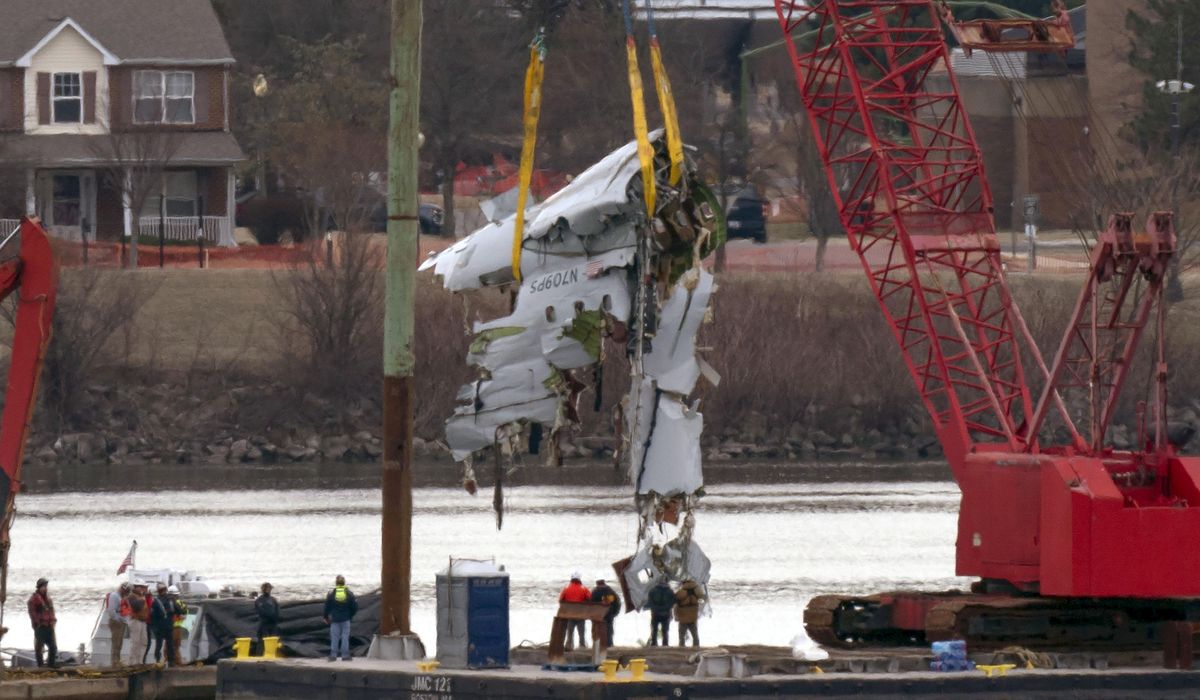
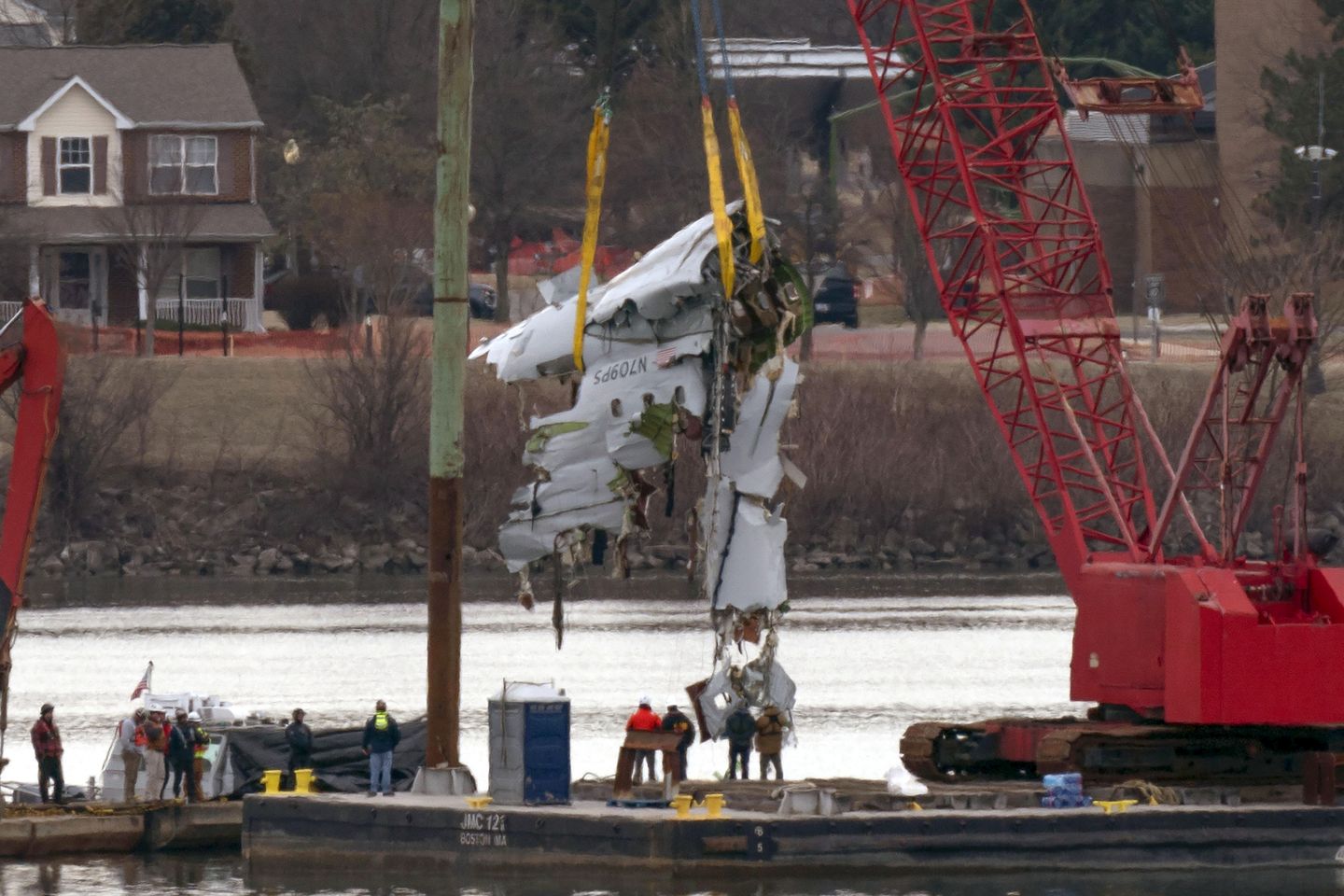
A House subcommittee report on January’s fatal midair collision over the Potomac River identified multiple missteps taken by an Army helicopter that contributed to the crash with a commercial airliner.
The House subcommittee on Military and Foreign Affairs’ report said that the Black Hawk helicopter failed to maintain sight of the other aircraft in the busy area around Ronald Reagan Washington National Airport.
The chopper also had its automated GPS turned off and failed to follow air-traffic controller instructions that it change course, according to the report, which was released Monday after a nine-month bipartisan investigation.
The collision between the Black Hawk training flight and an American Airlines Bombardier CRJ700 airliner killed all 67 people aboard both aircraft, the deadliest U.S. air crash in more than 20 years.
The subcommittee’s report focused on Defense Department actions and didn’t address any possible issues with the American flight or the civilian air traffic control team at Reagan National.
The subcommittee conducted three briefings with the Defense Department, highlighting the “pressing need for clearer military flight protocols, enhanced training, and regular audits of flight operations and capabilities” within the department.
“It is crucial that military personnel are given the tools and training they need to navigate this complex airspace and prevent accidents and miscommunications like these from ever happening again,” Subcommittee Chair William Timmons, South Carolina Republican, and Ranking Member Suhas Subramanyam, Virginia Democrat, said in a joint statement.
Much of the subcommittee’s report was based on a National Transportation Safety Board investigation that found that radio transmissions from the tower may not have been heard by the pilots.
The board said that 17 seconds before the collision, the tower directed the Black Hawk to “pass behind” the airplane.
However, that instruction may not have been heard by the crew, according to the helicopter’s cockpit voice recording.
Additionally, the Black Hawk’s automated GPS was not transmitting, preventing other aircraft and the public from detecting it.
The NTSB investigation is ongoing, and it is still evaluating whether transmitting would have made a difference in the collision.
The Army also lacks certain knowledge of the airport’s airspace, the subcommittee’s report said.
Rick Dressler, aviation site manager for Metro Aviation Inc, told the board that he was made “uncomfortable” by “gross misunderstandings” of the airspace coming from the unit of the U.S. Army Aviation Branch to which the Black Hawk was assigned.
Night vision goggles used by the Black Hawk pilots also make it “especially difficult” to see bright lights, similar to the conditions during the collision.
Stephen Casner, a human factors expert, told the board that, when wearing night-vision goggles, an aircraft approaching head-on will not appear to be moving, instead looking like buildings or other stationary objects.
Lastly, the subcommittee report stated that the Department of Defense hotline to the airport was offline due to the construction of a new air traffic control tower at the Pentagon, thus preventing direct communication.
Federal Aviation Administration officials discovered the hotline was offline after a near-miss incident in May, when two commercial jets were forced to abandon their approaches to the Washington airport due to an Army Black Hawk occupying the airspace.
Based on these findings, the subcommittee is recommending that the Department of Defense Inspector General conduct a comprehensive evaluation of all operations in U.S. civilian airspace.
The subcommittee’s report said that this incident demonstrates the urgent need for clearer guidelines, enhanced training and systematic audits of agency flight operations and capabilities.
“This tragic incident has highlighted the significant hazards inherent in military operations within the busy, mixed-use airspace,” the subcommittee report reads. “It underscores the critical importance of strict military compliance with FAA regulations, implementation of NTSB recommendations, and the adoption of best practices and safety measures.”
![Scott Bessent Explains The Big Picture Everyone is Missing During the Shutdown [WATCH]](https://www.right2024.com/wp-content/uploads/2025/11/Scott-Bessent-Explains-The-Big-Picture-Everyone-is-Missing-During-350x250.jpg)