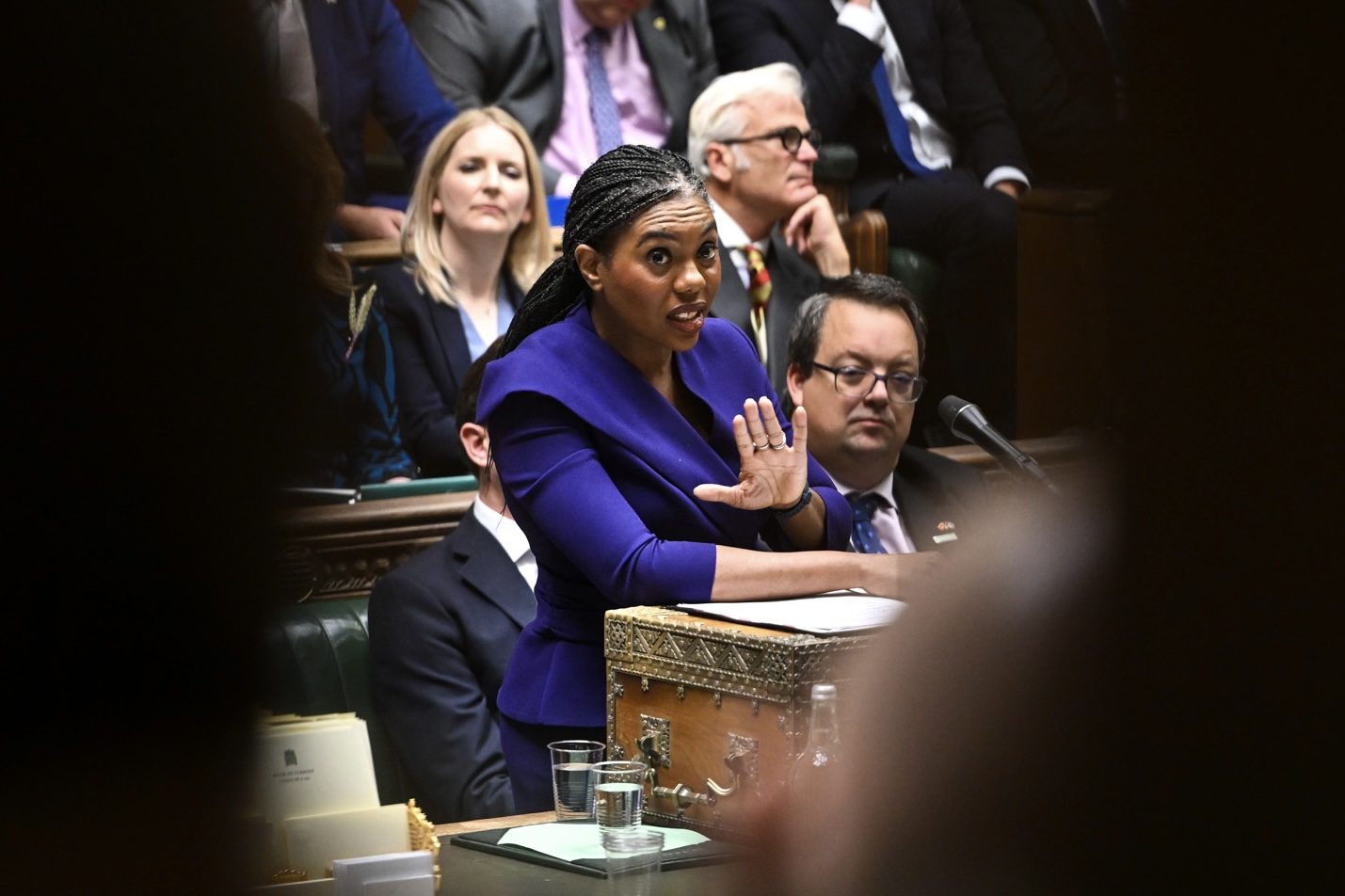
Kemi Badenoch last night chose her audience carefully. Not the whole parliamentary party assembled under the 1922 Committee – that gathering is reserved for tomorrow night – but the party’s right: the invitation-only 92 Group and the Common Sense Group.
Thirty-seven MPs gathered to hear Badenoch explain why, even without Robert Jenrick (and Andrew Rosindell), the Conservative Party under her leadership remains unmistakably right-wing.
Jenrick’s sacking and subsequent defection – the two do rather go together – has prompted a bout of soul-searching among Conservatives about what the party now is, and what it ought to become. The timing was deliberate. Badenoch’s first appearance amongst her parliamentary party was widely seen as an effort to steady nerves among MPs who might be wondering whether their own future lies elsewhere.
Even a single defection can have an outsized effect on a political party. It forces colleagues to reassess assumptions, question direction, and, in this case, confront the awkward fact that the defector had already made his own fully formed pitch during the leadership election on what the party does next – now his answer is Reform UK. That sharpens the anxiety.
But Jenrick’s dismissal and defection – six in ten voters believe Badenoch was right to sack him – has nonetheless managed to embolden some with the party’s One Nation tendency, not one he currently feels any affinity to (though once upon a time…). With their numbers thinned in this parliament, those outside see opportunity. Matthew Parris has urged the Conservatives to extend an olive branch to figures such as Kenneth Clarke, Michael Heseltine, David Gauke and Dominic Grieve. Gauke himself, writing in this parish, argued that with the populist voice gone, Badenoch should “enthusiastically take the party in a different direction”.
They may be disappointed.
At last night’s meeting, chaired by Sir John Hayes (himself the subject of Tory whip-watch speculation), Badenoch struck a defiant tone before what turned out to be a largely sympathetic room. “We are moving forward in unity around authentic conservatism,” I understand she told MPs. “There is no movement to the left, as some unhelpful ex-colleagues have said. We are more unified than ever.”
That message was repeated beyond the room. In a letter to all 116 Conservative MPs, Badenoch wrote: “Some of our former colleagues opining on social media seem to have taken these defections as a signal that the party is shifting (or should) ideologically away from the right. This is a serious misreading of the situation. These defections are not about policy differences or ideology; they are about character. We are the party of the right and must remain so.”
There is an important distinction here. The Conservatives cannot out-Reform Reform, as the One Nation critics correctly observe. But they can articulate a Conservative version of the right – one capable of attracting tactical voters who want to stop a Reform government and are prepared to vote Tory to do so. But that still requires a right-wing offer that does not collapse into either comfort zone nostalgia or Faragiste pastiche. That is where the new right sometimes loses track, forgetting that there can be a uniquely Conservative way forward. Badenoch’s allies believe that work is already under way, whatever the defectors may claim.
Take Onward’s Breaking Blue report after the election. It identified why former Conservative voters walked away, and what might bring them back – on issues of immigration, tax, and competence. Neil O’Brien, Onward’s co-founder and now Badenoch’s policy chief, who is routinely described as “sound” by his colleagues is charged with turning that diagnosis into a programme.
As one senior Tory put it to me after Jenrick’s defection: “Would you rather a party led by Kemi Badenoch with Neil O’Brien shaping policy, or Nigel Farage and Zia Yusuf, with Rob now thrown in, fighting over how to decide a position? It is not a difficult decision for lots of Tories.”
It may not be what some of the new right – especially those jumping to Reform – want to hear, but Jenrick’s exit does not mean the right wing of the Tory Party disappears. In Badenoch it has a reliable champion. Her supporters point to what they see as moral clarity on net zero, gender ideology, the ECHR, antisemitism and Israel. But even in his defection, while some of his former colleagues complained that he was “a selfish prick”, others acknowledged “while the manner of his departure was less than optimal, he was telling some home truths”.
There are critiques to be made of Badenoch, no doubt about it – and some of her MPs will make the case to tackle them. There are worries though. A feeling has begun to sit amongst some of Jenrick’s previous supporters that airing internal difference of opinion is being received as somehow anti Kemi and disloyal to the leader, rather than just pro the party and loyal to the Conservative brand.
That, according to one attendee, is precisely why Badenoch moved quickly to convene last night’s meeting: to rebut claims of a lurch leftwards and to allow the right to “rally around her” while still asking needed questions. Another MP described her demeanour as noticeably different: “Kemi came across as boil lanced.”
Questions began with Kieran Mullan, not a regular at such gatherings but, as Jenrick’s de facto deputy in the shadow justice team, keen to put something on the record. There had been no policy friction, he insisted. “Never did LOTO frustrate us on policy,” sources say he told the room. “Justice and LOTO were fully aligned”.
Next came two MPs frequently mentioned in defection rumours – Jack Rankin and Katie Lam – both new intake members and former Jenrick supporters. Rankin, I’m told, urged “the right of the party” to launch a renewed wave of support and become “Kemi’s praetorian guard”. While Lam echoed her support and called for optimism.
Sir Edward Leigh spoke of the duty to offer the country honesty as authentic conservatives, alongside supportive interventions from Iain Duncan Smith, Bernard Jenkin and David Davis. MPs were struck by the level of policy discussion, and by the fact that Badenoch stayed longer than planned. “It was very collegiate,” one said. “Very much: ‘We’ve not lurched to the centre’”.
That, ultimately, is the point. The Conservative Party is not about to be engaged in a quiet ideological retreat. Badenoch’s wager is that clarity and a party confident in its conservatism has more chance of recovery than one constantly glancing over its shoulder. The coming months will test whether that confidence can be sustained and proven in policy – but last night was a reminder that reports of a withdrawal of the Tory right is, at the very least, premature.



![Donald Trump Slams Chicago Leaders After Train Attack Leaves Woman Critically Burned [WATCH]](https://www.right2024.com/wp-content/uploads/2025/11/Trump-Torches-Powell-at-Investment-Forum-Presses-Scott-Bessent-to-350x250.jpg)