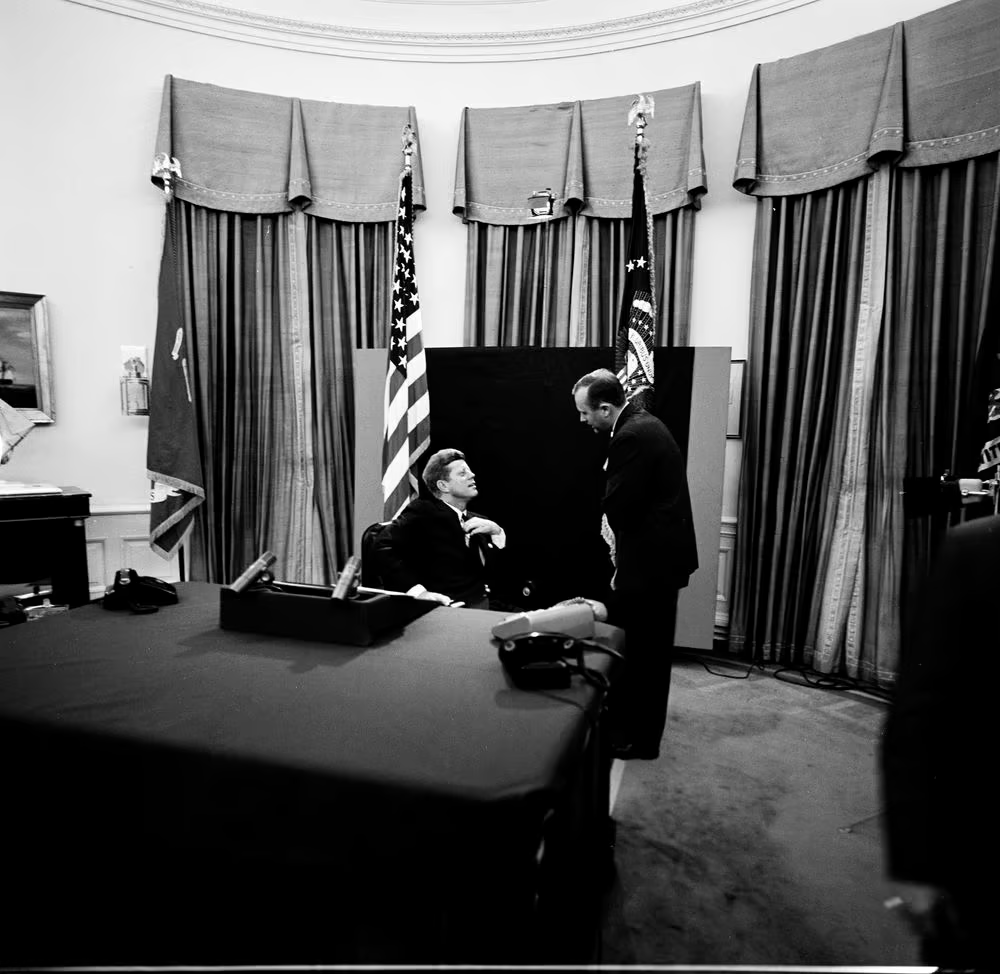
It was 20 years ago on November 21, 2005, that Hugh Sidey died at age 78 while vacationing in Paris. As Washington Bureau Chief and White House correspondent, Sidey wrote about every American president from Eisenhower to George W. Bush for Life and Time magazines. His regular column for Time titled “The Presidency” appeared from 1966 to 1996. He was a regular guest on the weekly, half-hour Public Broadcasting television show “Agronsky and Company,” where he verbally jousted with Carl Rowan, George Will, and James J. Kilpatrick. His fair-minded, unbiased reporting and assessments of presidents and their policies would be unrecognizable among today’s Washington press corps with their leftist, pro-Democratic Party ideological biases and Trump Derangement Syndrome.
Today, there are no Hugh Sidey’s in the Washington press corps.
Sidey was born in Iowa in 1927, earned a degree in journalism from Iowa State College in 1950, and worked for local newspapers in Iowa and Omaha, Nebraska. In 1955, he was hired by Life, and two years later joined the Washington staff of Time. His Midwest roots and local reporting experience mostly helped to inoculate him from the Beltway hive of reporters who view Washington, D.C. as the center of the universe.
Unlike the mostly liberal presidential scholars that mostly spew their liberal theories and praise Democratic presidents and their policies from their ivory towers, Sidey chronicled presidents as a beat reporter. In his columns and news stories, events, policies, and personalities trumped ideology. He analyzed how presidents used their power both at home and abroad. He understood how the personalities of presidents and their close advisers shaped their administrations for good or ill. He understood both the majesty of the office and the constitutional, political, and practical constraints on a president’s powers.
Sidey’s “The Presidency” columns for Time were fair-minded, non-ideological, fact-based reporting coupled with usually shrewd judgments about the men who occupied that office. He had a great respect for the office — its importance, its demands, its complications, and its pitfalls. In the introduction to a retrospective book titled Portraits of the Presidents (2000), Sidey described the nine presidents he covered as “triumphant political figures, but … wildly differing human beings, whose leadership styles were shaped by their individual characters and backgrounds.”
He admitted that often his initial impressions of the presidents he covered were wrong, and described his reporting as a “constant voyage of learning and correcting my views.” “The cauldron of the presidency,” he explained, “reveals unknown strengths in a person, just as it exposes hidden weaknesses.” Sidey wrote that one of a president’s greatest strengths is “intuition” because when crucial decisions are made presidents rarely have all the information they need. So, presidents often exercise judgments based on experience, education, intelligence, gut feelings, and hope.
After initially viewing Dwight Eisenhower as a passive president (a common view among Washington reporters and early scholars of his presidency), Sidey came to appreciate Ike’s judgement — keeping us out of the war between France and Vietnam; ending the Suez Crisis before it got out of hand; sending troops to enforce civil rights. In a 1968 article in Life (reprinted in Portraits of the Presidents), Sidey predicted that historians would come to appreciate Eisenhower’s steady, prudent, and patient leadership — as indeed they have.
Like many among Washington journalists, Sidey was beguiled by John Kennedy, and he never got over it. He accepted much of the mirage that was Camelot, overlooked or downplayed Kennedy’s personal recklessness and presidential failures. Sidey was fascinated by Lyndon Johnson, but understood that Johnson was “driven by his pride” and “haughty in his power.” Johnson’s legislative skills and political manipulation, Sidey wrote, helped pass important civil rights legislation, but those skills were useless in Vietnam, the debacle that he led America into, wasting treasure and lives.
Sidey wrote more about Richard Nixon than any other president. He called Nixon a “global strategic genius,” referencing the opening to China, détente with the Soviet Union, the airlift to Israel during the Yom Kippur War, and Nixon’s general understanding of world events and personalities. Sidey blamed Nixon for Watergate, but then he didn’t have access to the materials Geoff Shepard has gathered that tell a very different tale than the Woodward-Bernstein version. In a memorable 1978 Time column reflecting on the Nixon presidency, Sidey wrote that he wondered whether another dimension of the Nixon tragedy would get more attention — “the loss of a man to the world … a man who understood the men, the ingredients, the glory, the brutality, the action and reaction of power as well as anyone else of our time.”
Nixon’s successor, Gerald Ford, Sidey wrote, “was never intimidated by power and its responsibilities.” Nor was he “blinded by pride or arrogance.” Sidey misjudged Jimmy Carter, writing that Carter was “almost too idealistic for the job” of president, though he gave Carter high marks for the Camp David Accords and the Panama Canal Treaties. Carter had a mean streak that eluded Sidey’s normally perceptive gaze. His presidency was a dismal failure — Sidey understood that, but appreciated Carter’s post-presidential ministry of good works.
Sidey liked Ronald Reagan (they were both Midwesterners) and understood that even if Reagan sometimes got the details wrong, he mostly got the big picture right — never more so than with respect to the Cold War, which Reagan brought to a peaceful end. Some journalists during Reagan’s presidency caricatured him as a front man for his advisers, just as they had caricatured Eisenhower. They were wrong about Ike and wrong about Reagan. Sidey quoted then-Defense Secretary Caspar Weinberger in a Time column in 1985 (also reprinted in Portraits of the Presidents) about the successful military strike on the terrorists responsible for the Achille Lauro murder, that Reagan “has better judgment than all the rest of us put together.”
“George Bush ran the government better than any other of the modern presidents,” Sidey judged in Portraits of the Presidents. He wisely managed the end of the Cold War. He also fought a short and successful war in the Persian Gulf, wisely refusing “to enlarge and prolong the war,” as his son George W. Bush would do a decade later. And Sidey was much too gracious in his judgment and estimation of Bill Clinton, calling him a “survivor” who disgraced the presidency but was slick and flexible enough to “shed his liberal skin” and make the era of limited government his mantra. Sometimes Sidey was too fair-minded.
Today, there are no Hugh Sidey’s in the Washington press corps. We cannot know for sure how Sidey would have covered the Trump presidency, but he surely would have covered it more fairly than the Trump Deranged “journalists” who inhabit the D.C. swamp.
READ MORE from Francis P. Sempa:
Missionary Ridge and a Legacy of Courage





![Donald Trump Slams Chicago Leaders After Train Attack Leaves Woman Critically Burned [WATCH]](https://www.right2024.com/wp-content/uploads/2025/11/Trump-Torches-Powell-at-Investment-Forum-Presses-Scott-Bessent-to-350x250.jpg)

![James Carville Admits Democrats Had No Shutdown Endgame, Mishandled Strategy [WATCH]](https://www.right2024.com/wp-content/uploads/2025/11/1763070634_James-Carville-Admits-Democrats-Had-No-Shutdown-Endgame-Mishandled-Strategy-350x250.jpg)