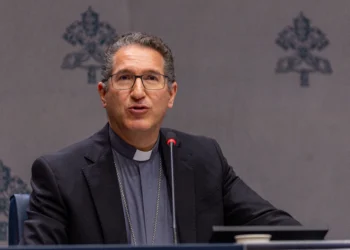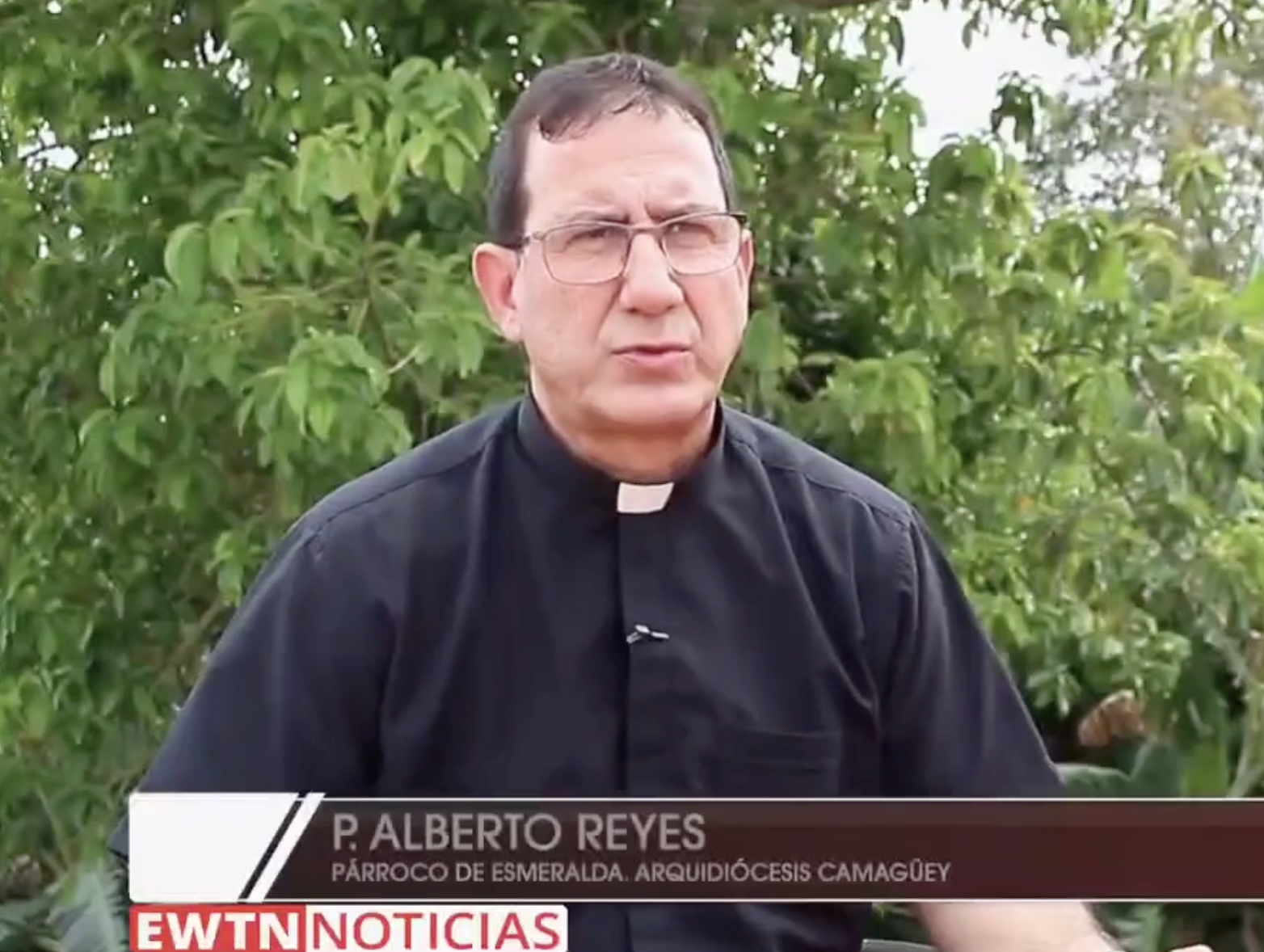
In addition to faith in Jesus Christ, the only thing that can save Cuba is for the current rulers to step down and for the country to transition to a genuine democracy, said Father Alberto Reyes, a priest of the Archdiocese of Camagüey.
In his most recent column, “I’ve Been Thinking,” the priest noted that Cubans “are fed up with so much deception,” deception that has accumulated over the 67 years of the communist revolution, led initially by Fidel Castro, then by his brother Raúl, and currently by Miguel Díaz-Canel.
“We were told that this revolution would be as green as the palm trees, even while the shackles of Marxist ideology were already being readied and we had already been sold out to Soviet imperialism,” he stated.
Reyes noted that despite the efforts of state-run media to uphold the regime’s narrative, reality demonstrates that the average Cuban goes hungry, suffers, and dies due to a lack of medications, and that schools fail to provide a quality education.
Added to this are repression, police harassment, and the intimidation of anyone who dissents. “Don’t tell me that human rights are respected in Cuba, or that there are no political prisoners… because it’s a lie,” he declared.
The priest stated that it can’t be claimed “that [the 1962 U.S. sanctions] are to blame for everything, because not only is that a lie, but it’s an insult to our intelligence.”
“And don’t tell me that this government cares about the people; don’t tell me that they just need us to give them more time; don’t keep urging me to practice ‘creative resistance’; don’t keep repeating that ‘this time, we really are going to build socialism’; don’t ask me to place my trust in them and hand over another 70 years of this people’s lives; don’t swear to me that the situation will be resolved shortly because it’s a lie,” he declared.
Reyes said that “the only thing that can save this people — in addition to faith in Jesus Christ — is for those who govern us today to finally depart and for there to be a total, absolute, and radical change of the political system to one that defends freedom and democracy in a real way, a system that chooses to speak the truth, even if it’s the hard truth.”
Talks between U.S. and Cuba
On March 13, Cuban President Díaz-Canel confirmed that regime officials “have recently held talks with representatives of the United States government” aimed at “seeking solutions through dialogue to the bilateral differences that exist between the two nations.”
Díaz-Canel made this announcement against the backdrop of new protests on the island, such as the one that took place in Morón, a city in Ciego de Ávila province, where a group of demonstrators attacked and set fire to the headquarters of the Communist Party of Cuba (PCC, by its Spanish acronym) in the early hours of March 14.
The media outlet Diario de Cuba reported that protests have spread to several cities, including Havana, Santiago de Cuba, and Holguín. The regime’s response has been to militarize the streets and protect the headquarters of the PCC.
U.S. President Donald Trump stated on March 15 that “Cuba also wants to make a deal, and I think we will pretty soon either make a deal or do whatever we have to do.”
“We’re talking to Cuba, but we’re going to do Iran before Cuba,” the president added, according to a report by USA Today.
The director of the Convivencia (Living Together) Center for Studies, Dagoberto Valdés, warned that what occurred in Morón is a warning sign of the people’s desperation.
“The regime must listen, pay attention, and respond effectively to these ‘signals,’ which serve as a warning call regarding just how far this state of collapse could go,” he said.
The Cuban academic said none of the people want violence but that “the only way to avoid violence and chaos is by opening the doors to the change Cuba needs, in a climate of serenity and peace — yet with the urgency that this critical moment demands.”
In this regard, he noted that as St. John Paul II stated during his 1998 visit, Cubans are called to be “the protagonists of our own personal and national history.”
“It is better to do this among ourselves, all Cubans, both on the Island and in the diaspora,” he said.
This story was first published by ACI Prensa, the Spanish-language sister service of EWTN News. It has been translated and adapted by EWTN News English.