In 1792, a young architect from Kilkenny, Ireland, began what would become one of the most famous landmarks in the world. Centuries later, James Hoban, who designed and oversaw the building of the White House, is now being remembered alongside other Irish Americans who made significant contributions to American history.
At a reception on March 20 at the newly opened Irish embassy on Pennsylvania Avenue in Washington, D.C., Ireland’s ambassador to the U.S., Geraldine Byrne Nason, highlighted Hoban’s life, saying he is among those Irish Americans who have left their “Irish fingerprints” on American’s founding.
“Irish immigrants helped to shape the very ideas at the heart of this great country,” Nason told approximately 200 guests, pointing out that 23 American presidents are of Irish heritage.
According to historian Matthew Costello with the White House Historical Association, Hoban relied on other Irish immigrants, as well as enslaved laborers, to bring his vision — based on Leinster House in Dublin — to life in 1800.
John Adams would be the first president to move into the White House, but the British sent Hoban’s work up in flames, burning the mansion down during the War of 1812.
Costello told EWTN News that Hoban would return to rebuild the White House, using the same Irish brethren as his stalwarts. His camaraderie with Irish immigrants was fostered not only by their shared origins but also by their Catholic faith during a time when Catholics were viewed with great suspicion — and often hostility. Many state constitutions forbade Catholics from holding public office.
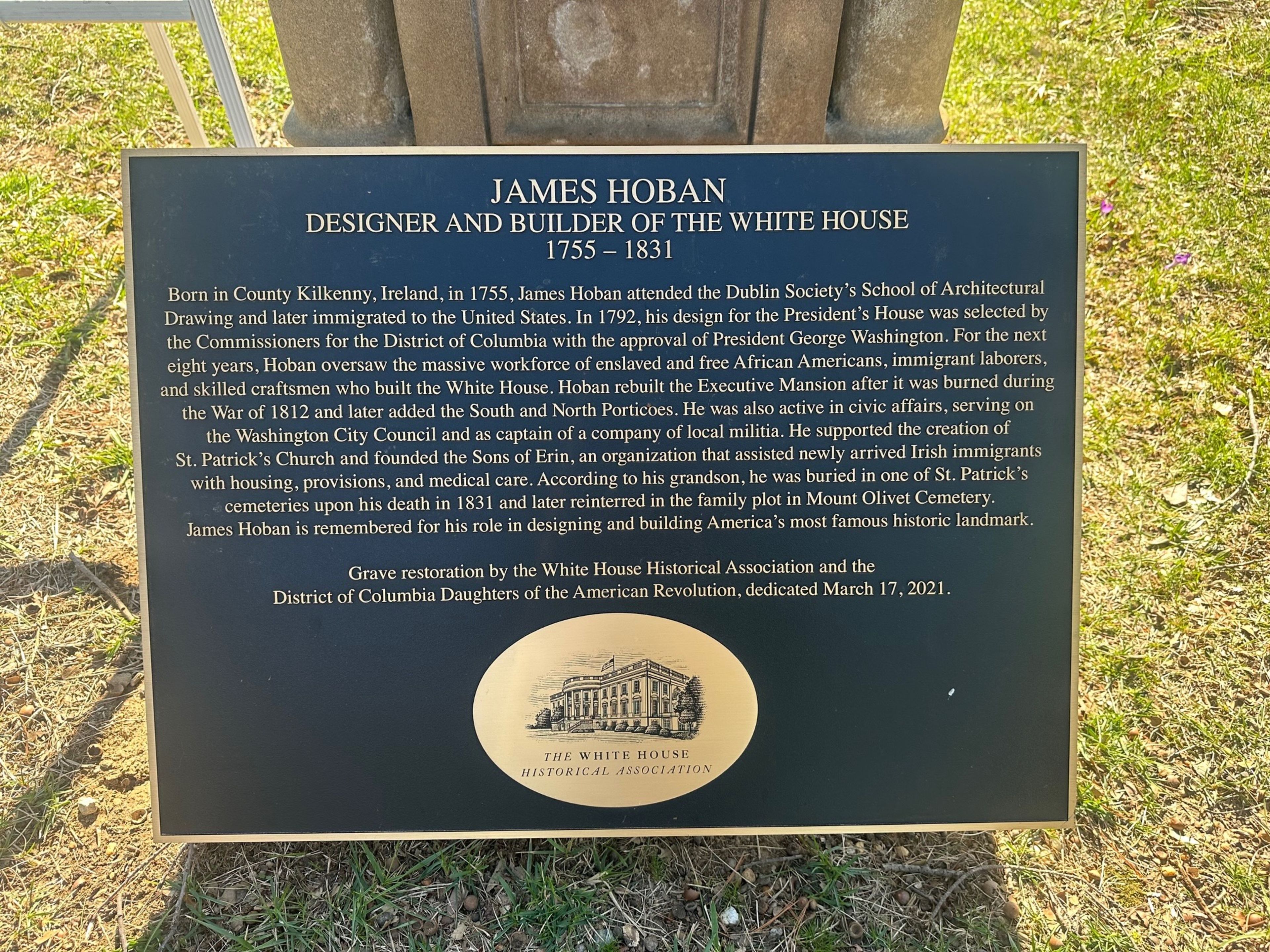
James Hoban, the Irish-born architect who designed the White House, is buried at Mount Olivet Cemetery in Washington, D.C. | Credit: Stephanie Green
Although the Jesuits brought Catholicism to America before the Revolution and founded Georgetown University in what was then Georgetown, Maryland, Hoban is celebrated as a founding father of the Irish Catholic community in the Federal City, which he nurtured and built like one of his renowned buildings.
In 1794, in anticipation of more Irish immigrants arriving in Washington, D.C., Hoban — along with fellow immigrant Father Anthony Caffry from County Mayo — started building St. Patrick’s Church, which is today the oldest Catholic parish in Washington, D.C.
Like the White House, the church was damaged by fire by British invaders but continues in its current iteration in the heart of the capital. Pope Francis visited the church in 2015.
By the time of Hoban’s death in 1831, Irish Catholics had made great progress in American society. The heralded architect would go on to serve as a captain in the Washington militia and on the city council. He is credited with the Octagon House in the Foggy Bottom neighborhood, various public buildings and city projects, and became superintendent of the construction of the U.S. Capitol.
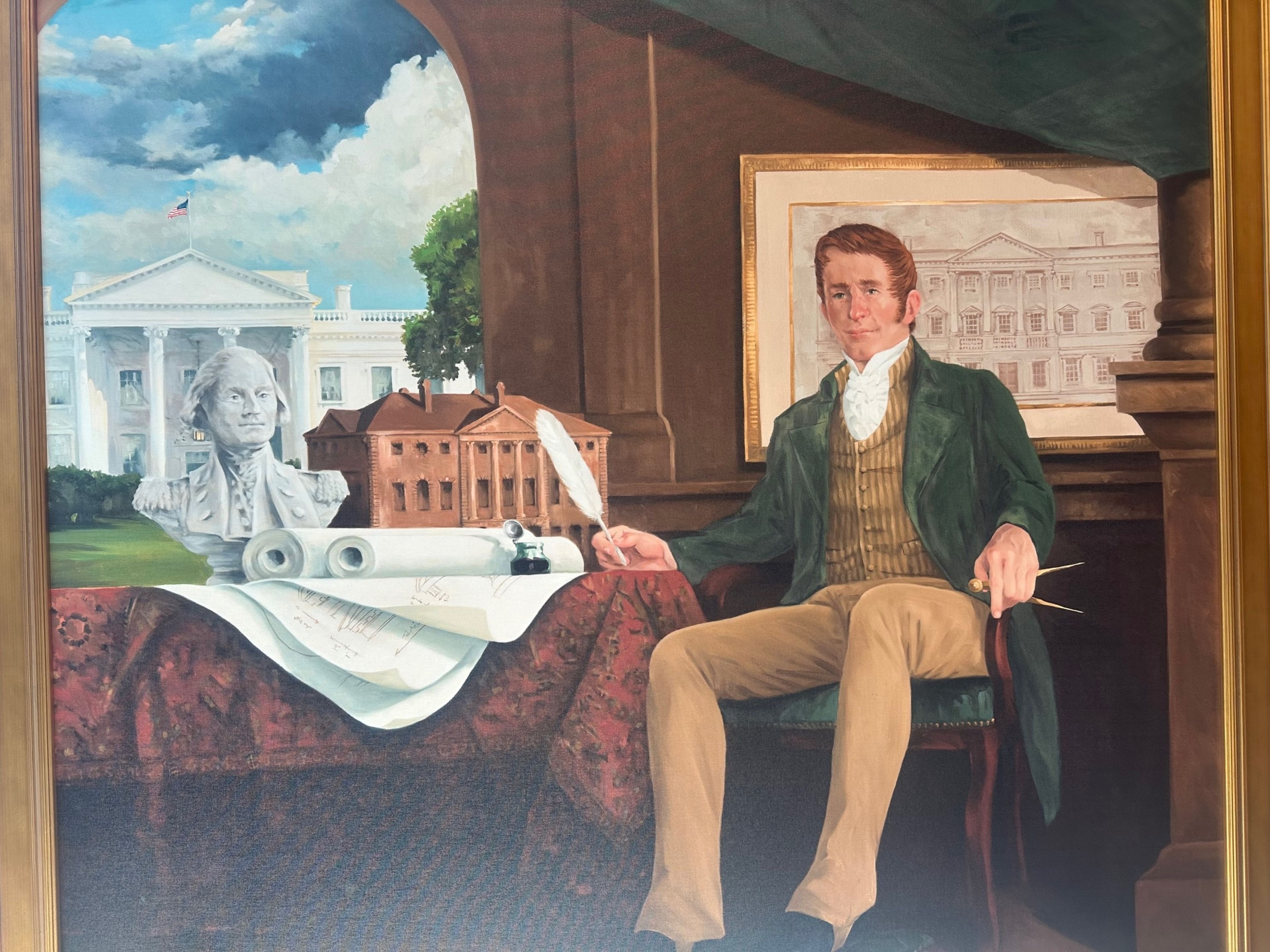
A portrait of James Hoban, architect and builder of the White House, an Irish-American immigrant. | Credit: Stephanie Green
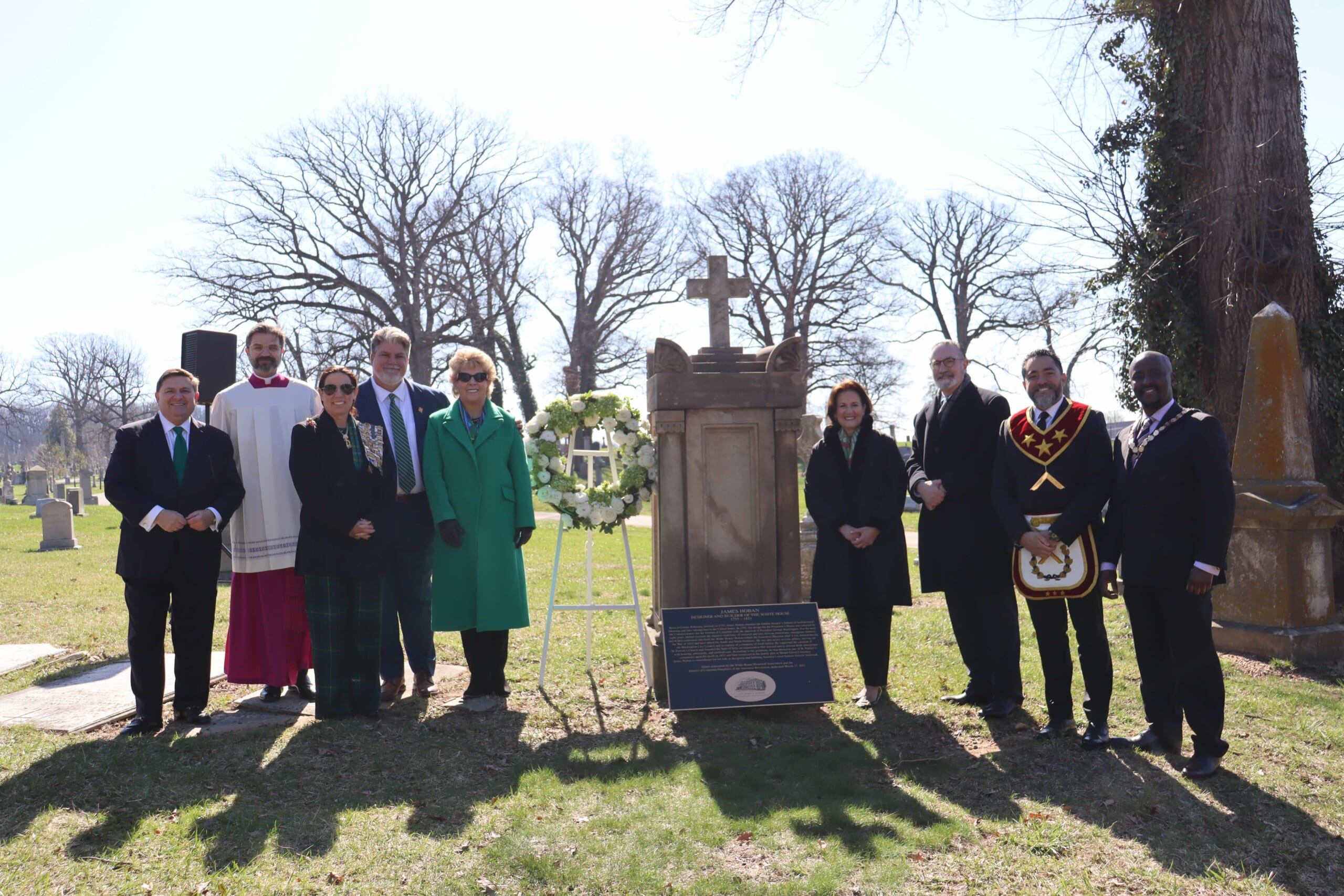
Hoban’s personal papers were burned in a fire after his death, which has obscured historians from discovering more about the man. Nevertheless, every year, the White House Historical Association gathers at Hoban’s grave at Mount Olivet Cemetery to keep his memory alive.
At this year’s ceremony on March 20, Hoban’s contributions were honored in view of America’s 250th commemoration. Monsignor Veceslav Tumir, first counselor from the apostolic nunciature, was there to salute Hoban’s ongoing connection to the Catholic community.
After a wreath placement ceremony at the cemetery hosted by the White House Historical Association and featuring Mark Carney of the Ancient Order of Hibernians, guests of the Irish ambassador gathered at the embassy, where Nason praised Hoban and other Irish patriots for their impressive contributions to historic architectural buildings as well as for lending their “Irishness” to the ideals of a young nation.
The embassy has brought together many examples of these contributions in a new exhibit called “The Emerald Thread,” which depicts how Ireland’s diaspora has been woven into American history. The artifacts are on display in a room overlooking the city and will will run through the America 250 celebrations this summer.
A large portrait of Hoban — a gift to the ambassador from the White House Historical Association — is among the exhibition’s many treasures.
Among other Irish-American heroes being highlighted by the embassy in the exhibit is Stephen Moylan of Cork, an Irish Catholic who became part of George Washington’s inner circle and served as his aide-de-camp during the Siege of Boston.