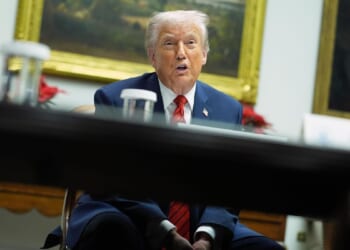
Affordability. It is the hot, new political slogan, a catch-all lament for the frustrations of daily economic life. But behind the chatter — behind the talk of grocery bills that resemble mortgage payments and jokes about needing a loan for a fast-food meal — sits a very old economic truth: when government mishandles money, prices tell the tale.
Over the past several years, Americans have endured what many have taken to calling “Bidenflation.” However partisan the term, the underlying reality is undeniable. The nation has experienced a price-level increase of more than 20 percent — an inflationary burst that hits hardest those least able to bear it: Seniors. Workers on fixed incomes. Families living paycheck to paycheck. (RELATED: Brit Hume Advises Trump How To Handle Inflation Ahead Of Midterms)
Inflation is not just an economic measure. It is a moral issue. It punishes prudence, erodes savings, and quietly transfers wealth from responsible citizens to an irresponsible state.
The reason is simple. Inflation is a form of taxation — one that requires no legislation, no debate, and no political courage. It results when the supply of money grows faster than the output of goods and services. Washington has long preferred this hidden tax to the more visible and politically costly kind. But the bill always comes due. Inflation is the mechanism through which government deficits express themselves in the real economy. What begins as a political convenience in Washington, D.C., ends as a higher grocery bill in Des Moines.
But beyond the monetary mismanagement lies a deeper error —one that goes to the heart of what a market economy is and how it functions. Prices are not arbitrary numbers that can be manipulated at will, as politicians often believe. They are signals — vital information that coordinates the behavior of hundreds of millions of individuals, none of whom could possibly know what everyone else wants, needs, or produces.
When prices rise, they tell producers where demand is strong. When prices fall, they warn that resources should flow elsewhere. This spontaneous, decentralized, and marvelously efficient system is the essence of a free economy. To “address affordability” by distorting these signals — through price controls, subsidies, punitive regulations, or political browbeating — is to blindfold the very mechanism that allows prosperity in the first place.
Consider the temptation, now revived in Washington, to “crack down” on certain industries for raising prices. The impulse is understandable: voters are angry, and politicians want to appear responsive. But blaming businesses for higher prices is like blaming thermometers for a fever. You may shatter the instrument, but the underlying illness will only worsen.
Every attempt to override price signals brings consequences. Price controls lead to shortages. Subsidies misallocate capital. Regulatory dictates choke off supply. These interventions do not make goods more affordable; they simply hide the cost, shift it, or postpone it — usually until after the next election. The result is always the same: less investment, fewer goods, and ultimately, higher prices still.
If policymakers truly wish to make life more affordable, they must begin by restoring the only environment in which long-term prosperity has ever flourished: stable money, limited government, and prices free to do their job. That means restraining federal spending, ending the habitual reliance on deficits, and committing to a monetary policy focused on long-run stability rather than short-term political convenience.
Affordability is not achieved by lecturing businesses. It arises from productivity — society’s ability to produce more with less. Productivity grows not through federal programs but through competition, innovation, and the freedom of individuals to pursue their own interests without arbitrary interference.
The public’s frustration is real, and so is the pain of rising prices. But if Washington wants to help, it must resist the urge to tinker and manipulate. The lesson is as old as economics itself: prosperity is the product of markets, not ministers; of prices, not politics.
James Carter is a Principal with Navigators Global. He previously served as Deputy Undersecretary for International Affairs at the U.S. Department of Labor (2006-07) and as the Director of the America First Policy Institute’s Center for American Prosperity (2021-23).
The views and opinions expressed in this commentary are those of the author and do not reflect the official position of the Daily Caller News Foundation.
All content created by the Daily Caller News Foundation, an independent and nonpartisan newswire service, is available without charge to any legitimate news publisher that can provide a large audience. All republished articles must include our logo, our reporter’s byline and their DCNF affiliation. For any questions about our guidelines or partnering with us, please contact licensing@dailycallernewsfoundation.org.

![Donald Trump Slams Chicago Leaders After Train Attack Leaves Woman Critically Burned [WATCH]](https://www.right2024.com/wp-content/uploads/2025/11/Trump-Torches-Powell-at-Investment-Forum-Presses-Scott-Bessent-to-350x250.jpg)