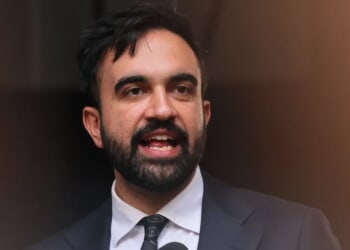
John Oxley is a consultant, writer, and broadcaster. His SubStack is Joxley Writes.
Labour’s drama around Andy Burnham was heartening to watch for most Conservatives.
Despite our party’s own problems, it is gratifying to see the other side grapple with the same sort of drama that undermined us in office.
Their public spat and a latent leadership challenge were a reminder that we are not the only ones who can succumb to the drama of internal machinations.
The official reason for the hamstringing of Burnham’s return to Parliament was the same thing that has driven his popularity: his mayoralty. For the Labour NEC, it proved a convenient way of blocking him. The party didn’t want the cost or the electoral risk of a by-election for Greater Manchester. There was also the fair criticism that walking out after less than half a term was a cynical move.
The more interesting question here, though, is not about the internal management of the Labour Party, but what it says about the role of mayors themselves. Metro-mayoralties were meant to cultivate leadership beyond Westminster. The role was introduced with the hope of attracting innovative outsiders—operators and builders with strong local leadership. Instead, the position looks increasingly like a holding pen for national politicians. It’s an extension of parliamentary career management by other means.
Of the current crop of strategic authority mayors, half are former MPs. London, the longest-standing and most prestigious, has never had a mayor who didn’t first come from the Commons. Mayoral roles have attracted characters who have lost their seat, hit a ceiling in their Westminster careers, or else have sought to harness the position to boost their profile. Andy Burnham would not, of course, be the first person to leverage mayoralty into a bid for Number 10.
It weakens the purpose of mayoralties and devolution in general to see them in such terms. Rather than spreading power downwards, it reinforces the centralisation of the British state. Instead of an office empowered to reshape how cities and regions are run, it starts to look like mayoralties are a place to bide your time until you can swing back into where the real power is – Westminster.
This drift is the result of the incentives we have baked into our political system. Candidate selection remains tightly controlled by national parties, favouring recognisable figures. The long campaign periods for mayoralties compound this. Someone already inside politics finds it far easier to dedicate a year or more of their lives to a full-time electoral fight, especially when the outcome isn’t guaranteed. Meanwhile, media attention still flows overwhelmingly through Westminster, rewarding mayors who maintain a national profile rather than those who quietly build in their local area. For someone like Burnham, it’s symbiotic – being a national figure already makes him stand out as mayor, and doing so draws him inexorably back towards national politics.
None of this is helped by Westminster’s stinginess when it comes to fully devolving power. Mayoral powers are relatively tightly constrained, particularly regarding fiscal autonomy. Though freer than councils in *how* they can spend money, what mayors can levy and spend is still decided mainly by Whitehall. The lack of freedom again encourages national figures who can call in favours with the national government, or pick fights with it, rather than building locally. Both Khan and Burnham burnished their profiles through fights with the central government under the Tories.
Making mayoralties an extension of Westminster politics undermines the good they can do. Since their introduction, the office has unlocked many easy wins. Success has come from utilising new powers and their heft across multiple councils to push through measures that could have stayed in limbo for decades. The role has also improved local democracy, giving voters a better idea of who is responsible for issues in their city or region, and achieving a prominence that council leaders rarely enjoy.
Concentrating visibility and authority in a single office was often enough to cut through stalled projects and fragmented local decision-making. But the mayoralties have failed to become magnets for unexpected talent to enter politics. Sir Andy Street stands as a rare example of someone who walked away from real-world success to take on a new executive role. Strikingly, he was one of the most effective wielders of that office, and popular too, winning cross-party plaudits and losing only narrowly in the Tory implosion of 2024.
Street’s relative rarity is itself revealing. Where mayoralties function primarily as extensions of parliamentary politics, they struggle to develop a distinct governing culture that can attract diverse people. Instead, they tend to become part of the same Westminster world, either as a step on the ladder, a slide towards retirement, or a breather between rounds of greater ambition.
Britain has long had a problem of over-centralisation.
It arguably has the least devolved power in the OECD and, consequently, some of the most significant disparities in regional growth and wealth. Metro-mayoralties have been a chance to reshape that and have proved a tentative success. That will be undermined if we come to see them purely as national political pantomime. They should be about finding the right talents to meet local challenges, not about how they play into Westminster careers and power battles.
As the mayoralties mature, they should become serious governing institutions in their own right – and attractive positions to hold in themselves, not a stepping stone. Institutions slowly teach people how to behave within them, shaping expectations about what success looks like and which careers feel worthwhile. If mayoralties come to be understood primarily as extensions of Westminster life, they will naturally attract those already fluent in its rhythms and quietly deter those whose instincts lie elsewhere. Over time, that risks narrowing the range of experience and leadership styles that devolution was meant to encourage.
The promise of mayoralties was not simply administrative efficiency, but the possibility of a more plural and grounded political culture. It would be a quiet loss if that opportunity slipped away unnoticed. Where and how the next Labour leader emerges is a matter for that party. But should Burnham succeed, even despite this delay, it would start to form a pattern: running a big city is primarily a way to vault yourself to the top of your party.
If such a feeling takes hold, it will reshape the office and, with it, blur some of the institutional purpose of devolution.


![Donald Trump Slams Chicago Leaders After Train Attack Leaves Woman Critically Burned [WATCH]](https://www.right2024.com/wp-content/uploads/2025/11/Trump-Torches-Powell-at-Investment-Forum-Presses-Scott-Bessent-to-350x250.jpg)
![CNN's Kaitlan Collins Fact-Checks Rep. Jasmine Crockett Over False Trump Ballroom Claim [WATCH]](https://www.right2024.com/wp-content/uploads/2025/10/1761954330_CNNs-Kaitlan-Collins-Fact-Checks-Rep-Jasmine-Crockett-Over-False-Trump-350x250.jpg)