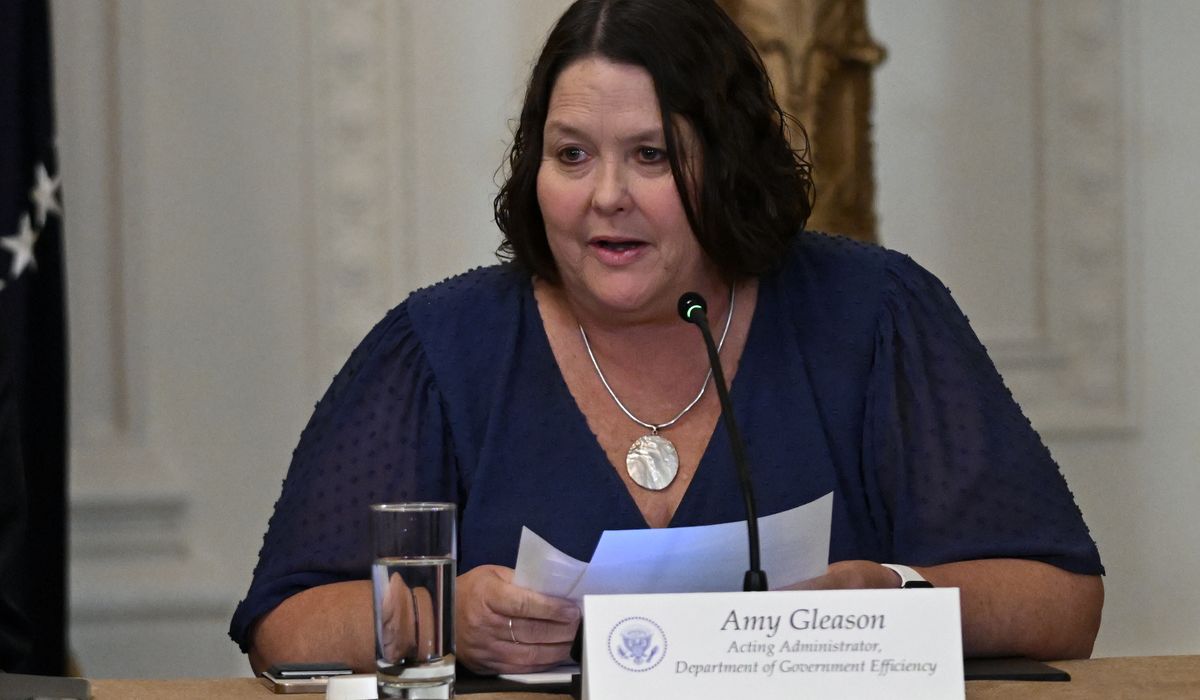

A federal judge gave approval Monday for a group to post online videos of former DOGE staffers struggling to answer questions about how they chose targets for the White House’s attack on the federal bureaucracy, saying the public’s right to know outweighed any threats or risk of harm.
The video is of depositions from two staffers at the Department of Government Efficiency, Justin Fox and Nate Cavanaugh, as well as the past and current heads of the National Endowment for the Humanities. They were recorded answering questions about how the Trump administration decided which NEH grants to try to revoke, particularly over diversity concerns.
Groups that challenged the elimination of the grants posted the video to YouTube, sparking a rash of headlines mocking the officials’ answers, including struggling to say what DEI is, and admitting that ChatGPT, an artificial intelligence tool, was used to identify targets.
U.S. District Judge Colleen McMahon, a Clinton appointee, had ordered the videos taken down earlier this month, but said Monday they could be reposted.
“Here, the testimony in the videos concerns the conduct of public officials acting in their official capacities — a context in which the public interest in transparency and accountability is at its apex,” she said.
She did scold the groups for trying to argue that the videos were judicial documents, which would then have a presumption of public access. She said the groups seemed to be playing a semantics game with the intention of posting the videos.
But she also said she’d never explicitly barred the videos from being posted in her previous orders, and saw no reason to do so now.
The Justice Department said Mr. Fox and Mr. Cavanaugh were harassed and even reportedly received death threats over the videos.
Judge McMahon said there are other laws to deal with that. But taking down videos showing government officials talking about government business wasn’t an answer.
“Reporting such conduct to law enforcement offers a far more effective means of stopping the harassment than any order this Court could enter restricting plaintiffs’ conduct, particularly when restricting plaintiffs’ ability to repost the videos would do nothing to deter or punish those third-party actors,” she wrote.
In one clip, Mr. Cavanaugh said he had no regrets that people might have lost jobs because of DOGE cuts.
“I think it was more important to reduce the federal deficit from $2 trillion to close to 0,” he said.
He was asked if they achieved that.
“No, we didn’t,” he said.



![Donald Trump Slams Chicago Leaders After Train Attack Leaves Woman Critically Burned [WATCH]](https://www.right2024.com/wp-content/uploads/2025/11/Trump-Torches-Powell-at-Investment-Forum-Presses-Scott-Bessent-to-350x250.jpg)

![Two Dead, 14 Injured After Gunfire Erupts Following College Football Game in Alabama [WATCH]](https://www.right2024.com/wp-content/uploads/2025/10/Two-Dead-14-Injured-After-Gunfire-Erupts-Following-College-Football-350x250.jpg)