Press Releases
|
March 18, 2026
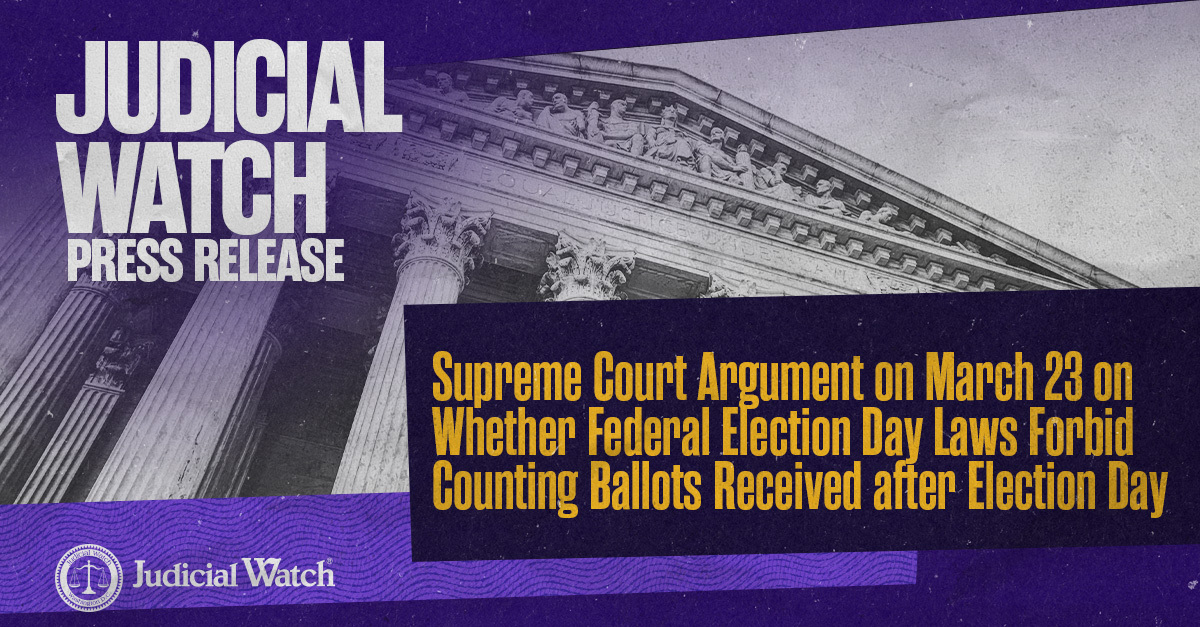
(Washington, DC) – Judicial Watch announced that the Supreme Court will hold oral argument on March 23 in a landmark election integrity case over whether the federal Election Day laws prohibit the counting of mail-in ballots that arrive after Election Day. The public can view the High Court’s oral arguments here: https://www.supremecourt.gov/oral_arguments/live.aspx. Judicial Watch brought the underlying lawsuit on behalf of the Libertarian Party of Mississippi. Judicial Watch has partnered with former Solicitor General Paul Clement, who will present oral argument to the High Court next week.
Judicial Watch’s legal team seeks to uphold a historic ruling by the U.S. Court of Appeals for the Fifth Circuit, which found that Mississippi’s counting of ballots received up to five days after Election Day to be unlawful. The suit has been consolidated with a similar challenge brought by the Republican National Committee (RNC), the Mississippi Republican Party, and others against Mississippi Secretary of State Michael Watson and local election officials (Watson v. Republican National Committee et al. (No. 24-1260)) (Libertarian Party of Mississippi v. Wetzel et al. (No. 1:24-cv-00037)).
Judicial Watch argues that the ordinary meaning of “election” at the time Congress enacted the statutes includes the full process of voting and the receipt of ballots by officials. Counting post-Election Day ballots is a relatively recent practice without any historic foundation. Allowing ballots to “trickle in” after Election Day creates opportunities for fraud and erodes public confidence.
Judicial Watch’s brief points out:
The whole point of the federal Election-Day statutes is to set a single uniform day for the election. Allowing ballots to trickle in days or weeks after Election Day is antithetical to that basic goal. Indeed, a patchwork of state ballot-receipt deadlines replicates the problems Congress was trying to remedy with a single national Election Day. It is entirely implausible to conclude that Congress—when thrice exercising its preemptive power under the Elections and Electors Clauses—left the door open for states to vitiate those statutes by postponing electoral outcomes with post-election ballot-receipt deadlines. Congress certainly did not leave states the power to undo this important federal time regulation by simply declaring all mailboxes to be ballot boxes.
***
Through the federal Election-Day statutes, Congress exercised its constitutional authority to set a uniform time for federal elections to occur. Text, historical practice, precedent, and common sense all demonstrate that those statutes set the deadline by which ballots must be submitted and received. Simply put, the ballot box closes on Election Day, and ballots that are not received until days or weeks after the date specified by Congress arrive after Election Day and should not be counted.
Congress set a uniform national Election Day, meaning the “ballot box closes” on that day.
“Federal law sets one Election Day. That deadline should be enforced,” stated Judicial Watch President Tom Fitton. “This case goes to whether federal election law will be applied as written. Congress established a single, uniform Election Day, and states cannot override that mandate with extended ballot-receipt deadlines. Allowing ballots to arrive after Election Day creates uncertainty, invites fraud, and erodes public confidence. The Supreme Court now has a critical opportunity to restore a clear national standard.”
Judicial Watch is a national leader in election integrity and voting rights litigation, with a record of successful lawsuits enforcing constitutional redistricting standards and cleaning voter rolls nationwide.
Judicial Watch took the lead in moving to enforce the Election Day federal deadlines, with lawsuits in Illinois, California, and Mississippi. In January, the Supreme Court ruled 7–2 in favor of affirming candidate standing in the Election Day challenge filed by Judicial Watch on behalf of Congressman Mike Bost and two presidential electors
Judicial Watch’s election law efforts are led by Senior Attorney Robert Popper, who previously served in the Voting Section of the Justice Department’s Civil Rights Division, where he managed voting rights investigations and litigation across dozens of states.
T. Russell Nobile, a senior Judicial Watch attorney and election law expert, in February 2026 provided testimony to the House Committee on House Administration at a hearing titled: “Make Elections Great Again: How to Restore Trust and Integrity in Federal Elections.”
Eric Lee is an attorney at Judicial Watch, where he focuses on enforcing federal and state laws that promote transparency and integrity in the electoral process. Eric graduated with his B.A. from St. Mary’s College of Maryland and received his J.D. from the University of Maryland School of Law. He is licensed to practice in California, Maryland, the District of Columbia, and in federal courts in Illinois and Colorado.
Paul D. Clement, James Y. Xi, and Philip Hammersley of Clement and Murphy PLLC are assisting Judicial Watch in this case. Clement, who has argued more than 100 cases before the Supreme Court, is former solicitor general under President George W. Bush from 2005-2008 and is widely regarded as among the top Supreme Court litigators in the country.
Federal courts in Oregon, California and Illinois have ruled that Judicial Watch’s lawsuits against those states to force them to clean their voter rolls may proceed.
Judicial Watch announced in May 2025 that its work led to the removal of more than five million ineligible names from voter rolls nationwide.
###




![Donald Trump Slams Chicago Leaders After Train Attack Leaves Woman Critically Burned [WATCH]](https://www.right2024.com/wp-content/uploads/2025/11/Trump-Torches-Powell-at-Investment-Forum-Presses-Scott-Bessent-to-350x250.jpg)