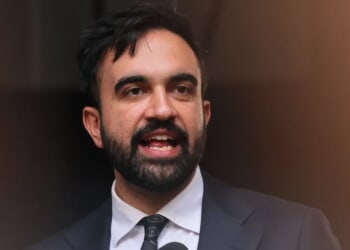
Katie Lam is a shadow Home Office minister and MP for Weald of Kent.
One of the clearest dividing lines in our politics is between those who trust the British people, and those who do not.
Fundamentally, Conservative principles are rooted in a belief that the British people themselves know best how to run their own lives. It’s why our party, at its best, has a long tradition of letting people keep more of their own money, in the knowledge that individuals are far better placed to spend that money than any government. It’s why we support getting out of the way of businesses, and to coin a phrase, it’s why we support the idea that the government should tread lightly in the lives of the public.
And it’s also why – again, at its best – the Conservative Party has defended our system.
For centuries, our system was one which gave more power and more liberty to the individual citizen than almost anywhere else. Until the constitutional vandalism of Tony Blair and New Labour, we had an all-powerful Parliament, accountable to the British people. The role of judges was to interpret Parliament’s will, not to rewrite their laws. We recognised that a democracy, in which the people can change their minds as the facts change, is far better than rule by lawyers, regulators, and bureaucrats.
For the past thirty years, many in Westminster have been experimenting with the idea that we shouldn’t trust the public after all. It’s why Tony Blair took away so much power from democratically accountable Ministers and from Parliament, then handed it over to unaccountable bureaucrats. It’s why our lives have become more and more regulated, and why businesses now struggle under masses of red tape.
And, fundamentally, it’s why this Government has announced an attack on jury trials, an ancient liberty which has long ensured a role for popular morality in the often faceless administration of justice.
The simple idea that legal cases should afford some input by our peers is a very old one. Aethelred the Unready’s third law code, issued exactly one thousand years before Tony Blair was elected in 1997, created a system in which twelve senior figures from the community were tasked with identifying the facts in any given case.
Most famously, the jury trial was mentioned in Magna Carta, which provided that “no free man is to be arrested or imprisoned…except by the lawful judgment of his peers or by the law of the land.”
At the time, all of those centuries ago, the institution of jury trial was revolutionary. Decisions on guilt or innocence were no longer made by God, via trials by ordeal, or by agents of the state. They were made by the people themselves. While many of our peers on the continent relied on state torturers and forced confessions to settle criminal cases, the English – and later the British – trod an exceptional path.
Eight centuries later, our juries remain just as important. As Lord Devlin said some seventy years ago, they are the lamp that shows that freedom lives.
And the liberty afforded by the jury trial is not a mere historical artefact, or an abstract principle. In recent years, we’ve seen just how important they are. In February, a jury at Merthyr Crown Court took just seventeen minutes to acquit Jamie Michael, a former Royal Marine accused of hate speech. According to research from the Free Speech Union, those who use free speech as a defence are more than twice as likely to be acquitted at a Crown Court, where jury trials are used, than at a Magistrates’ Court.
We may not always agree with those judgments. Yet I would be far happier placing my faith in the British people than in any single judge.
This Government, like Labour governments before them, doesn’t agree. At a fundamental, instinctive level, they don’t trust the British people. They argue that their plans to curb jury trials are an administrative necessity, yet this argument falls down on closer inspection.
For one, they’ve totally failed to take other steps to reduce the delays in our court system. This year alone, Crown Courts across England and Wales have failed to make use of 21,000 sitting days. The Lady Chief Justice has even offered more sitting days to the Government, but her offer has fallen on deaf ears.
The truth is that restricting jury trial has been an obsession for many in the Labour Party for a very long time. In 2007, the House of Lords repeatedly rejected Tony Blair’s attempts to restrict jury trials in fraud cases. Starmer and Lammy are just the latest in a long line of Labour ministers who dislike any aspect of our system which gives a voice to the British people.
This failed consensus, this lack of faith, has proven to be a disaster.
The past few decades have seen a marked decline in public confidence in our institutions, including the judiciary. Over that time, we have seen some instances of judicial activism, but we must be honest about the fact that, more often than not, the fault lies with politicians, who have often created bad laws and given judges enormous scope to interpret them. This Government’s plan to scrap jury trials would make that problem even worse, putting fundamental decisions about justice in the hands of a single judge.
To cast aside the jury trial in the name of short-term administrative convenience is a disgrace, but not a surprise. This is one of our most precious institutions. It derives from our trust in the British people, the source of our success for centuries. As we fight these proposals, we should remember that dividing line, between those who trust in the public and those who do not. It’s the single most important issue in our politics.
In the end, I am confident that those who are on the side of the public will win out, but we must make sure that jury trials are not made a casualty along the way.





![Donald Trump Slams Chicago Leaders After Train Attack Leaves Woman Critically Burned [WATCH]](https://www.right2024.com/wp-content/uploads/2025/11/Trump-Torches-Powell-at-Investment-Forum-Presses-Scott-Bessent-to-350x250.jpg)