Michael Lorimer is Chief Executive of DCS Group.
Britain’s economic story has always been written by people willing to take risks, build businesses and create work for others. From family firms to fast-growing challengers, enterprise is the quiet engine of national prosperity. Yet today, that engine is being asked to run with the handbrake on.
Prosperity comes through growth yet at precisely the moment when growth should be the Government’s central mission, British businesses face a cocktail of rising taxes, regulatory burdens and policy uncertainty that actively discourages long-term thinking. Nowhere is this clearer than in the treatment of family businesses.
The latest family business polling report from the Jobs Foundation paints a sobering picture. Changes announced in the Budget have shaken confidence among family firms, making it harder for them to plan, invest and pass businesses on to the next generation.
Family businesses account for a significant share of private sector employment in the UK. They invest smartly, train locally and think generationally. Undermining their stability may raise short-term revenue, but it risks long-term damage. Fewer jobs created, less capital invested and less wealth retained in Britain.
At DCS Group, we are determined not to let that happen on our watch.
Despite a difficult economic backdrop, we are on a clear path towards £1 billion in turnover. That ambition is not about scale for its own sake. It is about building a strong, sustainable British business that creates jobs, develops skills and supports a broad UK supply chain. Even in today’s climate, we are investing £10 million in a new Customer Innovation Centre and offices, because standing still is not an option.
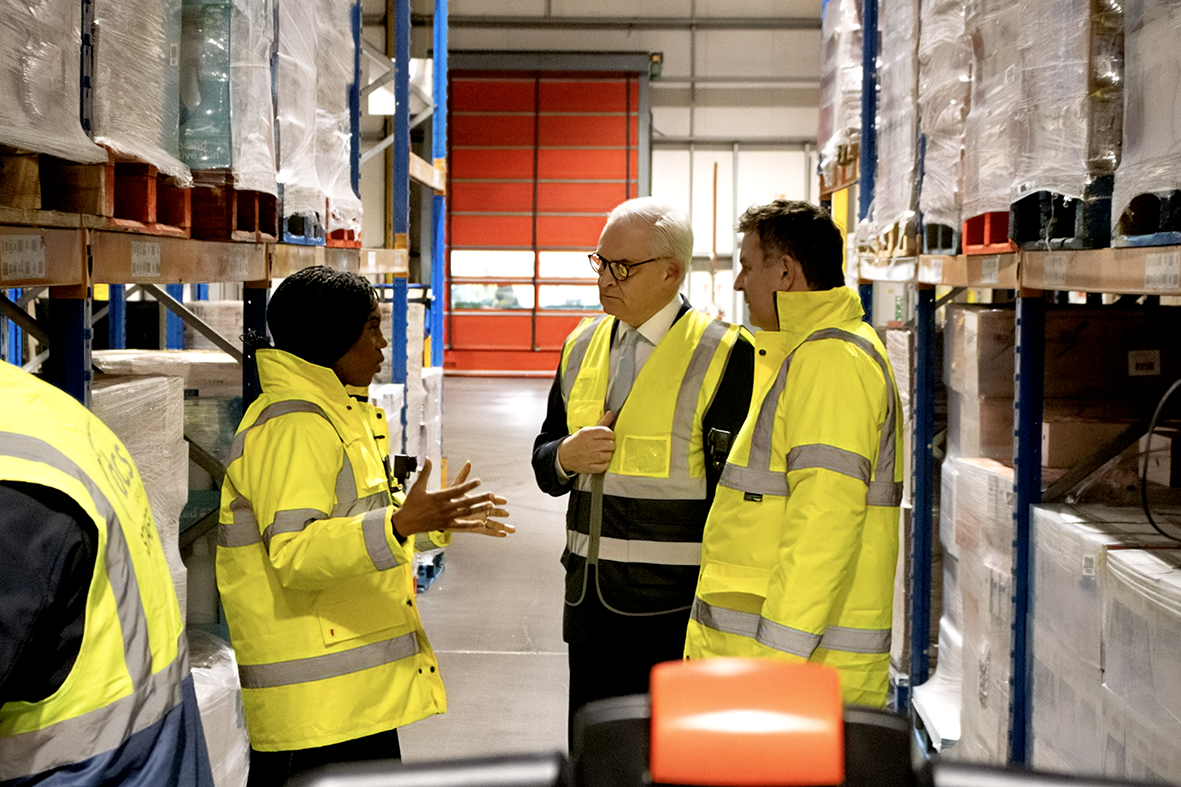
We were pleased to welcome Kemi Badenoch and Sir Mel Stride to DCS recently. They spent time on our warehouse floor, picking products and working on our co-packing lines, seeing first-hand the operational realities of a British business like ours. We discussed our growth plans, the pressures facing employers and the stark findings of the Jobs Foundation report. It was refreshing to have a serious policy conversation grounded in reality.
But while policy matters, businesses ultimately succeed or fail because of people.
People like Karen, now our Head of Quality and Compliance, who joined DCS in 2003 as a temporary warehouse order checker. She left school at 16 and learned her trade through on-the-job training and sheer determination. Over two decades, she progressed into senior leadership. Her journey is a reminder that Britain’s talent is not confined to university lecture halls.
Then there’s Ella, one of our health and safety apprentices, who joined us in her early twenties after an injury forced her to change career direction. She is now completing a level three apprenticeship, building skills and confidence in a culture that encourages responsibility and learning. This is exactly the kind of environment Britain needs if it is serious about opportunity and social mobility.
And then Lily, our Commercial Director. Lily joined DCS in 2012 in an administrative role created for her potential rather than her CV. Her drive and a strong work ethic saw her progress through every level of the commercial team and she now leads a function responsible for a substantial share of our revenue. Her story reflects what happens when ambition and talent combine with a business prepared to invest in its people.
Because of colleagues like Karen, Ella and Lily, DCS can succeed in almost any circumstances, even when government policy makes the environment harder than it should be. But that resilience comes at a cost. Not every business has the depth of talent, culture or financial headroom to absorb constant policy shocks. When government raises barriers to investment or succession, many firms are simply not strong enough to weather the storm.
The result is an unseen but very real opportunity cost. Businesses that never expand, jobs that are never created and tax revenues that are never generated for the Exchequer.
British entrepreneurs will always find a way to adapt. The real question is whether government wants to be an ally or an obstacle. If ministers are serious about growth, productivity and national renewal, they must stop penalising those who create jobs and start giving them the confidence to invest for the long term, not just for future prosperity, but for the health and wellbeing of our people, for which good jobs are an essential ingredient.
Karen, Ella and Lily embody Britain’s extraordinary potential. Their stories show how business, when allowed to thrive, can be a powerful force for good. The tragedy is that government too often fails to recognise it.





![Donald Trump Slams Chicago Leaders After Train Attack Leaves Woman Critically Burned [WATCH]](https://www.right2024.com/wp-content/uploads/2025/11/Trump-Torches-Powell-at-Investment-Forum-Presses-Scott-Bessent-to-350x250.jpg)

![CNN's Kaitlan Collins Fact-Checks Rep. Jasmine Crockett Over False Trump Ballroom Claim [WATCH]](https://www.right2024.com/wp-content/uploads/2025/10/1761954330_CNNs-Kaitlan-Collins-Fact-Checks-Rep-Jasmine-Crockett-Over-False-Trump-350x250.jpg)
![Keith Ellison Caught Promising to Fight State Agencies for Somali Fraudsters [WATCH]](https://www.right2024.com/wp-content/uploads/2026/01/Keith-Ellison-Caught-Promising-to-Fight-State-Agencies-for-Somali-350x250.jpg)