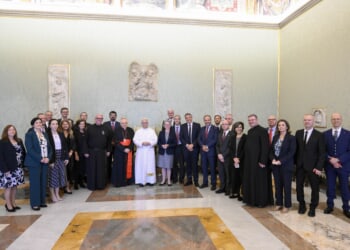
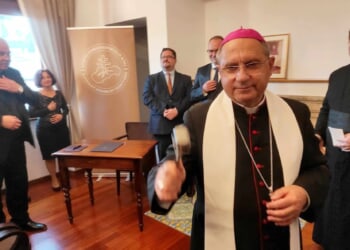
Following President Trump’s historic Abraham Accords that normalized relations between Israel and Arab nations, Argentine President Javier Milei officially inaugurated the Isaac Accords on November 30. The Isaac Accords adapt Trump’s model to the Latin American political and economic landscape and aim to strengthen Latin American and Israeli relations through political, economic, and cultural cooperation.
This new initiative was conceived last summer after Milei was an honored laureate of the Genesis Prize (GP) by GP chairman Stan Polovets and Israeli President Isaac Herzog. The prestigious prize and its $1 million award have been dubbed by TIME magazine as the “Jewish Nobel” for honoring “outstanding professional achievements, contributions to humanity, and deep commitment to Jewish values.” (RELATED: Milei’s Reform Agenda Is Bearing Fruit)
Milei used the prize money to seed the establishment of his visionary American Friends of the Isaac Accords (AFIA). According to Polovets, the AFIA is a vehicle to “encourage other Latin American leaders to stand with Israel … and reject the ideologies of terror that threaten our shared values and freedoms.” (RELATED: Eastern Horizons: New Alliance Architecture for Israel)
The official launch of the Isaac Accords in Buenos Aires at the end of November sets in motion a strategic and operational framework for Israel and Latin American democracies to promote diplomatic cooperation, establish education and cultural exchanges, and combat antisemitic extremism.
Promoting Diplomatic Cooperation
The so-called pink tide that ushered in new anti-Washington and socially progressive regimes across Latin America also resulted in overtly anti-Israel policies over the past two years. As the Israel–Hamas war unfolded after Oct. 7, new left-wing presidents in Colombia and Chile recalled their ambassadors from Israel, while Bolivia’s then-President Luis Arce broke all diplomatic relations with Jerusalem.
The Isaac Accords, however, take advantage of Latin America’s volatile political landscape as new heads of state offer the potential to reverse regional anti-Israel sentiment and increase pro-Israel voting at the U.N.
Bolivia is a prime example. Arce’s presidency between 2020 and 2025 followed in his predecessor Evo Morales’s footsteps by reaffirming his country’s alliance with the Iran–Venezuela–Cuba axis and doubling down on claims of Israeli genocide in Gaza. On Nov. 8, the new center-right president, Rodrigo Paz, replaced Arce in La Paz and has already entertained talks to reinstate relations with Israel by lifting visa restrictions.
“The decision will allow many Israelis to visit Bolivia again after many years, enjoy its vibrant culture and remarkable scenery, and strengthen ties between our nations,” Israeli Foreign Minister Gideon Sa’ar posted on X.
As political tides shift, the Isaac Accords provide the platform to consolidate new pro-Israel alliances. At the core of this diplomatic front is the recognition of Jerusalem as Israel’s capital and the location of foreign embassies.
On Dec. 1, Sa’ar inaugurated Ecuador’s new diplomatic office in Jerusalem. “Several Latin American countries — Guatemala, Paraguay, and Honduras — have already moved their embassies to Jerusalem,” Sa’ar stated, continuing that “the opening of Ecuador’s office in Jerusalem is another milestone on this important path.”
Argentina also plans to relocate its embassy to Jerusalem, with an inaugural ceremony scheduled for spring 2026.
Establishing Education and Cultural Exchanges
Another pillar buttressing the Isaac Accords’ mission is education and cultural exchanges aimed at fostering mutual understanding between Israel and Latin America. To accomplish this, member states will initially rely on existing NGOs and organizations to advance programs already in motion.
The Israel Innovative Network (ILAN), founded by Mexican philanthropist Isaac Assa, will connect Latin American students with Israeli entrepreneurs and public officials to equip next-generation leaders “to become catalysts for political change and support for Israel in their countries.”
The Israel Allies Foundation (IAF), already working to educate pro-Israel lawmakers in sixty-two countries, will add Isaac Accord member states to its expanding global network. Israel’s top medical institution, Rambam, is also gearing up to train emergency response personnel at the National Children’s Hospital in Costa Rica.
Partnerships with other groups, such as StandWithUs, the Philos Project, and Yalla Israel, will strengthen ties between students, public officials, advocacy networks, and Christian groups to support Israel and combat antisemitism. (RELATED: Israel Faces Increasing International Isolation Amid European Delusion)
Combating Antisemitism and Extremism
Milei’s unabashed support for Israel throughout its current wars and his outspoken Jewish advocacy form not only the bedrock of his Middle East foreign policy but also informs the Isaac Accords’ mission to combat antisemitism and extremism. “While the vast majority turned a deaf ear to the growth of antisemitism in their lands, we denounced it with even greater fervor, because evil cannot be met with indifference,” Milei said on Nov. 27, during the 90th anniversary of the Delegation of Argentine Israelite Association (DAIA).
Sa’ar called Milei’s presidency “a double miracle, for Argentina and for the Jewish people,” and called his affinity to Judaism and Israel “sincere, powerful and moving.”
Milei also described the Isaac Accords as part of a broader ideological alignment for the free world to “rise together against the threats to liberty seeking to lift their heads.” Countering these threats includes recognizing Hamas and Hezbollah as terrorist organizations.
In July 2024, Argentina became the first Latin American country to designate Hamas a terrorist organization. In his designatory statement, Milei cited the seven Argentine citizens killed and 15 taken hostage by Hamas on Oct. 7, and the terrorist attacks carried out on Argentine soil in the 1990s by Hamas’s Iranian sponsor.
Last spring, Paraguayan President Santiago Peña followed suit, announcing the terrorist designation of Hamas, Hezbollah, and the Iranian Islamic Revolutionary Guard Corps (IRGC).
The Expanding Pro-Israel Network.
Beyond bolstering Israel’s regional and global position and combating antisemitic threats, the Isaac Accords will also strengthen the bastions of Latin American democracy. The official launch of the accords coincided with Sa’ar’s diplomatic tour to Paraguay and Argentina at the end of November.
In Asunción, Sa’ar praised Peña’s efforts to develop “major defense capabilities” and signed security cooperation memorandums that will allow Israel to share its advanced military technologies.
The first phase of the Isaac Accords will initially focus on Uruguay, Panama, and Costa Rica, where projects are already on the table for security, economic, technological, and medical developments.
In February 2026, Argentine Foreign Minister Pablo Quirno will travel to Jerusalem to convert operational visions into real programs across the two regions for the next phases. Officials involved with these talks have stated that progress is “moving quickly,” and the benefits of these programs could rally other governments to join the accords.
Milei’s foreign policy ambitions have positioned Argentina as the regional broker of an expanding pro-Israel network whose pioneering Isaac Accords framework could serve as a model as Israel seeks new partners across the Global South.
READ MORE from Bennett Tucker:
The New Ceasefire Status Quo is War




![Donald Trump Slams Chicago Leaders After Train Attack Leaves Woman Critically Burned [WATCH]](https://www.right2024.com/wp-content/uploads/2025/11/Trump-Torches-Powell-at-Investment-Forum-Presses-Scott-Bessent-to-350x250.jpg)