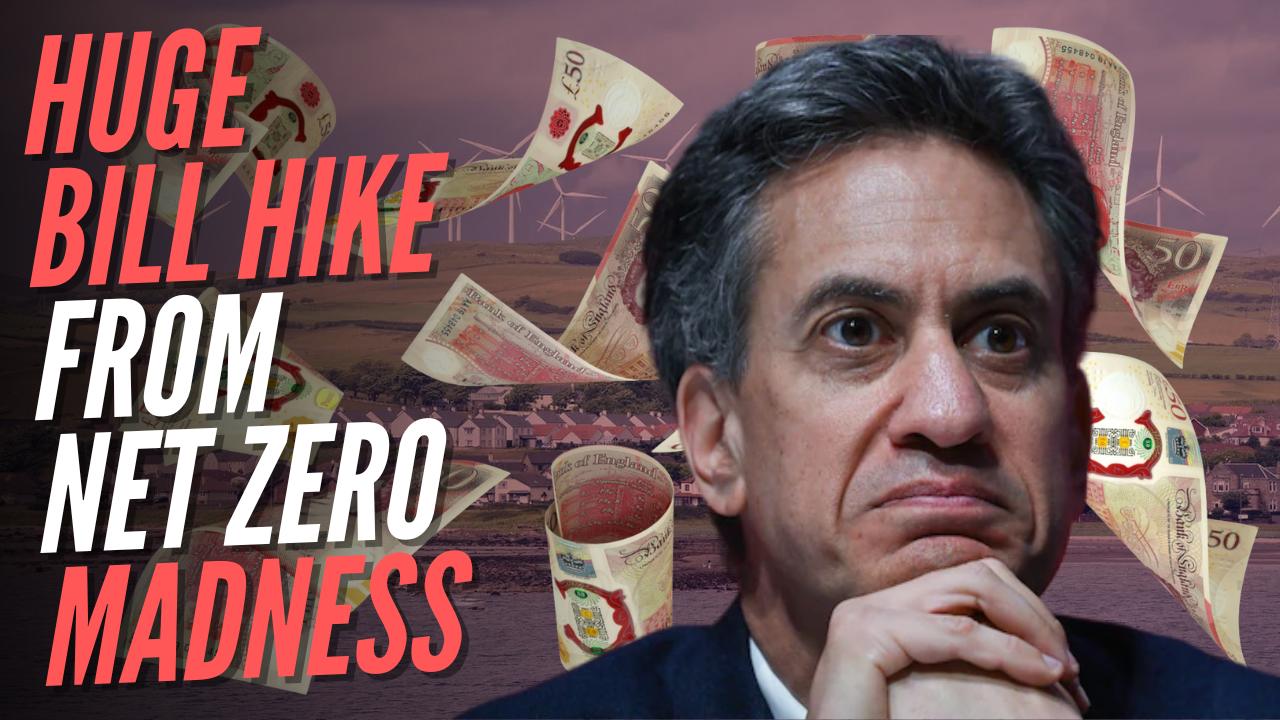
Miliband appeared at the Commons Environmental Audit Committee today to defend his attempts at the latest COP vanity conference in Brazil to push strict net zero policies:
“It would be a total dereliction if we walked away… siren voices are saying we should walk away from this process, it would be a total betrayal. I’ve got two kids who are 15 and 16, they would look at me in the future and rightly say ‘you have left future generations totally in the most appalling circumstances’… we are 1% of global emissions, if we walk away we are signing an absolute disaster warrant for future generations.”
This comes as UK billpayers are themselves set to be hit repeatedly by sky-high bills from the net zero ‘transition.’ Future generations will no doubt conclude that Miliband signed an absolute disaster warrant for consumers and businesses with ‘Clean Power 2030’…
Cheap energy campaign Net Zero Watch is warning that huge cost increases are a direct result of policies. A forecast by the National Energy System Operator predicts the fees which fund the maintenance of the UK’s high-voltage electricity transmission network will hike the average household energy bill will rise by £42.18 next year. That’s a whopping rise of 82% on this year…
Maurice Cousins, Campaign Director at Net Zero Watch, tells Guido:
“A near-doubling of charges is exactly what happens when you build an electricity system around the weather rather than physics. These spiralling costs are transmission costs, and they are entirely predictable. Once you depend on intermittent generation from remote sites, you need an oversized, heavily engineered transmission network to compensate and simply to move electricity to where it is required. None of this makes energy cheaper. To end the cost-of-Miliband crisis we need to ditch Clean Power 2030.”
Ofgem’s work is adding £108 to bills by 2031. The so-called TNUoS cost for the average household was £51.30 in 2025/26 – next year “the TNUoS cost for the average domestic household is forecast to be £93.48 for 2026/27 which forms 10.6% of the average annual electricity consumer bill.” A ‘total betrayal’…




![Donald Trump Slams Chicago Leaders After Train Attack Leaves Woman Critically Burned [WATCH]](https://www.right2024.com/wp-content/uploads/2025/11/Trump-Torches-Powell-at-Investment-Forum-Presses-Scott-Bessent-to-350x250.jpg)


![CNN's Kaitlan Collins Fact-Checks Rep. Jasmine Crockett Over False Trump Ballroom Claim [WATCH]](https://www.right2024.com/wp-content/uploads/2025/10/1761954330_CNNs-Kaitlan-Collins-Fact-Checks-Rep-Jasmine-Crockett-Over-False-Trump-350x250.jpg)