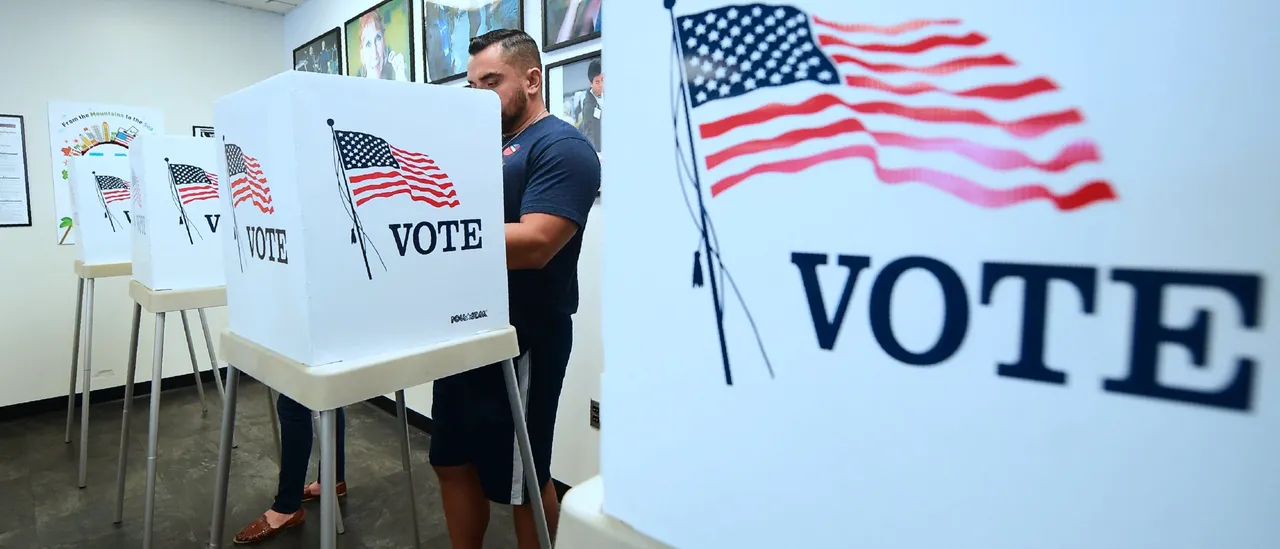
As the country heads towards the anniversary of the 250th year of the great American experiment, we should be reminded of the democratic system in place that allowed this country to prosper. America’s central idea is rule by the will of the people, which faces an ever present, existential crisis: we need honest, verifiable, and trustworthy elections.
Earlier this year, President Trump spearheaded much-needed election reform in a widely praised Executive Order intended to not just secure elections, but also to create a system that produces results that voters can trust. The central tenets for reform can be distilled into the following action items for states: (1) require photo voter ID to ensure that only legal, registered voters can cast a valid ballot; (2) eliminate or reduce mail-in balloting and early voting periods; (3) eliminate any post-Election Day ballot receipt period; and (4) require careful, verifiable, and up-to-date voter registration tracking for non-citizens registered to vote in local elections. (RELATED: Seven Primaries That Could Tear Democrats Apart In 2026)
The gist of President Trump’s landmark EO is to move towards one single Election Day, with the votes tallied that night and a presumptive winner accepting these results in a candidate victory party speech. Indeed, these changes to state election laws are highly supported by the public. A full 89% of voters support efforts by elections officials to process ballots on time so that the public can know a winner on election night.
Photo ID requirements remain central to these reforms. Voters of both parties overwhelmingly support photo ID requirements. A whopping 95% of Republicans and nearly 70% of Democrats support the requirement of a photo ID to vote. Polling that lopsided suggests a mandate for lawmakers willing to push forward with commonsense legislation. Yet, in many states, this isn’t the case.
President Trump’s EO is a strong foundation. Lasting change requires state legislation that codifies these core principles. One of the key states where courageous lawmakers are putting forward these proposals is Ohio, where Senate Bill 293 is currently sitting on Republican Gov. Mike DeWine’s desk, awaiting his signature.
Ohio has earned its reputation as a model for election administration. This hard work pays off: a staggering 91% of Ohioans are confident that votes are accurately cast and counted, and 83% believe Ohio’s ballot systems are secure from fraud, hacking, or other technological threats. These numbers tower over the national average, where only 49% of voters trust U.S. elections to be free, fair, and secure.
But why should Ohio stop at good when it can achieve great? At its core, SB 293 delivers practical protections without disrupting access. It ends a currently codified, unnecessary four-day post-Election Day receipt window for domestic absentee and mail-in ballots, ensuring more transparent results demanded by nearly all voters. And it preserves existing grace periods for military and overseas voters, ensuring they have a little more time to return their ballots from far-flung deployments across the globe.
The bill also codifies existing best practices to verify voter rolls through cross-checks with BMV, SAVE, and Social Security data. As bill sponsor Republican State Sen. Theresa Gavarone stated “By requiring ballots to be received and counted on Election Day and eliminating the possibility for non-citizens, dead and fictitious people, and duplicate registrations to legally be counted in our elections, Ohio has furthered our national reputation as an elections leader.” Republican Secretary of State Frank LaRose, who would enforce the law, fully endorses it.
Polls reveal a national crisis of confidence in states lacking robust safeguards, and even strong systems like Ohio’s can—and should—evolve to set an unbreakable standard. By signing SB 293, DeWine can cement Ohio’s leadership and inspire the nation, aligning with President Trump’s EO.
Meanwhile, states like Nevada are stagnant in reform. Nevada’s elections are notable for an extended counting process and late-night ballot count drops that stretch days. Ballot tallies that hit after hours — even by Las Vegas standards — routinely change the course of an election. Nevada voters wake up to new results and are left to wonder what happened overnight. Though some efforts to fix this chaotic process have been discussed, it remains a state that desperately needs significant election reform.
This is the backdrop on which we co-founded Save Election Day, a nonprofit solely dedicated to implementing President Trump’s EO on honest, verifiable, and trustworthy elections in the states. As election lawyers who have worked in the field — Election Day, early voting, the close calls, the inevitable recounts — we’ve rolled up our sleeves to resolve the election problems on the ground. And now we want to support bold lawmakers who understand that elections must take priority on the floors of statehouses, not just in polling places.
The rights of American citizens to have their votes accurately and timely counted and tabulated — without illegal dilution —and with confidence in the process, administration, and outcome of any U.S. election is fundamental to ensure the next 250 years of American greatness. Ohio is the first step, with many more to come.
Nicole Kelly and Steve Roberts are election lawyers at Lex Politica PLLC and co-founders of Save Election Day.
The views and opinions expressed in this commentary are those of the author and do not reflect the official position of the Daily Caller News Foundation.
All content created by the Daily Caller News Foundation, an independent and nonpartisan newswire service, is available without charge to any legitimate news publisher that can provide a large audience. All republished articles must include our logo, our reporter’s byline and their DCNF affiliation. For any questions about our guidelines or partnering with us, please contact licensing@dailycallernewsfoundation.org.



![Donald Trump Slams Chicago Leaders After Train Attack Leaves Woman Critically Burned [WATCH]](https://www.right2024.com/wp-content/uploads/2025/11/Trump-Torches-Powell-at-Investment-Forum-Presses-Scott-Bessent-to-350x250.jpg)

![James Carville Admits Democrats Had No Shutdown Endgame, Mishandled Strategy [WATCH]](https://www.right2024.com/wp-content/uploads/2025/11/1763070634_James-Carville-Admits-Democrats-Had-No-Shutdown-Endgame-Mishandled-Strategy-350x250.jpg)