The president of the Catholic Bishops’ Conference of Nigeria (CBCN) has raised concerns about rising insecurity in the West African country, decrying in particular what he describes as “senseless massacres” and “mass burials” in the country experiencing ongoing terrorism and banditry.
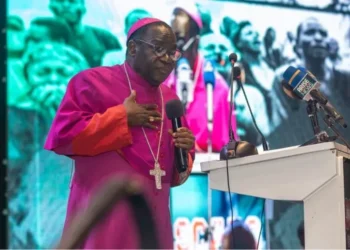
Delivering his address at the opening session of the CBCN’s 2026 first plenary meeting at the Catholic Secretariat of Nigeria Resource Centre in Durumi, Abuja, Archbishop Lucius Iwejuru Ugorji spoke at length about the country’s governance challenges and electoral irregularities, calling for proactive security measures, ethical leadership, and credible elections.
“Our country has continued to experience rising security challenges. We continue to hear sad tales of senseless massacres, mass burials, endless tears, and grief,” Ugorji said.
The archbishop, who leads Nigeria’s Archdiocese of Owerri, described the worsening wave of kidnappings and killings across Nigeria, noting that gun-wielding men in the country “operate boldly, freely, and unchallenged,” often exploiting weaknesses in the national security system to attack vulnerable communities.
He lamented that Nigeria “continues to bleed endlessly” and warned that the government must go beyond reactive responses to insecurity.
The archbishop said that authorities must invest in modern surveillance technology, strengthen intelligence systems, and ensure that perpetrators of terrorism and their sponsors are “swiftly arrested, prosecuted, and held accountable under the law to deter others.”
Ugorji also cautioned that delays in prosecuting terrorists or reintegrating former insurgents could undermine public trust, stating that such actions “give the impression of complicity on the side of government.”
The archbishop further condemned illegal mining, describing it as “national economic sabotage” that fuels terrorism and organized crime.
He said Nigeria continues to lose about $9 billion annually to illegal mining activities, which are “strongly linked to the rise and sustenance of banditry, kidnapping, and other organized crimes.”
Criminal groups, he explained, use proceeds from mineral sales to purchase weapons and finance terrorist operations.
The CBCN president also warned that hazardous chemicals used by illegal miners have caused “severe environmental degradation, soil and water contamination, loss of biodiversity, and a public health crisis,” urging the government to adopt more aggressive measures, including the use of drone technology and artificial intelligence to monitor mining sites.
Reflecting on Nigeria’s political situation, Ugorji identified poor leadership as a major cause of the nation’s challenges.
“The root of our afflictions as a nation is largely the problem of poor leadership and the wrong perception of politics among many of our leaders, merely as the rigging of elections and stealing of other people’s mandate,” he said, emphasizing that political leadership exists for the common good and requires moral integrity, stating that “a political leader worth the name is one who stands on moral high ground.”
The archbishop stressed that national wealth has not benefited all citizens, noting that despite abundant resources, “many of our fellow citizens are left behind and the gap between the rich and the poor widens.”
Ugorji also expressed concern about declining voter turnout in Nigeria’s elections, warning that continued decline would damage democracy.
He said electoral irregularities have weakened public confidence, pointing to falling participation rates over the years and cautioning that the trend “calls into question the legitimacy of elected officials in a democratic dispensation.”
To restore trust, he urged the National Assembly to ensure mandatory real-time transmission of election results to prevent manipulation, insisting that “this is the will of the people and has to be respected.”
He further warned lawmakers that “the world is watching! Above all, God is also watching.”
In his address, Ugorji highlighted the proclamation of a special Jubilee Year of St. Francis of Assisi, describing it as an opportunity for spiritual renewal and a call to peace and reconciliation in a divided world.
He encouraged parishes and Church institutions to organize retreats and urged the faithful to deepen their commitment to holiness and peace.
The CBCN president acknowledged Nigeria’s 2025 Tax Act, which seeks to reform the fiscal system, but noted that the reforms face challenges, including possible burdens on small businesses and fears that they could increase living costs and worsen hardship.
He noted growing international attention on Nigeria’s security situation following global concerns and government actions, including a national security emergency declared by President Bola Ahmed Tinubu.
At the conclusion of his address, the archbishop announced that he would step down as CBCN president at the end of the plenary session, thanking members for their support during his tenure.
“I take advantage of this opportunity to thank you for the cooperation and support I received from you all during my tenure as your chief servant,” he said.
This story was first published by ACI Africa, the sister service of EWTN News in Africa, and has been adapted by EWTN News English.