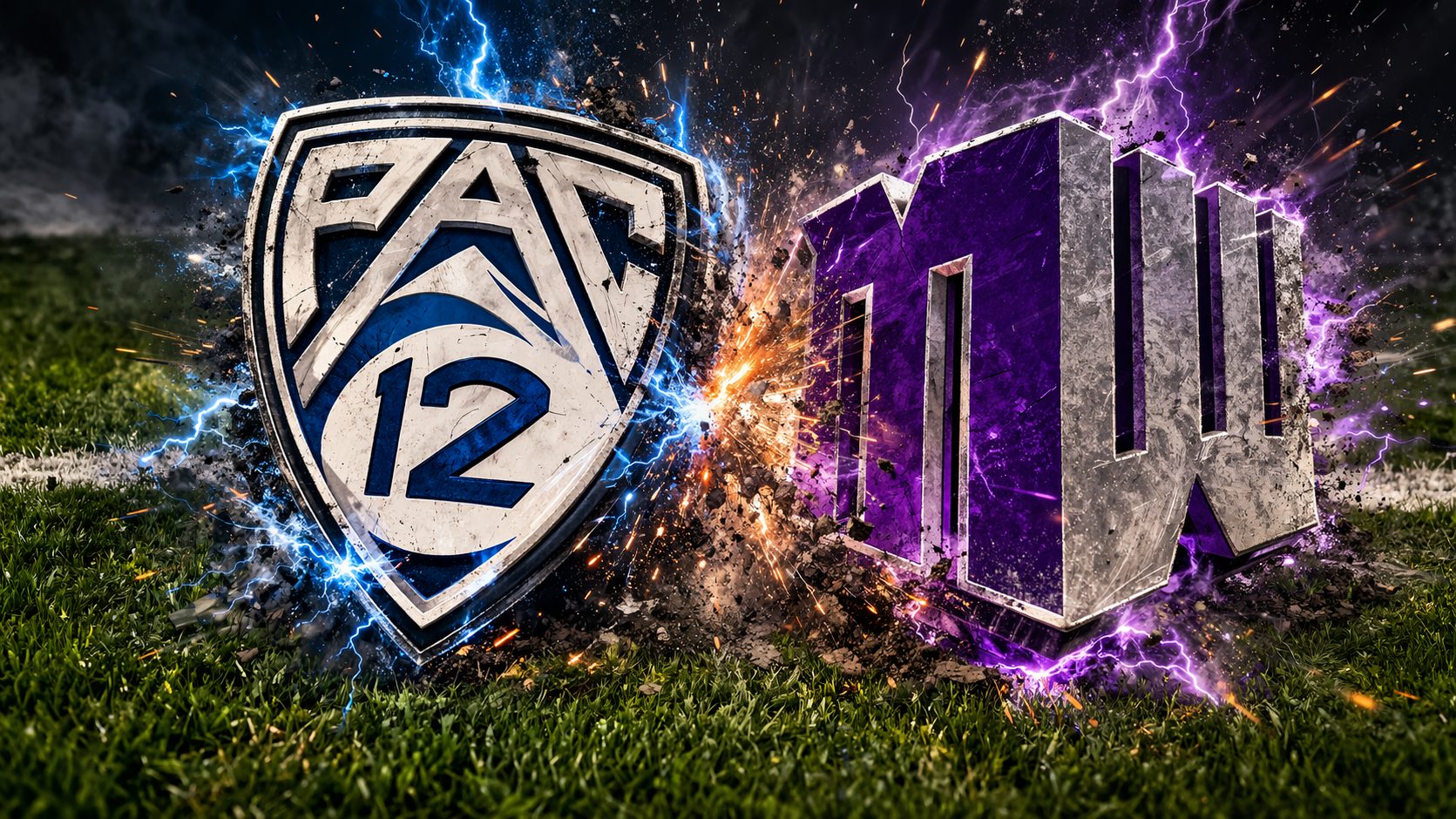
What happened with the Pac-12 and Mountain West is not some grand football rebirth. It is not a sleeping giant stretching its legs. It is mostly one decent Group of Five football league getting chopped up and turned into two average ones. Or, if we are being honest with the current alphabet soup, maybe two average “Group of 6” leagues.
Yes, there are money implications. Yes, there is branding value in the Pac-12 name. Yes, Oregon State and Washington State understandably needed a lifeboat after the old Pac-12 got blown to pieces. But on the field? The football product did not suddenly become something dramatically different. A logo change and a legal invoice do not turn upper-middle-class Group of Five football into the SEC or Big Ten.
The rebuilt Pac-12 will officially launch on July 1, 2026, with eight football members: Oregon State, Washington State, Boise State, Colorado State, Fresno State, San Diego State, Texas State, and Utah State. Gonzaga is also joining, but only as a non-football member. The league’s own 2026 football schedule announcement lays out that eight-team football setup clearly.
Here’s What They’re Not Telling You About Your Retirement
Meanwhile, the 2026 Mountain West football membership will be Air Force, Hawai‘i, Nevada, New Mexico, North Dakota State, Northern Illinois, San Jose State, UNLV, UTEP, and Wyoming. Hawai‘i is becoming a full-time Mountain West member in 2026, while UTEP joins as a full member and both Northern Illinois and North Dakota State join as football-only members.
And that right there is the whole joke.
The Pac-12 grabbed the Mountain West’s better recent brands in Boise State, Fresno State, San Diego State, Colorado State, and Utah State, then added Texas State to get to eight football schools. That creates a respectable league. But “respectable” is doing a lot of work here. This is still a conference built mostly from schools that were, until five minutes ago in college-football time, playing Mountain West schedules and cashing Mountain West checks. Oregon State and Washington State add some name recognition and a layer of former Power conference credibility, sure. But if the argument is that this is now a materially different football product, that is where the spin starts outrunning the facts.
The new Mountain West, on the other hand, did what wounded leagues do. It stabilized. It added UTEP. It added Northern Illinois for football. It added North Dakota State for football, which is fun and intriguing even if it is also a reminder that the league had to go shopping partly in Conference USA, partly in the MAC footprint, and partly in FCS royalty. That is not a knockout move. That is survival with decent taste.
This Could Be the Most Important Video Gun Owners Watch All Year
So what do these two leagues actually look like as football products?
The Pac-12 looks a little better at the top. Boise State remains the headliner brand in this whole shuffle, and Oregon State and Washington State bring the leftovers of major-conference identity. Fresno State and San Diego State have had enough relevance over the years to make Saturdays feel legitimate. Texas State gives the league a foothold in Texas and a little growth-story buzz. But after that, the idea that this is some great leap forward gets shaky. It is still a league where most Saturdays will look and feel like quality mid-tier college football, not a national weekly event. That is not an insult. That is the category.
The Mountain West now looks deeper in the “pretty solid, pretty random, maybe dangerous on the right Saturday” category. UNLV has had recent juice. Air Force remains a pain to deal with when it is rolling. Hawai‘i, Wyoming, and San Jose State all have varying levels of spoiler energy, at times. Northern Illinois has real football history. North Dakota State, perhaps the most intriguing storyline, brings a winning tradition, though the jump to FBS is still a jump. UTEP joining and New Mexico staying are more proof that this league is not dead, but it is also not exactly strolling into a room and demanding playoff respect.
That is why this whole thing feels less like elevation and more like division. The old Mountain West, before the raid, had a tighter cluster of the best brands and better teams under one roof. The new arrangement spreads those assets across two leagues. One conference got the Pac-12 label and a better sales pitch. The other got left to patch holes and prove it is still worth watching. But the actual football inventory across both leagues did not become more special. It got diluted.
And let’s not ignore the money fight, because that is the one place where this thing is undeniably more dramatic than the football. The Pac-12 and Mountain West have been fighting over more than $50 million in so-called poaching penalties tied to the departures, and the departing schools also faced separate exit-fee issues. That matters to presidents, commissioners, lawyers, and TV consultants. It matters a lot less to the guy on his couch in October trying to decide whether Pac-12 After Dark 2.0 is actually better than what he was already getting from late-night Mountain West games.
That is the real bottom line. The Pac-12 may absolutely end up in a better media position than the post-raid Mountain West. It may make more money. It may have stronger branding. Those are real wins. But let’s stop acting like the football transformation is some kind of miracle.
This was not a rebirth into national importance. It was conference musical chairs. The Pac-12 did not suddenly become the old Pac-12. The Mountain West did not vanish. One solid Group of Five league got split into two leagues that both have decent Saturdays, a few recognizable helmets, and a ceiling that still looks a lot like high-end mid-major football.
In other words, college football did what college football always does now: it made a giant mess, called it strategy, and sent the bill to everybody else.
The opinions expressed by contributors and/or content partners are their own and do not necessarily reflect the views of LifeZette. Contact us for guidelines on submitting your own commentary.




![Two Dead, 14 Injured After Gunfire Erupts Following College Football Game in Alabama [WATCH]](https://www.right2024.com/wp-content/uploads/2025/10/Two-Dead-14-Injured-After-Gunfire-Erupts-Following-College-Football-350x250.jpg)
![CNN's Kaitlan Collins Fact-Checks Rep. Jasmine Crockett Over False Trump Ballroom Claim [WATCH]](https://www.right2024.com/wp-content/uploads/2025/10/1761954330_CNNs-Kaitlan-Collins-Fact-Checks-Rep-Jasmine-Crockett-Over-False-Trump-350x250.jpg)