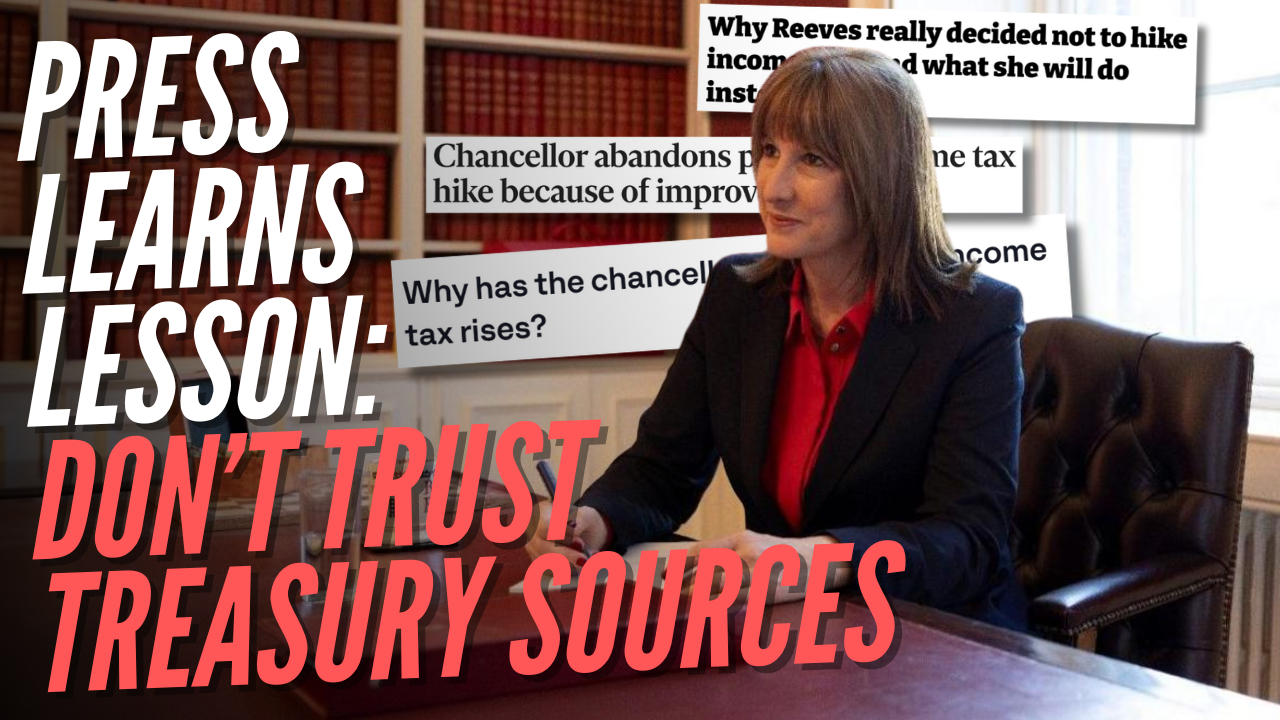
Now that it has been spelled out by the OBR that the black hole did not in fact exist media reports which swallowed the Treasury’s spin entirely look ludicrous. It was clearly a rearguard action on the back of the FT’s report at the time anyway…
The Treasury’s full-blown deception operation played out in the headlines:
- Bloomberg: “Reeves’ Tax U-Turn Came After Better Forecasts from UK Watchdog“
- PA: “The PA news agency understands the strength of tax receipts has improved forecasting from the Office for Budget Responsibility, allowing for the U-turn.”
- i paper: “Rachel Reeves has decided not to raise income tax after discovering that the “black hole” in the Budget is smaller than previously feared, The i Paper understands.”
The BBC wrote as its headline: “Reeves backs away from income tax rates rise after improved economic forecasts.” Hook line and sinker…
It went on: “A proposal to increase income tax rates by 2p, while cutting National Insurance by the same amount, was sent to the OBR as an option earlier this month to be costed, to help fill what was then a £30bn gap in the public finances, mainly caused by a downgrade to productivity. Newer assessments from the OBR appear to have increased the projected strength of wages and tax receipts in the coming years and offset several billion pounds of that gap, taking it closer to £20bn.”
Robert Peston mused on his main ITV report:
“I am told that earlier this week, the Treasury received improved data on current and expected future wage growth, and that this has therefore increased forecasts of future tax revenues.
This, of course, means that the projected margin by which the chancellor will fail to meet her fiscal targets – the hole in the budget – has fallen, and presumably to less than the previously projected £30 billion hole.
Which means the pressure on Reeves to raise income tax rates – and therefore breach the party’s election manifesto – is not what it was even last weekend (1p on the basic rate raises circa £8 billion, and a penny on all the rates raises circa £10 billion in toto).”
As it turns out OBR forecasts had strong wage growth eliminating the productivity black hole as far back as September, and fully delivered by late October. The £20-30 billion black hole did not exist. The media, which spends a lot of the time pointing out to Reeves that she can’t be trusted, went ahead and reported without scrutiny the Treasury’s Budget forecast deceptions…
![Donald Trump Slams Chicago Leaders After Train Attack Leaves Woman Critically Burned [WATCH]](https://www.right2024.com/wp-content/uploads/2025/11/Trump-Torches-Powell-at-Investment-Forum-Presses-Scott-Bessent-to-350x250.jpg)