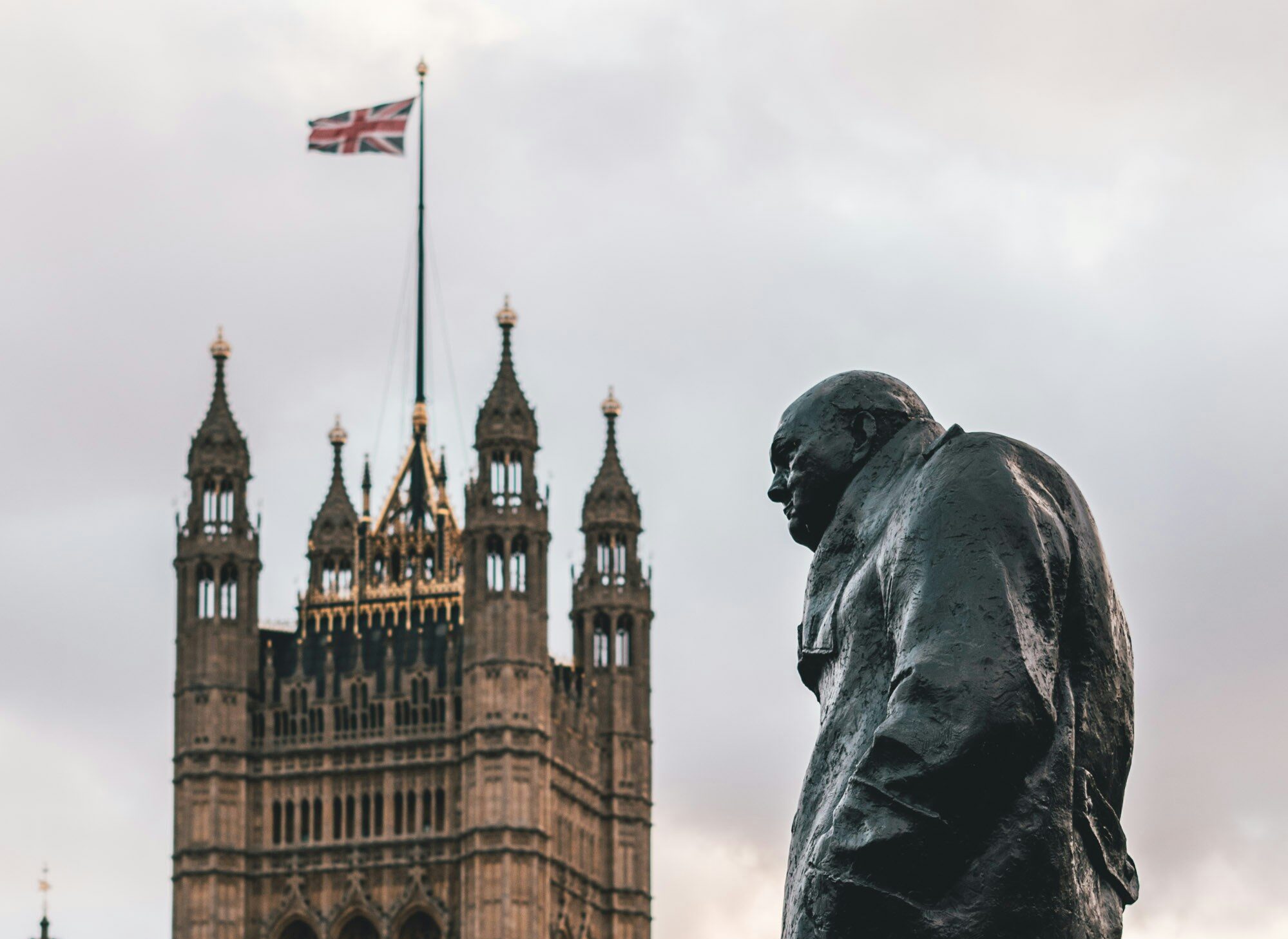
Some people are put on earth to do more than one big thing. Winston S. Churchill was such a man. If he had just been the new prime minister inspiring his people’s courage — the incarnation of Britain “standing alone” against Nazi Germany in 1940 — that would have been enough. If he had given but three of his signal speeches in two months during that critical time — “I have nothing to offer but blood, toil, tears and sweat”; “We shall fight on the seas and oceans … we shall fight on the beaches … we shall never surrender”; “This was their finest hour” — that would have been enough. If his wartime leadership (May 1940-July 1945) that translated “standing alone” into a formidable alliance against the Nazis had been all there was, that would have been enough. But World War II was the soaring middle of Churchill’s statesmanship. (RELATED: Churchill as Hero of World War II)
Like few other public figures, Churchill (1874-1965) grasped early the nature of totalitarianism in the 20th century. He knew war was deadly serious when waged by ordinary bad actors seeking power, treasure, and status. But when bad actors were driven by ideology, their pursuit of power was worse in kind and form. Radical ideology made the difference in the modern era and fully formed in the 20th century, and Churchill fought communism, Nazism, and fascism with ferocity. After opposing them for decades in his political rhetoric and actions, Churchill linked and called out “the two giant marauders, war and tyranny,” by name in 1946.
From the start, Churchill saw that Bolshevism — Marxism-Leninism in action — exploited the circumstances of World War I and shaped the 20th century. In the House of Commons, describing the Bolshevik Revolution, he stated Vladimir Lenin was sent into Russia by the Germans in 1917, “in the same way that you might send a phial containing a culture of typhoid or of cholera to be poured into the water supply of a great city, and it worked with amazing accuracy.” Lenin termed Churchill, a proponent of Allied assistance to the anti-Bolshevik Russian forces in 1918-1920, as “the greatest hater of Soviet Russia.” Years after his Communist comrade’s death in 1924, Leon Trotsky criticized Churchill as “a champion of capitalist violence” and poor historian. Tit for tat continued, and, in the 1930s, Churchill looked to the “two great Anti-Communist nations, Britain and the United States,” to combat Soviet “new tyranny” as well as the Great Depression. In 1934, he described President Franklin D. Roosevelt as an antidote to dictatorship with an “impulse” to help “the people in every land, and which as it grows the brighter may well eclipse both the lurid flames of German Nordic national self-assertion and the baleful unnatural lights which are diffused from Soviet Russia.”
Yet Churchill’s formidable World War II alliance included the Soviet Union, which meant both acknowledging and ignoring that regime’s tyrannical, “unnatural lights.” Before American entry into the war, and even before the 1939 Molotov–Ribbentrop Pact was terminated by Operation Barbarossa, the German invasion of the USSR in June 1941, Churchill regarded the Nazis as the greater, immediate enemy to Britain and the West. “The Nazi regime is indistinguishable from the worst features of Communism,” he emphasized in a June 22 broadcast on the night of Barbarossa, before turning to his strategic reasoning for support of the Soviet Union. “No one has been a more consistent opponent of Communism than I have for the last twenty-five years. I will unsay no word that I have spoken about it. But all this fades away before the spectacle which is now unfolding.” As he memorably told his private secretary, “If Hitler invaded Hell I would make at least a favorable reference to the Devil in the House of Commons.” After the Japanese attack on Pearl Harbor in December 1941, Roosevelt and the United States formally joined the war and completed the Big Three alliance. (RELATED: Forty Years Ago Reagan Began to Undo the Stain of Yalta)
He called for freedom-loving alliances to build up the “sinews of peace” … to prevent war and establish “conditions of freedom and democracy as rapidly as possible in all countries.”
Well before the end of World War II, Churchill recognized the Soviet Union as the greater postwar enemy, a totalitarian impediment to the framework for peace set forth in the 1941 Atlantic Charter and the proposed United Nations Organization. He foresaw the Cold War, with origins back to 1917 that grew from earlier, deeper roots in the 19th century; and he used the term “iron curtain” twice in spring 1945 telegrams to new President Harry Truman and, in mid-August 1945, on the floor of the House of Commons. In May 1945, Churchill considered Operation Unthinkable — a contingency plan (known at the time to the Kremlin thanks to Soviet double agent Guy Burgess, yet declassified only in the late 1990s) to launch a surprise attack on Soviet forces in Germany to eject them from Europe — which he and his military advisors rejected as unworkable.
Voted out of office partway through the Potsdam wartime conference of summer 1945, Churchill remained a singular statesman. In the joyous yet turbulent months after World War II, when Americans were just sensing that the Soviet Union was no longer their ally, he sought to give a major address in the United States. Churchill was proud of his half-American heritage through his mother, and he had made nine previous, substantive trips to the United States. He wrote Truman in late 1945 that America was at “a pinnacle of glory and power not exceeded by any nation in the whole history of the world, and with that come not only opportunities literally for saving misguided humanity but also terrible responsibilities if these opportunities cannot be seized.”
Truman personally encouraged the former prime minister to accept a speaking invitation at Westminster College in Fulton, Missouri. He already believed much of what Churchill intended to say about Soviet communism and the West, although the midwestern American — both democrat and Democrat — always distanced himself from “fraternal association” with the British empire. Truman was on a parallel, though at times slower, track to Churchill’s in 1945. Before any contact with Churchill in early 1946 about the content of the Fulton message, Truman had intensified his criticisms of the Soviet Union in discussions with top advisors.
Churchill and Truman traveled together by train to Missouri. Their 1000-mile, 24-hour trip deepened their relationship, as they conversed, looked over the speech, and played poker. Their motorcade was greeted by the 8,000-person population of Fulton and another 20,000 people who came from all over Missouri. On March 5, 1946, Churchill gave the perfect speech at the perfect time. With Truman making brief introductory remarks and then sitting on stage in his own home state, Churchill helped to define the nature and challenges of the Cold War — over a year before that term came into popular use.
Churchill’s speech imparts lessons to this day. Deserving of memorization as much as “We hold these truths to be self-evident…” or “that this nation, under God, shall have a new birth of freedom” is: “From Stettin in the Baltic to Trieste in the Adriatic, an iron curtain has descended across the Continent.” Naming great Central and Eastern European countries that had been forced into “the Soviet sphere,” Churchill urged the protection of other states such as Greece, Turkey, Iran, western Germany, France, and Italy from communist encroachment and pressures. He stressed America’s role in securing the future of liberty and underscored its “special relationship” with Britain as central to the defense of Western civilization. He called for freedom-loving alliances to build up the “sinews of peace” — his formal title for the speech — to prevent war and establish “conditions of freedom and democracy as rapidly as possible in all countries.” While expressing admiration for the Russian people, and even for his erstwhile “wartime comrade, Marshall Stalin,” Churchill was clear that “[a] shadow has fallen upon the scenes so lately lighted by the Allied victory” and that the Soviets disrespected weakness and wanted “the fruits of war and the indefinite expansion of their power and doctrines.”
A new kind of war was already underway, and Churchill — as only he could do at that moment 80 years ago — used his political voice to educate the United States and the world. Americans listened, even if somewhat reluctantly. Soon, under Truman’s Cold War statesmanship, they agreed that the “sinews of peace” must be strengthened through a grand alliance of the Western democracies and a robust defense of the “great principles of freedom” of individual rights, rule of law, and constitutional government. Now, as then, strength-based alliances between and among democracies and an ongoing commitment to our fundamental rights and freedoms provide the best response to the persistent, giant marauders of war and tyranny.
Elizabeth Edwards Spalding, PhD, is a senior fellow at Pepperdine University School of Public Policy, chairman of the Victims of Communism Memorial Foundation (VOC), and author of The First Cold Warrior: Harry Truman, Containment, and the Remaking of Liberal Internationalism.
READ MORE:
The Cold War Started During World War II



![Donald Trump Slams Chicago Leaders After Train Attack Leaves Woman Critically Burned [WATCH]](https://www.right2024.com/wp-content/uploads/2025/11/Trump-Torches-Powell-at-Investment-Forum-Presses-Scott-Bessent-to-350x250.jpg)