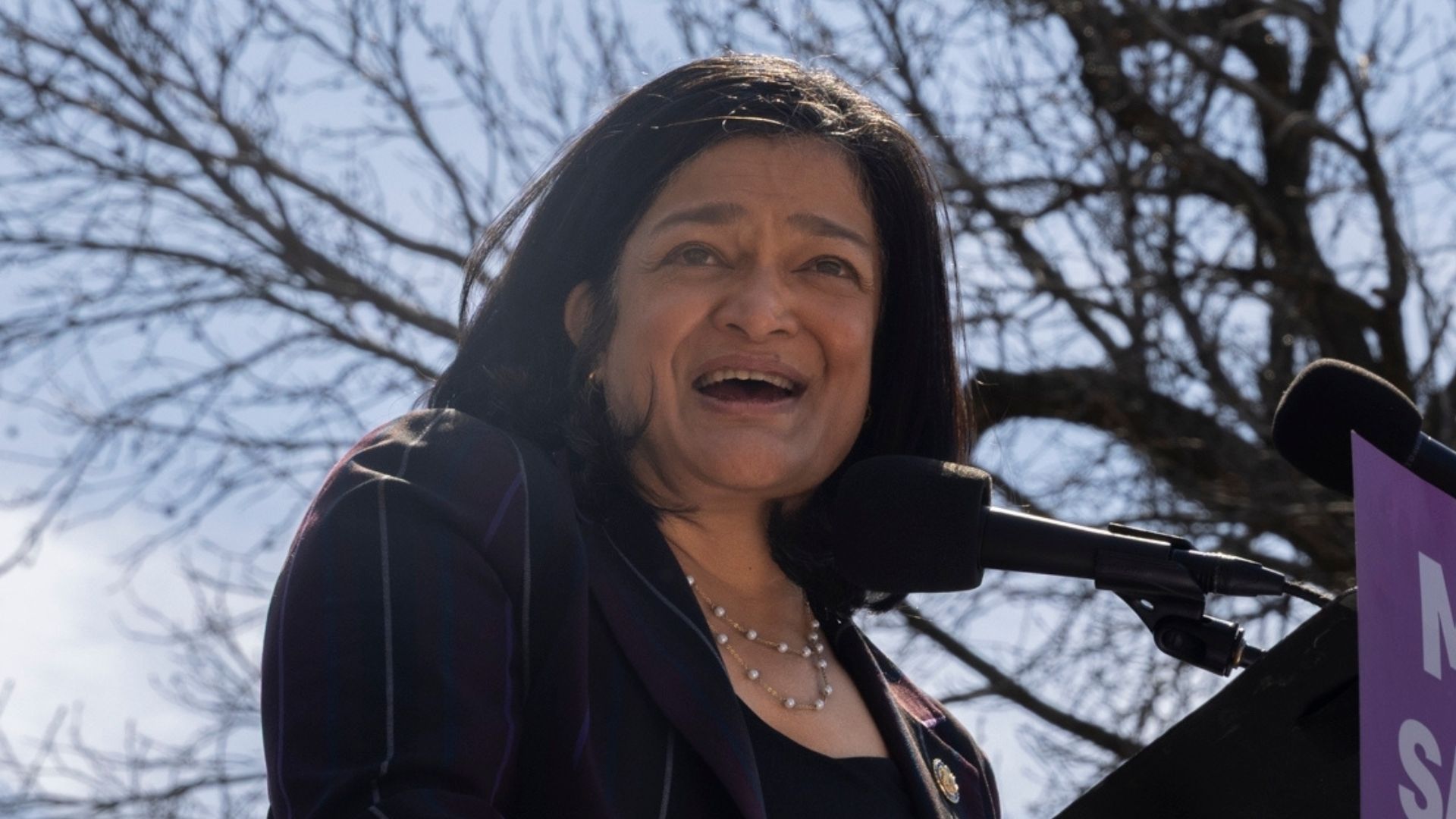
Commentator Michael Knowles criticized a recent statement by Democratic Rep. Pramila Jayapal of Washington after she claimed that immigrants from Somalia helped build the United States, arguing that the historical record does not support the assertion.
Knowles addressed Jayapal’s remarks while referencing a video clip in which the congresswoman discussed immigration and America’s development.
“Democrat Congresswoman Pramila Jayapal recently claimed that immigrants from Somalia built this country, the United States of America,” Knowles said.
Jayapal made the comment while speaking broadly about immigration and the role of newcomers in American history.
“Immigrants have built this country from all over the world, Somalia, India, wherever they’re from,” Jayapal said.
Knowles responded by outlining what he described as the foundational timeline of the United States and contrasting it with the historical presence of Somali immigrants in the country.
“It’s a strange claim, since the Americas were discovered by Christopher Columbus in 1492 settled by the Virginia Company at Jamestown in 1607 and settled in New England by the pilgrims on the Mayflower in 1620 founded as a cohesive nation through the revolutionary war between 1775 and 1783 and governed by the Constitution, which was ratified in 1788 all of which occurred between 132 and 428 years before the first documented Somali arrived in the 1920s,” Knowles said.
This Could Be the Most Important Video Gun Owners Watch All Year
According to Knowles, the earliest Somali arrivals in the United States were limited in number and scope.
“When Somalis did finally make it over here in the 20s, it was not by the millions or by the 1000s or even by the hundreds. It was by the dozens, handfuls of sailors so minuscule that they barely even appear in the historical record,” he said.
Knowles continued by describing subsequent decades, noting that Somali presence in the United States remained limited even as global and political conditions changed.
“In the 1950s as Somali territories moved toward independence, after decades of colonial government by the British, the French and the Italians, some Somali students attended American universities,” Knowles said. “Again, we’re talking about a vanishingly small number of Somalis visiting and studying in the United States.”
He added that major changes to U.S. immigration law did not immediately result in large-scale Somali immigration.
“Even after the Hart Celler act of 1965 radically transformed America’s immigration system, inaugurating the policy of mass migration that persists to this day. Somalis still barely came to the United States,” Knowles said.
Knowles cited political instability in Somalia and refugee policy changes as the turning point.
“In 1969 the Somali Republic collapsed after only nine years of existence, giving way to the Marxist, Leninist Somali democratic republic,” he said.
“Even then, only a minuscule number of Somalis made it to America by 1991 year before the collapse of the Somali democratic republic, fewer than 2100 Somali natives lived in the United States.”
He said the numbers increased significantly after civil war and changes in U.S. refugee policy.
“That all changed in 1991 when civil war and state failure sent hundreds of 1000s of Somalis fleeing the US had adopted a new policy welcoming political refugees in 1980,” Knowles said.
“So by 2011 nearly 100,000 Somalis had been welcomed into the United States as refugees.”
Knowles then argued that Somali immigrants did not play a role in America’s foundational achievements.
“What exactly did they build in America?” he asked.
“They didn’t sign the Declaration of Independence. They didn’t build our military, or found any universities, or make any of the discoveries or invent any of the inventions that made America a global superpower and gave us the American century. They weren’t even here when all that stuff happened.”
He acknowledged that Somali communities have established institutions in the U.S. since arriving in larger numbers in recent decades.
“When Somalis began arriving in the 1990s and 2000s they built mosques and Islamic centers and Quranic schools. They opened Halal shops and grocery stores that sent remittances back to Somalia,” Knowles said.
Knowles also referenced criminal cases tied to welfare fraud.
“Beyond these legal, or at least semi legal, businesses, a major source of remittances to Somalia has been the American taxpayer,” he said, adding that “the most impressive institution that Somalis have built in the United States is the kind of community group that perpetrated one of the most expansive cases of welfare fraud in American history.”
Citing reporting by Ryan Thorpe and Christopher Rufo at City Journal, Knowles said, “Somali criminals stole billions of dollars in taxpayer dollars during just a single gubernatorial administration in Minnesota alone.”
He further claimed that some of that money was diverted overseas.
“Much of that money went straight back to Somalia, with at least some of it ending up in the hands of the Islamic terrorist group al Shabaab,” Knowles said.
Knowles concluded by referencing economic data about Somalia.
“According to a 2024 report, remittances from abroad, and especially from the United States today, account for between 30 and 50% of the Somalian economy,” he said.
“In other words, Somalis didn’t build America,” Knowles added. “They’ve never really contributed anything to America, but they have managed to take, steal and transfer enough wealth from America that in as much as Somalia exists Today as a nation at all America built Somalia.”
WATCH:
Somalis, it turns out, did not build America. pic.twitter.com/2cv4XI7XSs
— Michael Knowles (@michaeljknowles) December 14, 2025





![Donald Trump Slams Chicago Leaders After Train Attack Leaves Woman Critically Burned [WATCH]](https://www.right2024.com/wp-content/uploads/2025/11/Trump-Torches-Powell-at-Investment-Forum-Presses-Scott-Bessent-to-350x250.jpg)


![CNN's Kaitlan Collins Fact-Checks Rep. Jasmine Crockett Over False Trump Ballroom Claim [WATCH]](https://www.right2024.com/wp-content/uploads/2025/10/1761954330_CNNs-Kaitlan-Collins-Fact-Checks-Rep-Jasmine-Crockett-Over-False-Trump-350x250.jpg)