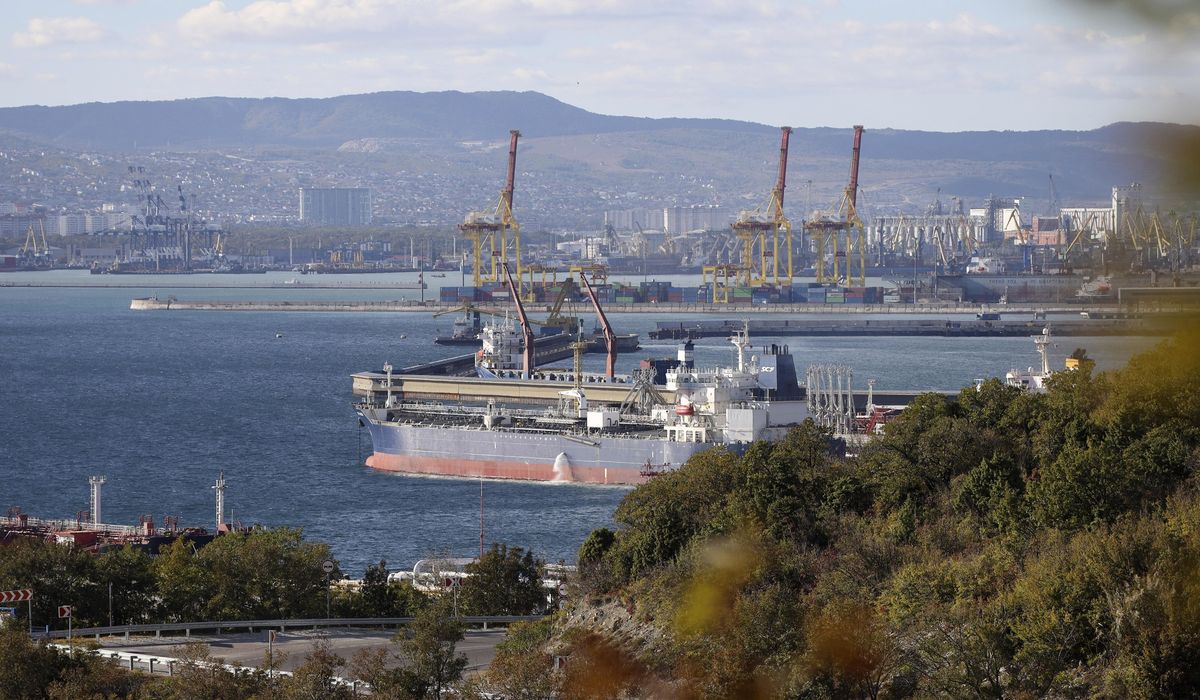

The sanctions against Russia for invading Ukraine could have hobbled Moscow’s war effort from the start had they been applied more strictly and with better cooperation from the West, according to a 2024 Nobel laureate from the Massachusetts Institute of Technology.
Simon Johnson, an economist at MIT’s Sloan School of Management, told a panel at the Brookings Institution that the West needed to learn the right lessons from the past four years and not the wrong ones.
The U.S. implemented sweeping sanctions against Russia immediately following its full-scale invasion of neighboring Ukraine in February 2022. The Biden administration targeted the country’s financial system, banned imports of Russian oil, gas, and coal, and froze financial assets of hundreds of oligarchs and political figures, including President Vladimir Putin.
But Moscow’s armored attack into Ukrainian territory continued, leading some to conclude that sanctions against Russia or other large countries aren’t effective.
“Sanctions can work, but only if they are enforced. And for enforcement to work, we need close cooperation within the [Group of Seven], and particularly between the U.S. and the [European Union],” Mr. Johnson said. “For enforcement to be entirely credible and effective, the West has to be willing to incur at least some potential costs, although clever policy design can reduce those costs.”
He also pushed back on the idea that sanctions are solely an incremental tool that could never be expected to alter the course of a war involving a large country like Russia. The West could have imposed a complete embargo on Russian oil in the days after the invasion. Such a move would have caused global oil prices to spike, potentially pushing countries like the U.S. into a recession. Russia, the world’s third-largest oil producer, would have fared much worse, Mr. Johnson noted.
“Russia would have gone into a deep financial crisis. Oil is by far Russia’s largest source of foreign exchange,” he said. “The Ruble would have collapsed, inflation would have soared, and Russia’s financial markets would have seized up. It’s very difficult to fight when your economy is imploding.”
Urban Ahlin, Sweden’s ambassador to the U.S., said the Kremlin is trying to construct a false narrative about the status of its war. Russia tells the West and its own people that its economy is strong, sanctions aren’t working, and that it is winning on the battlefield against Ukraine. While Russia has managed to take a few kilometers of Ukrainian territory over the past four years, the financial and personnel costs have been staggering, he said.
The Kremlin has also been on an unregulated borrowing spree to finance the war, leading some private banks to later seek a bailout from state-owned banks, Mr. Ahlin said.
“If there are any Americans longing to have a wonderful relationship with Russia and do lots of business, I can tell you this: Be cautious. There are lots of toxic assets in the banking sector in Russia,” he said. “So yes, the sanctions are working. The Ukrainians are winning the war, and the Russian economy is soon to tank.”
Russia is devoting between 7% and 8% of its GDP to the military, a larger percentage than the Soviet Union spent during the Cold War, said Jovita Neliupsiene, the European Union’s ambassador to the U.S. She noted that Russia’s war against its much-smaller neighbor has taken as long as the battle against the Nazis in World War II.
“That should be embarrassing. But let’s not fool ourselves, they can continue this war,” she said.
Ms. Neliupsiene said Russia can impose more drastic economic measures on its population than democratic countries, including spending so much money on the military.
“It [the Russian economy] can last for some time. But it’s not sustainable. It will actually tank at a certain point,” she said.
Senator Sheldon Whitehouse, Rhode Island Democrat, said there is bipartisan support for Ukraine on Capitol Hill. Senators Roger Wicker of Mississippi and James Risch of Idaho, the GOP chairmen of the Senate armed services and foreign affairs committees, remain committed to Kyiv’s sovereignty, he said.
“Ukraine actually is in a place, if properly supported, to gain a victory, and frankly, to gain an important victory,” Sen. Whitehouse said.
He warned that other nations, including potential adversaries, are keeping an eye on the outcome in Ukraine to gauge how much the West is willing to support smaller countries in peril.
“There’s a lesson here behind the immediate conflict, which is: Can you do well by invading peaceful neighbors?” Mr. Whitehouse said. “If you can do well by invading peaceful neighbors, don’t think that the Chinese won’t be watching.”



![Donald Trump Slams Chicago Leaders After Train Attack Leaves Woman Critically Burned [WATCH]](https://www.right2024.com/wp-content/uploads/2025/11/Trump-Torches-Powell-at-Investment-Forum-Presses-Scott-Bessent-to-350x250.jpg)

![Kamala Comes Unglued, Makes Bogus Claim About Her Landslide Loss to Trump [WATCH]](https://www.right2024.com/wp-content/uploads/2025/10/Kamala-Comes-Unglued-Makes-Bogus-Claim-About-Her-Landslide-Loss-350x250.jpg)