Dr Stephen Goss is a freelance historian, lectures in history and politics in London, and is a Conservative councillor in Reading.
Yesterday was Easter. Three days ago was therefore Good Friday.
This weekend is not only of religious significance, but of political as well. Easter 1916 saw Irish republicans launch a rebellion in Dublin. Despite being a failure, the Government’s heavy-handed response produced a new generation of martyrs for the ‘Irish cause’ and the Easter Rising has subsequently become the foundation myth of the Republic of Ireland.
Just over 80 years later a peace settlement was reached in Belfast, on Good Friday, which ended the Troubles. The hope and expectation was that this agreement would re-shape politics in Northern Ireland and bring it – gradually, eventually – in line with the constitutional politics practiced in the other jurisdictions of the British Isles (regardless of your preferred sovereignty).
The hope was that politics would cease to be existential. The Agreement aimed to replicate what most of Great Britain takes for granted: that political opponents are adversaries, not enemies; that losing an election does not threaten one’s identity or community. It has, in important respects, succeeded. The large-scale violence of the Troubles has ended. The everyday reality of life in Northern Ireland has been transformed. Yet the deeper process of normalisation remains incomplete. Politics is still structured around identity. Parties are aligned along communal lines.
Nearly three decades on, what is striking is not simply that Northern Ireland has effectively been frozen in aspic, but that England appears to be creeping towards the identity-driven politics the Agreement was designed to move beyond.
The risk for England is not that it will fall into Northern Ireland’s problems and divisions in any simple or direct way. Yet the underlying dynamic – the politicisation of identity, the emergence of parallel communities, the framing of politics as a struggle between them – is recognisable.
Consider first ‘Operation Raise the Colours’ and what provoked it.
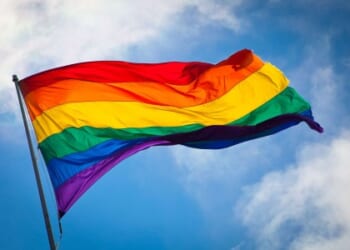
The campaign reflects a surge in visible, performative British identity – particularly in response to perceived cultural or constitutional threats. This echoes the symbolism of flags in Northern Ireland, where they mark territory, identity, and political allegiance. The 2012–13 Belfast City Hall flag protests, triggered by a decision to limit the number of days the Union flag was flown, resulted in rioting, the storming of the City Hall itself, and months of protests. To say nothing of an outburst of flying the national flag anywhere and everywhere in loyalist areas. What has emerging in parts of England is a similar politicisation of symbols: flags are increasingly used to delineate who belongs and who does not.
England is not Northern Ireland, but the emergence of communities that live alongside rather than with one another, is comparable. A report by the government last month admits that societal cohesion is now a problem. When communities become socially and spatially distinct, politics begins to organise around those divisions.
Electoral behaviour reflects that this is no longer an abstract concern but an observable pattern. The Gorton and Denton by-election provides a clear case. The Green Party victory, and the way their campaign was conducted, highlighted the constituency’s demographic realities. Engagement was highly localised and community-specific, with significant attention paid to issues – particularly foreign policy positions relating to Gaza – that resonated strongly with Muslim voters. The controversy surrounding Labour’s stance on the conflict in the Holy Land, and the backlash it has generated among Muslim communities, shaped both the tone and priorities of the campaign. This was not a traditional contest fought primarily on policy or national leadership, but one in which identity-linked concerns played a central role in mobilisation.
This is not an isolated example. In the 2024 Rochdale by-election, Labour was forced to withdraw support for its candidate following comments about Israel. Yet the dynamics of the contest were again heavily shaped by communal alignment. George Galloway’s victory was built explicitly on mobilising Muslim voters around Gaza, with campaign messaging framed in overtly communal terms. This mirrors the logic of electoral competition within unionism and nationalism. Parties do not primarily compete to win over a majority of voters, but to demonstrate that they are the most credible representatives of their own community. The rise of Sinn Féin at the expense of the SDLP, and the pressure on the DUP from harder-line unionist parties, reflects the same dynamic: mobilisation within a bloc, rather than persuasion beyond it.
Labour’s wider electoral strategy reflects an awareness of this reality.
The party has increasingly engaged with Muslim voters as a distinct and electorally significant bloc, particularly in urban constituencies such as Bradford West, Birmingham Ladywood, and Ilford South. Candidate selections, public statements, and policy emphases have, at times, been shaped by the need to maintain support within these communities. Again, engagement is not the issue – segmentation is. When parties begin to adjust their positions in response to the perceived preferences of specific groups (especially on issues that are not uniformly prioritised across the wider electorate) it reinforces the sense that politics is a negotiation between blocs rather than a shared civic process. In Northern Ireland, this is not a deviation from normal politics but its foundation. Parties are expected to speak for their community, and are judged on how effectively they defend it. Candidate selection, messaging, and policy emphasis are all shaped by this expectation. What appears in England as targeted outreach or electoral pragmatism resembles, in Northern Ireland, the settled logic of a system in which politics is conducted between communities rather than across them.
The controversy surrounding the public celebration of iftar in Trafalgar Square offers a further parallel. Objections to the event – framed variously around the use of public space or the perceived favouring of one community’s religious observance – echo long-standing disputes in Northern Ireland over the route and legitimacy of Orange Order parades.
In both cases, what is formally presented as a question of access or neutrality quickly acquires a deeper political charge. In Northern Ireland, marching through contested areas has historically been understood not simply as cultural expression but as an assertion of identity and territorial presence, often provoking similar complaints. The arguments that accompany such disputes: who has the right to occupy shared civic space, on what terms, and whether accommodation constitutes fairness or favouritism – are now becoming more familiar in England. The parallel is not exact, but the underlying dynamic is recognisable: public space becomes a stage on which competing identities are performed and contested, and what might otherwise be routine civic decisions take on a broader political significance.
Northern Ireland demonstrates what happens when identity becomes the primary organising principle of politics. Compromise becomes betrayal, opponents become enemies, and institutions are forced to manage division rather than bridge it. Nearly 30 years after the Agreement, Northern Ireland remains peaceful but not fully reconciled; a society where politics is still shaped by who you are, not just what you believe.
England is not there. But elements of that dynamic are becoming more visible: the politicisation of symbols, the emergence of parallel communities, the framing of cultural difference as political conflict, and the growing salience of identity in electoral politics.
Perhaps England too now needs to learn the lessons of the Peace Process and Agreement.
![Kamala Comes Unglued, Makes Bogus Claim About Her Landslide Loss to Trump [WATCH]](https://www.right2024.com/wp-content/uploads/2025/10/Kamala-Comes-Unglued-Makes-Bogus-Claim-About-Her-Landslide-Loss-350x250.jpg)