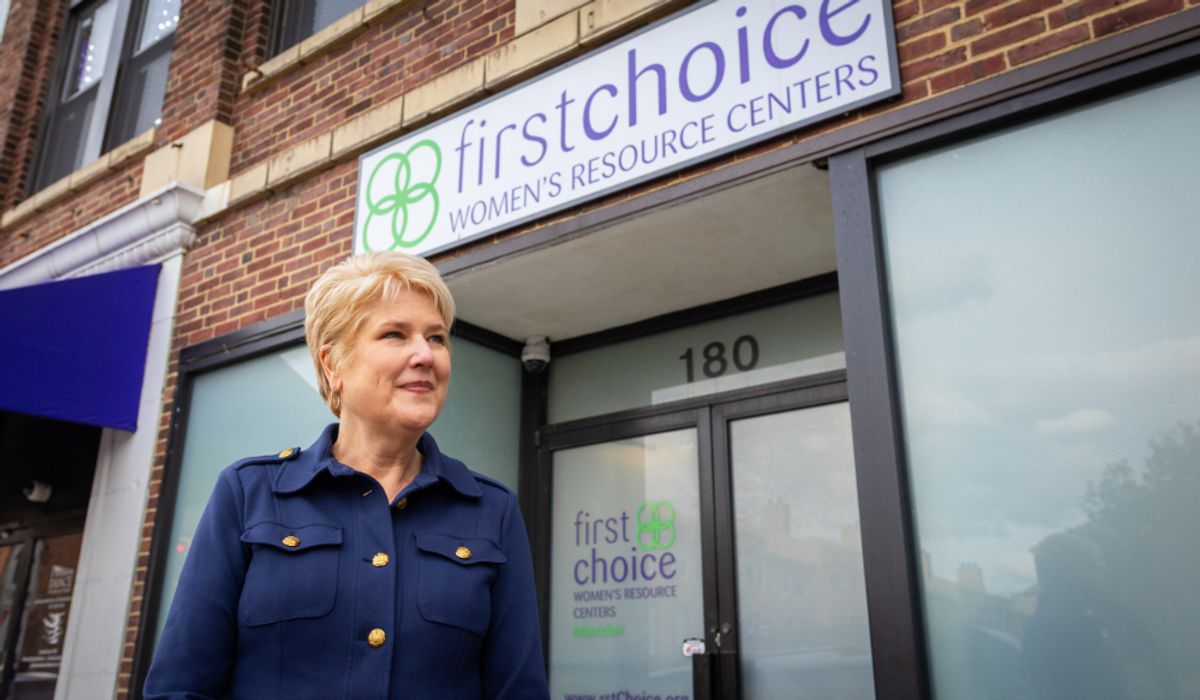
New Jersey has been hostile to pro-life pregnancy centers for years, but when the state slapped First Choice Women’s Resource Centers with a subpoena demanding the names of its donors, Aimee Huber decided it was time to fight.
Ms. Huber, executive director of the five-facility network, accused New Jersey Attorney General Matthew Platkin of violating the center’s First Amendment rights in a case scheduled for oral argument Tuesday before the U.S. Supreme Court.
“Since pregnancy centers like ours do not perform or refer for abortion, we are targets for a government that disagrees with our views,” said Ms. Huber on a recent press call. “If our attorney general can bully us, it can happen in other states that promote abortion.”
She added that “it’s our hope that our efforts will result in protection for pregnancy centers across the nation.”
Democrats have long accused pro-life pregnancy centers of deceiving clients by masquerading as abortion clinics, which the centers deny, but the pro-choice opposition surged after the Supreme Court’s June 2022 decision in Dobbs v. Jackson.
Mr. Platkin, a Democrat, issued a “consumer alert” about crisis pregnancy centers in December 2022, warning that they may “provide false or misleading information about abortion” and offering “tips on how to spot a CPC.”
In November 2023, he issued a subpoena seeking documents dating back 10 years on First Choice’s advertising, statements on abortion-pill reversals, and the identities of its donors, arguing that the clinics may be “misleading donors and potential clients” in violation of state law.
First Choice sued in federal court to block the subpoena, but the 3rd Circuit Court of Appeals ruled last year that the center’s case was not yet “ripe,” holding that the faith-based network must first adjudicate its claims in state court before bringing a federal challenge.
Mr. Platkin had no additional comment Monday on the case, but his office referred to his statement issued in June after the Supreme Court agreed to hear the matter.
“The question before the U.S. Supreme Court focuses on whether First Choice sued prematurely, not whether our subpoena was valid,” said Mr. Platkin in the statement. “I am optimistic that we will prevail when the Supreme Court considers that question.”
He added that “First Choice is looking for a special exception from the usual procedural rules as it tries to avoid complying with an entirely lawful state subpoena, something the U.S. Constitution does not permit it to do.”
The subpoena is not self-executing, meaning that it “can only be enforced by a New Jersey state court,” and so far the courts have declined the state’s enforcement requests, according to the state’s February opposition brief to the Supreme Court.
“The Third Circuit specifically considered Petitioner’s allegations and record evidence, along with the unique procedural posture, and held that Petitioner had not sufficiently presented any chill to its constitutional rights stemming from the subpoena,” said the brief.
Mr. Wilson countered that the case belongs in federal court, saying that “the heart of First Choice’s First Amendment challenge is its claims about its associational rights,” specifically donor privacy.
Erik Baptist, director of ADF’s Center for Life and Regulatory Practice, said the attorney general is “trying to force First Choice to litigate its case in state court,” even though federal courts have more experience with cases involving constitutional rights.
“This is especially egregious in New Jersey, where the governor appoints both the attorney general and state judges, giving him a structural home-court advantage,” said Mr. Baptist.
Anyone seeking to donate to First Choice via its website will have no doubt that it doesn’t perform abortions, he said, contrary to Mr. Platkin’s claims.
“His theory of deception is that these donors, when they’re going onto First Choice’s website and they see on the donations page pictures of happy smiling families with babies, might think they’re donating to an abortion clinic by mistake and accidentally give to First Choice instead,” said Mr. Wilson.
First Choice offers free medical services, including pregnancy tests and ultrasounds, as well as free material goods like diapers and baby clothes at its locations in Jersey City, Montclair, Morristown, Newark and New Brunswick.
The prospect of complying with the subpoena was “completely daunting” for the small nonprofit, which receives no government funding, said Ms. Huber.
Mr. Wilson framed the concerns about misled donors as an excuse to “harass and persecute First Choice for its protected speech and get donors to stop supporting it.”
“That’s something the Supreme Court has been concerned about for a long time,” he said.
Indeed, this isn’t the first time a Democrat attorney general has sought to gain access to the names of conservative donors.
In 2021, the Supreme Court rejected in a 6-3 decision a policy initiated by then-California Attorney General Kamala Harris to require nonprofits to disclose their donors, an effort challenged by the Americans for Prosperity Foundation and the Thomas More Society.
The high court noted that hundreds of nonprofit organizations on both the left and right filed briefs in support of the lawsuit, citing fears that the disclosure policy would chill donor support.




![Donald Trump Slams Chicago Leaders After Train Attack Leaves Woman Critically Burned [WATCH]](https://www.right2024.com/wp-content/uploads/2025/11/Trump-Torches-Powell-at-Investment-Forum-Presses-Scott-Bessent-to-350x250.jpg)


![James Carville Admits Democrats Had No Shutdown Endgame, Mishandled Strategy [WATCH]](https://www.right2024.com/wp-content/uploads/2025/11/1763070634_James-Carville-Admits-Democrats-Had-No-Shutdown-Endgame-Mishandled-Strategy-350x250.jpg)