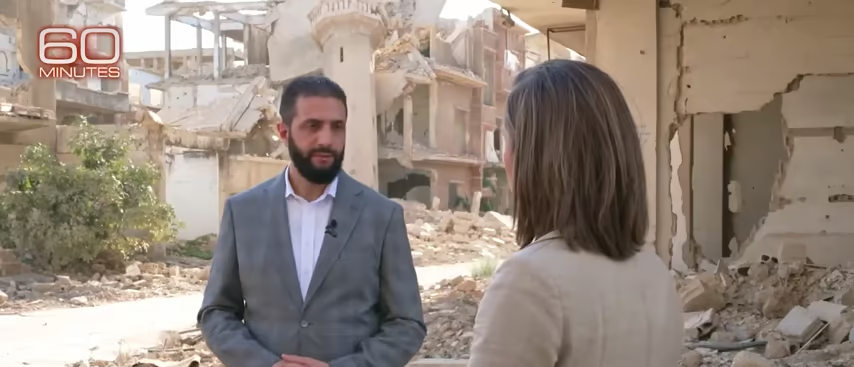
Syrian overtures to broker a detente with the United States and de-escalate with Israel have turned out to be hollow, thanks to Syria. Mere weeks ago, Syrian leader Ahmed Al-Sharaa stated in an interview that he hopes “that Syria is no longer looked at as a security threat” but instead “as a geopolitical ally” to the United States. But the plain fact is that Syria is what it always was: a force hostile to American and Israeli interests.
First, al-Sharaa is allowing Jamaa al-Islamiyya (JI) to operate in Syria. JI is an offshoot of the Muslim Brotherhood, and its armed wing (the al-Fajr Forces) has fought Israel since the 1980s from Lebanon. It had partnered with both Hamas and Hezbollah against the Jewish State, and operates along the Syria/Lebanon border. (RELATED: I am a Muslim: Reject the Muslim Brotherhood)
JI has recently built up its capabilities in Syria and was able to plant IEDs and start planning rocket attacks against Israel. After Israel arrested two of these terrorists in their beds, JI, in an apparent premeditated terrorist attack, wounded six IDF soldiers in a firefight before the IDF killed three of the terrorists. Two of the IDF soldiers were critically wounded, with one being saved by doctors after a bullet hit his heart.
Of note here is that, according to an Israeli report, members of Syrian intelligence helped orchestrate the terrorist attack, as well as attacks on the Druze in southern Syria. If true, this should be a game-changer for how Israel and the U.S. should approach Syria in the future. (RELATED: Syrian Bedouin and Druze Feuds Escalate to Regional Conflict)
This observation reiterates what is already well known: that Syria is harboring much more than just JI, and that these jihadi forces are very close to Israel’s border.
Another interesting detail is that a mere two days before the above terrorist attack, an Israeli reservist in the Golan Heights observed that “ISIS, al-Qaida, Hezbollah, Iranians and regime forces are here [in the Golan Heights].” This observation reiterates what is already well known: that Syria is harboring much more than just JI, and that these jihadi forces are very close to Israel’s border.
In fact, Israel’s Defense Minister, Israel Katz, has disclosed in a recent meeting with the Knesset Foreign Affairs and Defense Committee that the Houthis and other terrorist groups are operating in Syria, and that the Houthis are planning to invade Israel via the Golan Heights. (RELATED: Houthi Senior Officials Killed in Renewed Israeli Airstrikes)
This follows reporting in the Israeli press that another one of the Jewish State’s archenemies, the Palestinian Islamic Jihad (PIJ), is ramping up the presence of its military wing, the al-Quds Brigades, in Syria, especially in Palestinian refugee camps close to Damascus. This is notable as Syrian leader al-Sharaa has appointed a liaison with the PIJ, suggesting that the new regime has given the terrorist group legitimacy and safe harbor. The reporting indicated that the PIJ may be taking advantage of the current U.S. pressure prohibiting Israel from bombing Syria.
The PIJ was formed in 1981 as an offshoot of the Muslim Brotherhood. It receives support from both Iran and Hezbollah, and has partnered with Hamas at various times, including in executing the October 7 attack on Israel. The U.S. declared it a Foreign Terrorist Organization in 1997, and also designated its Secretary General, Ziyad al-Nakhalah, as a specially designated global terrorist in 2014. Others that have declared the PIJ as a terrorist organization include: Australia, Canada, the EU, Israel, New Zealand, and the UK. PIJ’s first leader was assassinated by the Mossad in 1995 in Malta.
The increased activity of JI, the Houthis, the PIJ, and others put into question the Syrian regime’s willingness to vanquish terrorism from within its borders. According to one analysis, 22 of Al-Sharaa’s senior commanders are jihadists. While a senior Trump administration official has recently confirmed that Syria will be in a coalition to defeat the Islamic State, it should be noted that Al-Sharaa’s previous group, Al-Nusra, broke with the Islamic State over finances, not ideology. With all the other jihadist groups operating in Syria, does Syria’s promise to partner with the U.S. against the Islamic State actually mean anything? (RELATED: Syria’s New Leader Will Bring Jihad Not Peace)
Meanwhile, Israel continues to defend its historical claims and strategic interests in the Golan Heights. Since December 2024, the IDF has remained in nine locations inside the part of the Golan Heights previously held by Syria, including Mt. Hermon.
On Israel’s continued presence in southern Syria, Israeli Prime Minister Benjamin Netanyahu stated, “We attach immense importance to our capability here, both defensive and offensive,” while a senior Israeli official stated a comprehensive deal with Syria is “not in the cards right now.”
The lack of a diplomatic breakthrough is Syria’s fault. Israel is currently willing to withdraw from southern Syria only in exchange for a full peace deal, something al-Sharaa is not willing to give. Unless and until Syria is willing to sign a full peace with Israel and truly sever all ties with terrorist groups, Israel should continue to hold the line in the territories it took from Syria since December 2024, including the highly strategic Mt. Hermon. Unless and until real and durable change occurs in Syria, Israel and the U.S. should view Syria as a hostile force in the region.
READ MORE from Steve Postal:
‘Mamdani the Hater’ Slanders Jews and Judaism
Will Trump Get Saudi Arabia to Join the Abraham Accords?
Kazakhstan Joins the Abraham Accords. Will Others in Central Asia Follow?





![Donald Trump Slams Chicago Leaders After Train Attack Leaves Woman Critically Burned [WATCH]](https://www.right2024.com/wp-content/uploads/2025/11/Trump-Torches-Powell-at-Investment-Forum-Presses-Scott-Bessent-to-350x250.jpg)