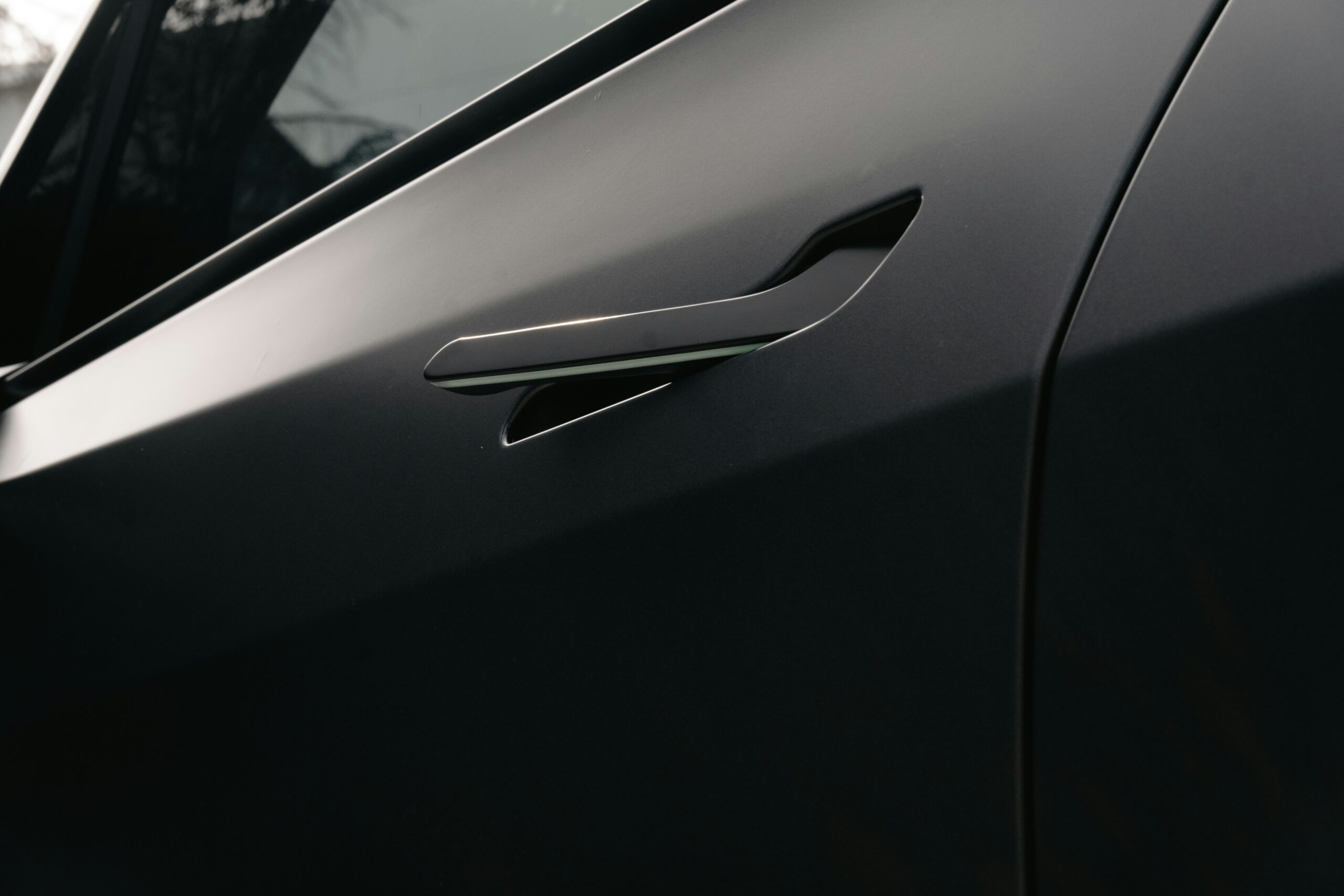
It used to be that you had to lock yourself out of your vehicle, as in locking the doors and then forgetting where you left the keys (or losing them). Today, the car locks you out and sometimes, even if you have the key — the transmitter fob, that is — you still can’t get back in.
Because the flush-mounted door pulls and electrically operated door locks won’t work.
A young mother in California found out how it works. Or rather, sometimes doesn’t.
Her Cadillac Lyriq EV, which has the flush-mounted, electrically extending (and retracting) door pulls that Teslas have and which several other vehicle manufacturers, including GM, have copied, locked her out while her infant daughter was still inside. For the next half-hour, she tried everything shy of breaking the glass to get the device to open up. Luckily, no one dies — this time.
Flush-mounted door pulls and electrically controlled locks are a feature that’s not unlike the gullwing doors that DeLoreans had back in the ‘80s, in that both seemed “cool” and “futuristic” relative to old-fashioned-seeming outward-opening doors and fixed door pulls.
But as “futuristic” and “cool” as they may look, both brought new problems along for the ride. The gullwing doors were difficult to open and close manually once you were in the car, and electric actuation made the process much more complex and thus more failure-prone. The same problem besets these flush-mounted door pulls. They rely on complex actuators that are dependent upon electrical signals and — most importantly — upon electricity.
When the California woman’s device — her EV — developed a fault with its electrical system (apparently, the battery), the doors could not be unlocked, even though she had managed to get the door pulls to extend. This was potentially more than an inconvenience because she had left her baby inside the device. Luckily for the baby, it wasn’t summer yet. If it had been, the baby might have died.
She did end up having to pay the dealer $1,000 to fix the glitch. Imagine that. As opposed to paying a guy with a slim jim $50 to pop the lock.
One of the interesting things about this event is that OnStar could not help. You have probably heard about OnStar being able to unlock a vehicle so equipped remotely, a very helpful thing if you can’t get into your vehicle because you lost the keys. But OnStar was unable to help in the case of this device because the remote-unlocking feature is dependent upon electricity. If the vehicle’s electrical system is dead or faulty, there’s nothing OnStar (or similar, OnStar-emulating “concierge” services) can do.
Angela Chao, the now-deceased sister-in-law of The Dirty Old Turtle (Senate Majority Leader Mitch McConnell), found out all about it in her final moments, which were experienced in a slowly submerging Tesla she’d inadvertently backed into a pond after having a bit too much to drink, according to news reports of her accidental death. Once the Tesla hit the water, its electrically-actuated door pulls/locking mechanism fritzed out and — though they tried — people who came to her aid were unable to get the doors open before the car went all the way under, taking Chao with it.
You may also have read about the college kids who died in a Tesla Cybertruck — not because they got killed in the crash, but because they could not be pulled out of the Tesla after it crashed. The flush-mounted door pulls gave would-be rescuers nothing to grab hold of, and even if they had managed to grab hold of them, the electric locking mechanism kept the doors locked.
Tesla — and GM — do provide an emergency manual release, but the problem is that the driver of the vehicle who is locked inside has to know where it is and also how to operate it, with perhaps seconds to figure it out before it’s too late. Similarly, the person on the outside frantically trying to get inside must be aware of the location of the release mechanism and be able to operate it in time.
These problems are compounded by an additional problem. That being the laminated side glass Teslas and some other “emulator” vehicles have, which is very difficult to break in an emergency, as for example when the vehicle is rapidly submerging in a pond, or a baby is cooking inside the device.
So why is it allowed by the same government that says it is keeping us “safe” by preventing us from being able to legally disable defective airbags? Well, several reasons why. The first is the arbitrariness of the government. It decides — and decrees — that air bags are “safe” and that we must not only have them but must not ever disable them (even when they are admitted to be defective by the government) and also decides to do nothing about innately dangerous flush-mounted door pulls/electrically activated door locks as well as innately fire-prone devices and “self driving” devices that regularly drive into things. The second is a kind of elaboration of the first. The government is incompetent. More finely, it is run by incompetents. Arrogant ones (the two qualities often come together as one).
This gets us to the real problem, which is the foolishness of people who rely upon the government to keep them “safe.” This attitude cancels out what would otherwise be self-preservative due diligence. Instead of just assuming things like flush-mounted/electrically dependent door pulls and locks are “safe” — because the assumption is they would not be legally available if they weren’t — people would, absent government, be obliged to check into it themselves.
It would be on them, in other words, if something happened.
Of course it still is — in the sense that if you’re dead or your kid is because you assumed the government was keeping you (and your kid) “safe,” it’s on you.
Maybe it’s better not to so assume.
READ MORE from Eric Peters:








![James Carville Admits Democrats Had No Shutdown Endgame, Mishandled Strategy [WATCH]](https://www.right2024.com/wp-content/uploads/2025/11/1763070634_James-Carville-Admits-Democrats-Had-No-Shutdown-Endgame-Mishandled-Strategy-350x250.jpg)