BANGKOK, Thailand — Thailand authorities have seized more than $300 million from two Bangkok banks in a new crackdown on international criminals accused of laundering money from online scam centers in neighboring Cambodia and Myanmar, but the top suspects are still at large.
“The individuals involved are all scammers. Three or four who have been arrested are major players,” Thai Prime Minister Anutin Charnvirakul announced on Wednesday after a nationwide investigation.
“The seized or frozen assets amount to more than 10 billion baht ($312.5 million),” Mr. Anutin said without naming the arrested people. According to the released statement, suspects have been charged with “conspiracy, running a criminal association, public fraud, and money laundering.”
More than a dozen top suspects are still at large, including Yim Leak, the chairman of BIC Group, a major financial network in Cambodia. Mr. Leak is accused of “bringing criminal proceeds into Thailand for money laundering or business investment.”
Cash was allegedly laundered through fake “mule accounts” before reaching two of Thailand’s biggest banks.
The funds seized in the investigation were from Mr. Leak’s accounts at Bangkok Bank and Kasikorn Bank, the Bangkok Post reported Thursday.
Police have arrested 29 of 42 accused conspirators in the investigation.
The arrests and seizures come two weeks after financial investigator Tom Wright warned that Thailand was being used by scammers as a money laundering hub.
“If you allow that kind of stuff to happen and flow into your country, buy your politicians and buy your companies, illegally and secretively … then the sovereignty of your country is in question, right?” Mr. Wright said during a news conference at the Foreign Correspondents’ Club of Thailand on Nov. 19.
In Cambodia, for example, “to launder huge amounts of money, they put bags of cash on private jets that get flown from Phnom Penh into Thailand,” Mr. Wright said.
Mr. Leak and his wife allegedly helped move money for Benjamin Mauerberger, alias Ben Smith, Thai authorities said Wednesday.
“Both individuals had companies in Thailand registered at the same address and engaged in cross-shareholding between their wives, particularly in real estate and private aviation businesses — business types frequently used to disguise illegal money trails,” the police summary said.
Mr. Wright, a former Wall Street Journal reporter whose “Whale Hunting” website examines financial scandals worldwide, is investigating Mr. Mauerberger, who hobnobs with Cambodian, Thai and other political leaders and investors.
“For weeks, we’ve been reporting on how South African money launderer Benjamin Mauerberger sits at the center of a sprawling Chinese-Cambodian criminal scam network,” Mr. Wright said Wednesday.
“We’ve shown how Mauerberger laundered hundreds of millions of dollars, paying huge bribes to Thai politicians and bureaucrats, undermining the country’s democracy, and fueling one of the world’s fastest-growing crimes … Now, Prime Minister Anutin Charnvirakul’s government has seized $300 million in assets, including yachts, luxury cars, and Thai equities. In a statement today, [Thai] police put Mauerberger squarely at the center of a criminal network, the first time Thailand’s government has acknowledged this,” Mr. Wright posted on his site.
Mr. Mauerberger is a “super connected” South African with several passports, including a “diplomatic passport” from Cambodia. “He is believed to be in Dubai at the moment,” after being based in Thailand for more than 20 years, Mr. Wright said.
’Immense impact of Southeast Asian scam centers’
“Among the most serious falsehoods are claims that I am involved in Cambodian money laundering, call-center scams, and human trafficking,” Mr. Mauerberger said in October.
“I have never had and will never have, any connection to such activities,” Mr. Mauerberger said.
The mostly Chinese-dominated scam operations are accused of exploiting more than 120,000 workers from dozens of countries who staff the call centers found in Myanmar and Cambodia, according to international human rights groups and investigators.
Many scam workers were kidnapped and tortured into fooling people online, while others eagerly chose to work for scammers in exchange for relatively high salaries, investigators said.
Scammers operate heavily guarded, multistory buildings that house “phone farms” where they run “sha zhu pan” scams — “pig butchering” — on a mass scale.
The Chinese slang describes fattening victims — including unsuspecting, often lonely Americans and other Westerners — with flattery and lies on Tinder, TikTok and social media platforms while using ChatGPT, malware, deepfake forgeries, and technological tricks to appear trustworthy.
Victims are lured by get-rich-quick schemes involving Bitcoin, real estate or other faux investments. Others are cooed into falling in love with a sweet-talking stranger who slowly shifts the relationship into draining their assets through deceit or sextortion.
Foreign governments advise travelers to be leery of accepting legitimate-sounding job offers in Thailand, because of the danger of being kidnapped and smuggled into Myanmar or Cambodia.
Dead bodies, bombed buildings and destroyed StarLink telecommunications are the latest visible elements of Southeast Asia’s worsening crypto and romance scams, squeezing billions from victims in the U.S. and around the world.
“A U.S. government estimate reported that Americans lost at least $10 billion in 2024 to Southeast Asia-based scam operations, a 66 percent increase over the prior year,” the U.S. Treasury Department’s Office of Foreign Assets Control said on Nov. 12.
OFAC warned against “the immense impact of Southeast Asian scam centers on Americans.”
The U.S. Secret Service’s Global Investigative Operations Center and Homeland Security’s Financial Crimes Task Force are also grappling with the cases.
Pressure on Thailand to act against scammers increased after at least two Thais recently died in Poipet, a Cambodian border town infamous for alleged illegal scam centers.
Their bodies displayed bruises possibly from torture after they were unable to scam enough victims, investigators said.
In November, South Korean and Cambodian security officials arrested 17 Koreans working in Cambodian scam centers after a South Korean university student was allegedly tricked to work as a scammer in Cambodia and tortured to death in August, The Washington Times reported on Friday from Seoul.
China sentenced five extradited Chinese-Myanmar men to death on Nov. 4, including billionaires Bai Suocheng and his son Bai Yingcang, for homicide, fraud and other crimes committed while operating scam centers, casinos and brothels for several years in Myanmar’s Kokang region near the border with southern China.
Elsewhere, Myanmar’s military has been using drones during the past two months to bomb KK Park, an infamous 500-acre scam complex. KK Park is one of several scam centers in Myanmar along the Moei River, which forms the border with Thailand across from Mae Sot city.
During clashes on Wednesday, Myanmar’s military reportedly occupied KK Park while battling minority ethnic Karen National Union guerrillas who have been fighting since World War II for an independent or autonomous homeland.
Explosions ripped through the sprawling complex, which included housing, shops and prostitutes to reward successful scammers.
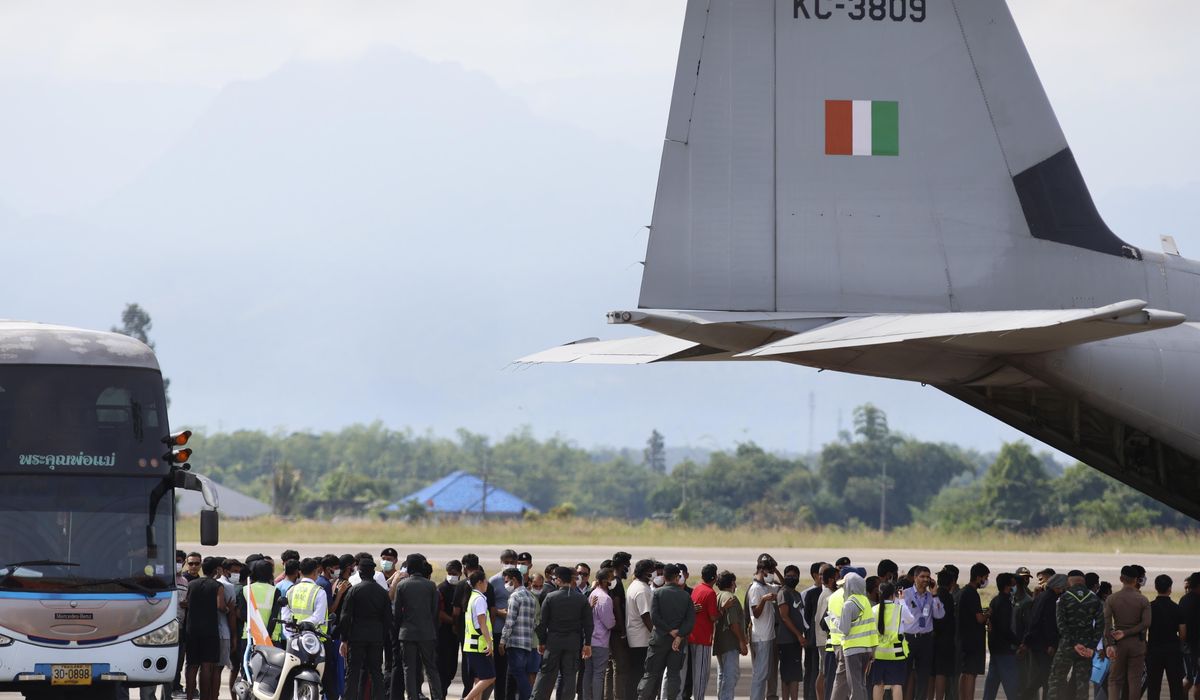
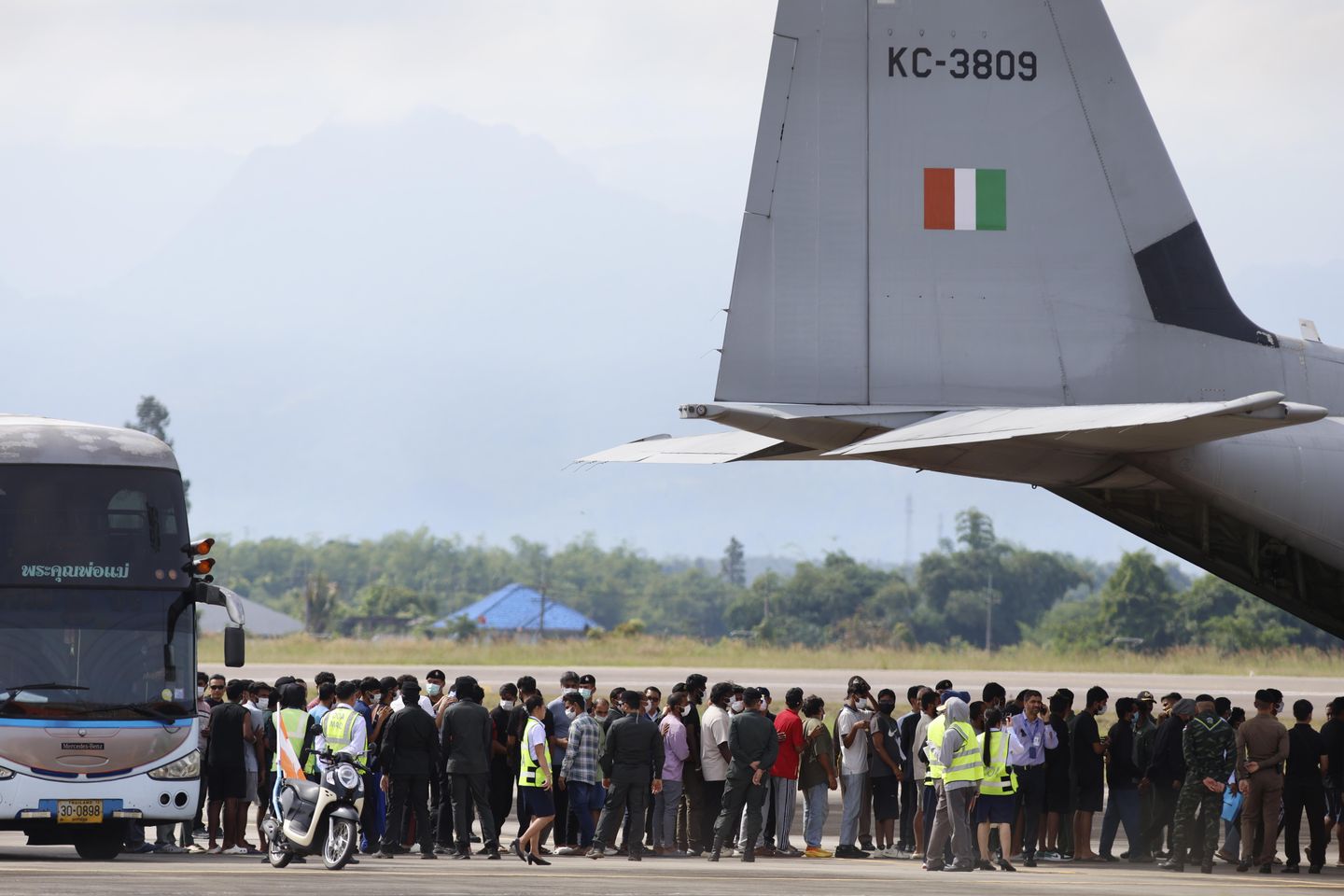
In November, more than 1,500 Indians, Chinese, Pakistanis, Vietnamese, Ethiopians, Kenyans, Filipinos, Ugandans, Nepalis, a South Sudanese, an Egyptian, a Kazakhstani, a Burundian, and a Rwandan, plus others, fled across the Moei River into Thailand to escape the bombardments.
Elon Musk’s Starlink satellite network “disabled over 2,500 Starlink Kits in the vicinity of [Myanmar’s] suspected scam centers,” said SpaceX Vice-President Lauren Dreyer, after Starlink’s internet equipment appeared on KK Park’s rooftops.
The U.S. Justice Department meanwhile unsealed an indictment in federal court in New York City in October “charging Cambodian national Chen Zhi, also known as Vincent, 37, the founder and chairman of Prince Holding Group (PCG) — Prince Group — a multinational business conglomerate based in Cambodia, with wire fraud conspiracy and money laundering conspiracy for directing Prince Group’s operation of forced-labor scam compounds across Cambodia.”
The Justice Department said, “Individuals, held against their will in the compounds, engaged in cryptocurrency investment fraud schemes known as ’pig butchering’ scams that stole billions of dollars from victims in the United States and around the world.”
The FBI, New York’s Eastern District Attorney’s Office and the Justice Department’s National Security Division seized $15 billion in Bitcoin from China-born Chen Zhi’s alleged fraud profits.
On Oct. 26, PHG’s then-Chief Communications Officer Gabriel Tan said, “PHG categorically rejects all claims that it is involved in human trafficking, online scamming, the slave trade, money laundering or any other criminal enterprises.”





![Donald Trump Slams Chicago Leaders After Train Attack Leaves Woman Critically Burned [WATCH]](https://www.right2024.com/wp-content/uploads/2025/11/Trump-Torches-Powell-at-Investment-Forum-Presses-Scott-Bessent-to-350x250.jpg)