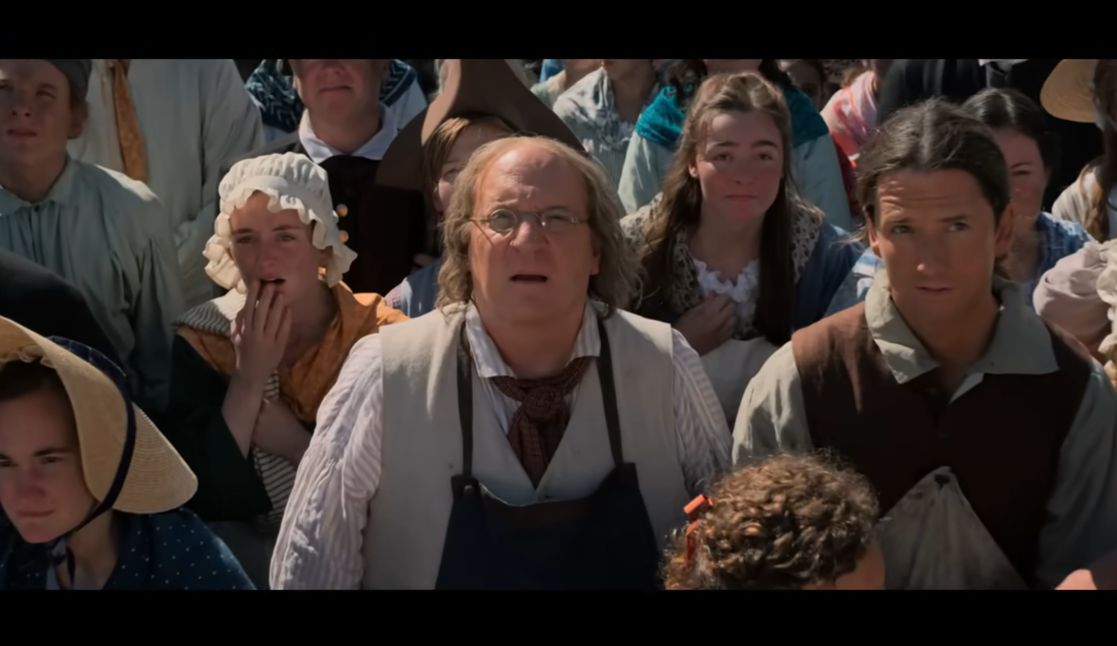
The new film A Great Awakening explores the remarkable collaboration between George Whitefield and Benjamin Franklin. The men were remarkably different. Though both came from humble homes, Whitefield was an Englishman, educated at Oxford and ordained as an Anglican minister, whereas Franklin grew up in a humble home and left school at age 10 and then made his way up on his own to become a polymath inventor, a successful businessman and writer, and a politician.
More importantly, Franklin left behind the Puritan pieties of his father in favor of the kind of Deism popular in the Age of Enlightenment. As the practical component to round out the otherwise abstract and intellectual nature of that theology, Franklin stressed the cultivation of practical virtues and a sound sense of personal and civic duty. He put his inventiveness, industriousness, and practical sagacity to use for the common good, whether through life-bettering inventions like bifocals, the Franklin stove, and the lightning rod, or through such civic projects as the founding of the University of Pennsylvania, helping to draft the Declaration of Independence, and the one who argued through the Great Compromise that resulted in the framing of the Constitution.
Whitefield’s trajectory went in the opposite direction. His own background was not so pious, but he grew into a deep and gripping faith that made him a driver of the transformative Christian revival movement known as the Great Awakening. He was known for his ringing voice and lucid delivery, sustained soulful energy and emotion, which moved many people to commit to his emotionally immediate kind of religiosity, which demanded the immediacy of a new spiritual birth.
In the film, Franklin retrospectively sees in Whitefield a driving force behind American independence. Though Franklin continued to resist the Calvinist doctrine of preordination that underlay Whitefield’s preaching, he embraced the democratized version of the church that Whitefield practiced. For Whitefield, the whole country, if not the whole world, was his parish, and he crisscrossed all of the colonies, preaching wherever he could. Franklin could see the practical accomplishment of Whitefield’s immense drive and saw its commitment to breaking down all the barriers between man and God as something that would break down the barriers of tyranny as the struggle for independence began.
That “providential agency” is nowhere more evident than in religion and civil aims aligning themselves to create the First Amendment.
Franklin found himself increasingly in tune with Whitefield’s emphasis on bringing his message across lines of class and race. Franklin released the slave labor he had employed, and before long made abolition his cause, which he would unsuccessfully try to see through to law in the First Congress.
But Franklin, while admiring Whitefield’s faith, did not allow his rationality to be steamrolled. In a powerful scene in the movie, he balked when Whitefield turned his power on Franklin directly, seeking to convert him to his way of seeing God. As Franklin resisted, Whitefield became more and more direct and provocatively personal. Franklin responded in kind, pointing out where Whitefield had compromised himself morally — in order save a Georgia orphanage he had founded, Whitefield used cheap slave labor to balance the books. Whitefield in a howl confessed his sin, telling Franklin that his own failings were irrelevant. But he got no conversion, no surrender. He would not get one before he died.
But Franklin was changed. The movie shows how in his old age, at the foundering Constitutional Convention, Franklin delivered a powerful speech that recommended that each day the Convention should entreat God for help. It was shortly after that suggestion was adopted that the convention found its bearings.
In his prayer, he affirms on his own terms that God is providential and governs the affairs of humankind. He proposes acknowledgement of that as necessary to transcending the differences that were overwhelming the sense of common purpose. In Franklin’s words:
I have lived, Sir, a long time; and the longer I live, the more convincing Proofs I see of this Truth, That GOD governs in the Affairs of Men! And if a Sparrow cannot fall to the Ground without his Notice, is it probable that an Empire can rise without his Aid? We have been assured, Sir, in the Sacred Writings, that “except the Lord build the House, they labor in vain that build it.” I firmly believe this; and I also believe that without his concurring Aid, we shall succeed in this political Building no better than the Builders of Babel.
This excellent film helps us answer the question: Should religion drive politics or should politics drive religion?
Surely someone who changes religion to gain political advantage should be viewed skeptically. Religion is about ultimate truth and highest values, among other things. Gaining political power at the expense of truth or value smells rotten.
Religion driving politics is something else. First the good: Religious scruples will constrain the quest for power. Being accountable to one’s religion, one is in some way self-governing and so constrained from turning to serve power itself, which is inevitably disastrous.
But there is also the bad. When one religion is empowered politically, it has often used that empowerment to disadvantage those who do not share the ruling religion. Ask a Christian convert in Pakistan if he or she is happy that the government there is religious. Or ask a Jew or Muslim in Torquemada’s Spain. There is a well-trodden path to what Voltaire called L’infame that the Founders of America were variously resolved not to tread.
The Founders embraced the workable remedy for this political malaise — freedom of religion. The government can constrain itself from coercing religious conformity, thus evading infamy. But does this not land us right back where we were before? For without the inner restraints that religion moves people to accept, they are once more unconstrained in pursuit of power, except for the outer coercive constraint of secular law.
But what if religion itself points to freedom? What if religious sources themselves teach that the government must not coerce religious uniformity, only a civil code?
Whitefield practiced this in his own religious life. He was a fierce critic of established “old light” religion, whether the Church in England or the old-style worship in America, as both fell short of the immediacy and spontaneity that he demanded. His religiosity was inherently free, Franklin saw, except in that aspect that came to light when he tried to browbeat Franklin emotionally.
But Franklin in the end saw that Whitfield had been brutally honest with himself as well as with Franklin. And that moved Franklin to come to see God as the mover of human affairs to whom prayer was indispensable, not only personally, but to the affairs of the nation.
This is not a faith that can be coerced; and those that must be coerced admit by that their inadequacy as a divine instrument.
This is another thread in the golden skein taken up by the 16th century forbears of modern Western politics, those such as Grotius, Selden, and Harrington who saw that the freedom of worship was already established in the Noahide Code taught by the rabbis of the Talmud. In this code, only seven fundamental laws can be understood as mandated by divine law, and each nation is sanctioned only to govern its civic affairs. leaving religion to the people.
It is not surprising in the light of this mindset of the Founders and Framers, affirming freedom as a religious imperative, that we find George Washington quoting the words of the sexton of Newport’s Jewish congregation to affirm to America’s Jews that:
The Government of the United States, which gives to bigotry no sanction, to persecution no assistance requires only that they who live under its protection should demean themselves as good citizens.
Washington was not known for piety any more than Franklin. But, as Franklin did in his speech to the Constitutional Convention, Washington affirmed that in America’s beginning, divine Providence was evident in human affairs.
This, too, Washington confirmed in a letter to another American Jewish congregation in Savannah:
May the same wonder-working Deity, who long since delivering the Hebrews from their Egyptian Oppressors planted them in the promised land — whose providential agency has lately been conspicuous in establishing these United States as an independent nation — still continue to water them with the dews of Heaven and to make the inhabitants of every denomination participate in the temporal and spiritual blessings of that people whose God is [the Lord].
That “providential agency” is nowhere more evident than in religion and civil aims aligning themselves to create the First Amendment and a national culture that abhors religious hatred. This is a crucial part of America’s true greatness. Those who peddle religious hatred of the oldest sort belie that greatness and deny the great providential awakening that Franklin gave voice to in proclaiming “GOD governs in the Affairs of Men!”
READ MORE from Shmuel Klatzkin:
All That Is Gold Does Not Glitter
Tolkien and the Power of Fantasy
Sacred Limits and Free Institutions




![Two Dead, 14 Injured After Gunfire Erupts Following College Football Game in Alabama [WATCH]](https://www.right2024.com/wp-content/uploads/2025/10/Two-Dead-14-Injured-After-Gunfire-Erupts-Following-College-Football-350x250.jpg)