
There was a time, not long ago, when Republicans and Democrats breathed the same civic air. They fought like brothers in the backseat — elbows out, constant sniping — but still shared a similar path. They could argue tax brackets all morning, then agree by lunch that criminals should be jailed, children should be taught to read, and men shouldn’t be competing in women’s track.
They shared the same basic vocabulary. Patriotism wasn’t a slur, police weren’t the enemy, and teachers weren’t social engineers. A job was a means to self-reliance, not a lifestyle accessory. Welfare was a safety net, not a hammock.
That era is gone, buried without ceremony.
The divide now runs deeper than ballots. It’s moral, behavioral, and biological. One side builds; the other dismantles. One sharpens the blade of restraint; the other waves the blunt instrument of indulgence. One trains for life’s rigors; the other turns every obstacle into an “awareness campaign.”
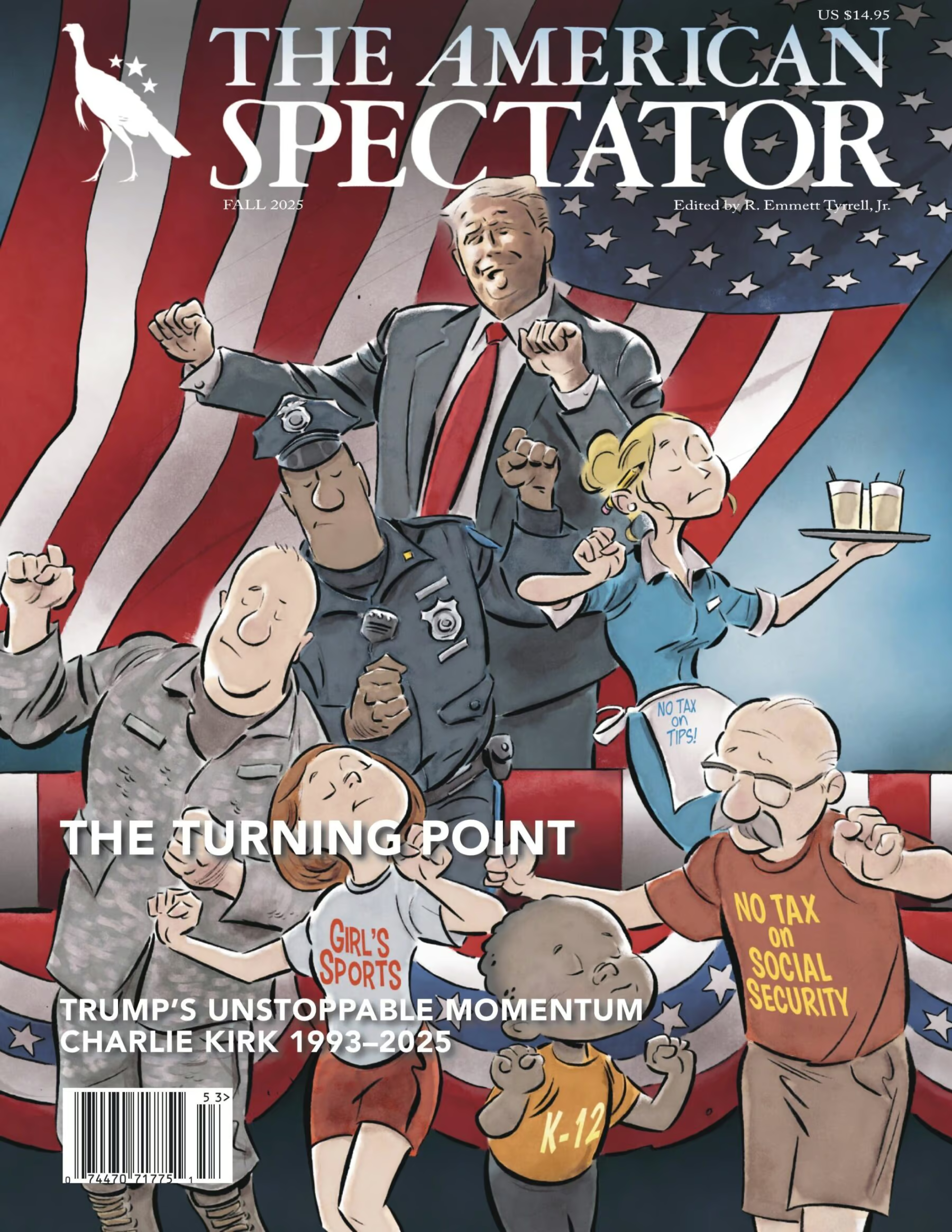
Subscribe to The American Spectator to receive our latest print magazine.
Some might see this as policy drift. They’re wrong. This is a fracture over reality itself. The argument is no longer over which solution works, but whether the problem exists at all. It’s not a dispute over how truth should be applied, but whether truth can even survive its passage through the filters of ideology, emotion, and outright delusion. Facts are bent until they snap, and feeling steps in to claim the empty space. What used to be settled — crime is bad, borders matter, men and women are different — is now treated as controversial, even dangerous.
You see it in boardrooms where diversity chiefs leave with cardboard boxes after years of overseeing slide decks and policies that weakened the nation rather than strengthening it. In classrooms where students tackle Cicero, Euclid, and Shakespeare instead of writing diary entries about their “gender journey.” In churches where young people kneel for communion, reciting prayers older than their great-grandparents, instead of sprawling in beanbags for “sharing circles” about their feelings.
Conservatives are pouring concrete into the footings — standards, order, continuity. At the same time, liberals are draping fairy lights over crumbling beams, hoping no one notices the roof is caving in.
This isn’t just red versus blue. It’s order versus disorder, duty versus decay.
Our ancestors knew it: Freedom without order is chaos with better branding. Excellence without discipline doesn’t exist. The therapeutic culture promised transformation through self-expression. The disciplinary culture delivers it through self-mastery. One produces a parade of feelings. The other produces a functioning society.
Dismantling DEI Dogma
This is the year when corporate America’s diversity apparatus melted like frost at noon. Chief diversity officers, six-figure sermonizers of “unconscious bias,” found themselves unconsciously unemployed. Campuses across the nation hacked through DEI bureaucracies with guillotine efficiency.
Ohio State University didn’t tinker. Instead, it erased every DEI office in one decree. The University of Florida followed suit. The University of North Carolina cut entire diversity divisions, sending vice provosts back to the job market. Fortune 500s quietly scrubbed rainbow pledges from their websites like teenagers deleting incriminating texts before handing over their phones. Even Nike and Google, temples of corporate virtue-signaling, stopped funding the kinds of internal “inclusion councils” that had become permanent fixtures of the HR floor plan.
Conservatives kept asking for proof, not platitudes. Progressives answered with panels, pamphlets, and pageantry about microaggressions. When the cuts came, the apocalypse didn’t. Universities didn’t combust. Companies didn’t crumble. What they got was something rare: employees working, deadlines met, meetings cut, and memos shrinking to a single page. Progressives built temples to feelings — fragile, frivolous, and futile. Conservatives built systems that stand, and they will continue to stand long after the tide of trend and sentiment recedes.
Religious Revival
Gen Z was billed as the most secular in history. Yet, rather astonishingly, they’re filling Catholic pews like concert crowds pressing the stage. Conversions in some dioceses have spiked 70 percent in a year, driven largely by young men. Therapy couches are traded for confessionals. “Manifestation” journals are replaced by missals.
The Church offers what “wellness culture” never will — an immovable anchor in a sea of chaos and moral drift. Wellness culture sells mood boards, morning routines, and self-affirmations that dissolve the moment real suffering arrives. Catholic and historic Protestant traditions plant a stake in the ground and say, “Here is the Truth — tested by centuries, defended by martyrs, and sealed in blood.” They speak with the authority of Augustine, Aquinas, Luther, and Calvin — voices that shaped law, language, and liberty itself. Liberal culture whispers, “Your truth is valid.” The Church answers, “Truth is not yours to edit.” In an age where everything is negotiable — identity, morality, even biology — the nonnegotiable becomes magnetic, especially to a generation raised on shifting ground.
It’s not incense and Latin for its own sake; it’s the counterweight to a culture of spiritual fast food. Whether it’s young Catholics kneeling on stone, fasting before Communion, and memorizing creeds that don’t change with the algorithm, or young Protestants immersing themselves in Scripture, confessing sin, and singing hymns written centuries before they were born, the pattern is the same: a return to what is fixed, not fashionable. They’re not escaping reality; they’re mastering it, using discipline as the lever that lifts them beyond it.
The Crime Lab of Ideology
Few arenas expose the divide between Left and Right more starkly than criminal justice. Progressives treated armed robbery as a symptom. They claimed it resulted from anything other than individual choice, be it poverty, inequality, or bad childhoods. Conservatives treated it as what it is: a crime, with a victim and a perpetrator.
You no doubt remember the disastrous policy experiments of the Biden years. Police budgets shrank, leaving fewer officers on patrol. “Restorative justice” replaced prosecution, swapping prison terms for circles of dialogue and “healing exercises.” The results weren’t subtle. Crime rose like floodwater. Meanwhile, jurisdictions that gave criminals swift, predictable consequences saw rates fall, sometimes dramatically.
Even progressive voters snapped. San Francisco dumped its “compassionate” prosecutor after sidewalks turned into obstacle courses of addicts, shattered glass, and human waste. New York’s mayor, elected on promises of reform, ended up hiring more cops, not more “violence interrupters.”
Conservatives hold to a truth progressives dodge: Understanding a cause doesn’t erase accountability. Poverty, addiction, and trauma are fundamental factors, yes. But a reason is not an alibi, and empathy without enforcement is just permission.
Across the country, more Americans are rediscovering the ancient luxury of walking down the street without losing a wallet, a watch, or a sense of safety. They can linger at a café without a lookout. They can let their kids ride bikes without running a risk assessment. They can walk home at night without an instinctive glance over the shoulder every few steps. They’re rediscovering what a civilized society feels like — streets that belong to the public, not to predators. And the truth is that it looks good, it feels better, and it’s exactly what most people thought they were paying taxes for in the first place.
Reality Bites Back
Nothing vindicated conservative discipline more than the slow, awkward collapse of “gender-blind” sports. For years, progressives assured us that biological sex didn’t matter. Speed, strength, and bone density were just social constructs. The public was encouraged to get used to seeing podiums filled with athletes who looked suspiciously like the men they were told not to call men.
Now, however, even the governing bodies are beginning to abandon the fantasy. Locker rooms are separated again, not just because of a much-needed moral awakening, but also because lawsuits and awkward news footage had piled up too high. Scholarships now go to actual women, not to men in drag. Biological and broader reality have been restored.
The Discipline Difference
Discipline pays compound interest. Every enforced standard raises the next. Every boundary honored strengthens the whole. Every consequence delivered sharpens the appetite for achievement.
Permissiveness compounds too — downward. Each excuse weakens the foundation. Each lowered bar breeds mediocrity. Each evaded reckoning makes the eventual crash harder and louder.
The conservative renewal is coming from Washington, but it’s also being chosen — parent by parent, school by school, company by company.
While the undisciplined debate emotions, the disciplined are shaping the world. While the unfocused form committees, the focused form character. While the indulgent chase comfort, the committed build competence.
This isn’t just red versus blue. It’s order versus disorder, duty versus decay — heaven or hell, depending on the road you take. Those who choose discipline will define and direct the future. Those who choose avoidance won’t just inherit the rubble. They’ll be doomed to dwell in it.
Subscribe to The American Spectator to receive our fall 2025 print magazine.



![Donald Trump Slams Chicago Leaders After Train Attack Leaves Woman Critically Burned [WATCH]](https://www.right2024.com/wp-content/uploads/2025/11/Trump-Torches-Powell-at-Investment-Forum-Presses-Scott-Bessent-to-350x250.jpg)