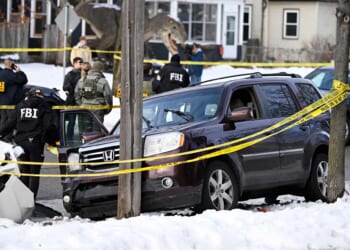
The FBI is reportedly investigating a shooting at Old Dominion as an act of terrorism. The shooter was Mohamed Bailor Jalloh, who died after being subdued by ROTC students, according to news reports. Jalloh, a former member of the Army National Guard, was previously prosecuted for attempting to support ISIS in 2016. He reportedly shouted “Allahu Akbar” before opening fire.
The FBI is also investigating an attack on a synagogue in West Bloomfield, Michigan, as a terrorist attack. Ayman Mohamad Ghazali, a naturalized U.S. citizen from Lebanon, drove his truck into the synagogue and exchanged gunfire with a security guard, according to NBC News. The attacker was killed. Meanwhile, in New York City, two terror suspects, Emir Balat and Ibrahim Kayumi, are charged with trying to use improvised explosive devices in what is being called an “ISIS-inspired attack.” And a gunman in Austin, Texas, Ndiaga Diagne, wearing a shirt with the words “Property of Allah” and a T-shirt with an Iranian flag design, killed three and injured 13 in what the FBI believes was an attack related to the war against Iran.
Chief Justice Rehnquist concluded that during wars and crises, the laws are not silent, but they do speak with a different voice.
Every war has its domestic side — and it’s never pretty. The United States, during its undeclared war with France in 1798, passed the Alien and Sedition Acts, which authorized the president to detain and expel enemy aliens. During the War of 1812, the Madison administration interned some British citizens and exiled others. During the Civil War, President Abraham Lincoln took a series of measures against Confederate sympathizers and opponents of the Union of dubious constitutionality. In World War I, the Wilson administration arrested more than 8,000 “enemy aliens” (mostly German) and interned more than 2,300.
During the Second World War, President Franklin Roosevelt issued proclamations which declared that Japanese, German, and Italian aliens in the U.S. “shall be liable to be apprehended, restrained, secured and removed as alien enemies.” FDR followed that up by issuing Executive Order 9066, which resulted in the internment of more than 100,000 people of Japanese ancestry in the United States.
During the Vietnam War, the war’s domestic opponents were surveilled and, in some cases, infiltrated by the Johnson and Nixon administrations. After the terrorist attacks of September 11, 2001, Congress passed the Patriot Act, which gave the president broad powers to surveil and detain enemy aliens, including the use of military tribunals to prosecute enemy combatants.
Nations that go to war almost always take extraordinary steps to improve domestic security, and, as noted above, that has often involved surveillance and internment of suspected enemy aliens. Many years ago, Supreme Court Chief Justice William Rehnquist wrote a book titled All the Laws But One, in which he reviewed the history of American law during wartime and foreign crises. Chief Justice Rehnquist concluded that during wars and crises, the laws are not silent, but they do speak with a different voice. They speak with a different voice because the nation’s security is at risk during wars and crises, and commanders-in-chief are afforded much broader latitude to protect the American citizens than during ordinary times.
It is too soon to tell whether the recent terrorist attacks are directly related to our war against Iran. The mullahs governing Iran are the leading state sponsors of terrorism in the world. Our armed forces have, in a relatively short time, significantly degraded Iran’s military capabilities, so asymmetric warfare may be Iran’s best option. Bruce Hoffman, a counterterrorism expert at the Council on Foreign Relations, notes that federal, state, and local authorities are on heightened alert for war-related terror attacks on American soil.
President Trump recently told reporters that President Joe Biden’s open border policy likely increased the terrorism threat within the United States, and said that his administration is watching potential Iranian “sleeper cells” within our country. The president also confirmed that the FBI has warned law enforcement in California of the possibility of Iranian drone attacks launched from ships.
During wartime, all American presidents have determined that their first duty is to protect the American people from attacks by the enemy. This has led some presidents to take extraordinary measures to protect the safety and security of American citizens during wars and crises. It was our third president, Thomas Jefferson, who once wrote: “A strict observance of the written laws is doubtless one of the highest virtues of a good citizen, but it is not the highest. The laws of necessity, of self-preservation, of saving our country when in danger, are of higher obligation. To lose our country by a scrupulous adherence to written law would be to lose the law itself, with life, liberty, property and all those who are enjoying them with us; thus absurdly sacrificing the end to the means.”
READ MORE from Francis P. Sempa:


![Donald Trump Slams Chicago Leaders After Train Attack Leaves Woman Critically Burned [WATCH]](https://www.right2024.com/wp-content/uploads/2025/11/Trump-Torches-Powell-at-Investment-Forum-Presses-Scott-Bessent-to-350x250.jpg)

![James Carville Admits Democrats Had No Shutdown Endgame, Mishandled Strategy [WATCH]](https://www.right2024.com/wp-content/uploads/2025/11/1763070634_James-Carville-Admits-Democrats-Had-No-Shutdown-Endgame-Mishandled-Strategy-350x250.jpg)