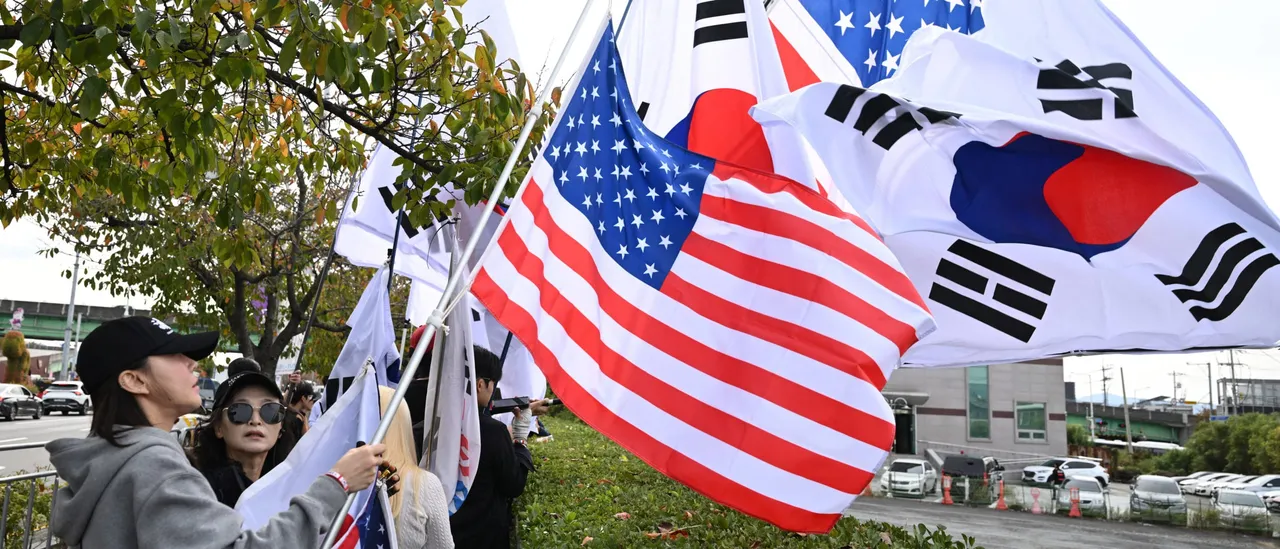
This content was produced via a partnership with KCPAC. The views and opinions expressed in this commentary are those of the authors and do not reflect the official position of the Daily Caller.
Missing Guardrails in South Korea
During President Donald Trump’s first term, I served as Ambassador at Large for the U.S. State Department’s Office of Global Criminal Justice. The very existence of my position is a testament to the goodness and greatness of the United States of America. In 1970s, my family gratefully immigrated from South Korea to America, where the rule of law stands as the guardian of democracy and the provides the foundations for a constitutional republic. As ambassador, I was involved in the indictment, sanctioning, capture and/or conviction of mass atrocity criminals in places such as Sri Lanka, Rwanda, the Balkans and Lebanon.
Without the rule of law, even well-designed systems risk collapse into disorder and authoritarianism. As I write, South Korea faces an unprecedented convergence of internal and external threats to its democracy, including alleged election manipulation, judicial pressure and foreign influence from North Korea and the Chinese Communist Party.
This article describes the current risks to the rule of law, national sovereignty and civil liberties, and emphasizes the crucial role of unified, nonviolent resistance in safeguarding democratic institutions. Drawing on historical precedent and my personal observation, I argue that sustained civic engagement, strategic action and the courage of judges, officials and the actions of South Korean citizens are essential to restoring freedom and accountability. Ultimately, the preservation of democracy in South Korea is both a national imperative and will be a beacon for the rest of the world. (RELATED: Why South Korea’s Election Integrity Should Matter To America)
For several months now, I have been warning that South Korea, which has long been regarded as a model of democratic development in Asia, now faces a deepening crisis that threatens its constitutional integrity and the will of its people. In short, South Korea as we know it is about to be lost.
I speak with the confidence of experience with international legal matters during my period as Ambassador-at-Large for Global Criminal Justice from 2019-2021. To use a simple analogy, the rule of law acts like guardrails on a mountain road: essential constraints that prevent a society from plunging into chaos. Without those guardrails, disasters happen — people fall, get injured, even killed. In a democracy, those guardrails are laws that protect the people’s democratic rights through free and fair elections. When such protections are eroded, democratic systems begin to fail. The rule of law is not merely a concept — it is the structure that allows democracy to function and flourish.
Election Fraud: June 3rd 2025 Presidential Election
As leader of an international election monitoring team, we found indications of possible computerized manipulation, falsified ballots and coordinated interference during recent elections, including the recent presidential election in South Korea, held on June 3rd 2025. Our team produced reports now available at www.election-fraud.com documenting alleged irregularities.
When I was in South Korea covering the June election, I invited South Korea’s National Election Commission (NEC) and the Association of World Election Bodies (AWEB) to publicly debate these issues during our investigation. We asked them to bring their best evidence and reasoning; we would bring ours. But no one responded. And since then, no one has refuted our findings. This absence of transparent engagement from these national bodies undermined my confidence in South Korea’s democratic process and raises serious questions about institutional accountability. (RELATED: The Red Shadow Destroying South Korea)
But there were other events that caused me great alarm. I became concerned over the treatment of individuals protesting these alleged election irregularities. In one instance, a video appeared to show police throwing down a demonstrator protesting electoral fraud in front of a moving vehicle outside the National Election Commission. Supporters said he was seriously injured. This appeared to symbolize how truth and justice were being thrown to the ground. It seems those who stand for democracy are attacked instead of being heard.
In another case, Lee Jin-sook, the former chair of the Korean Communications Council, was arrested and on being detained she is reported to have raised her handcuffed wrists and declared: “This is war!”
To me this was a deeply symbolic moment — a war on democracy, a war on the rule of law and a war against justice.
Geopolitical Concerns and Foreign Interference
It is important to see Korea’s democratic crisis within a broader geopolitical struggle. The Chinese Communist Party (CCP) advocates an aggressive doctrine of “unrestricted warfare,” whereby China has deployed multiple forms of nonmilitary aggression — including cyber operations and institutional infiltration — to influence and destabilize democratic societies.
I have witnessed these tactics of “marching through institutions” for decades, working to reshape media, education and government structures in ways that favor communization. South Korea is rapidly approaching a tipping point caused by this systematic degradation of democracy. I believe that we should urgently consider the current position.
“The question now is whether a free and fair democracy that upholds the rule of law will prevail — or whether a communist-aligned dictatorship will take hold.”
These threatening developments carry direct implications for the U.S.–Republic of Korea (ROK) Mutual Defense Treaty. Under Article 3 of this treaty, both nations are bound to coordinate in response to attacks (potentially including cyberattacks) on the other. If evidence of foreign-directed election interference is substantiated, it could represent not only an internal constitutional crisis but also a breach of mutual defense commitments. The use of cyber tools and electronic manipulation by external actors constitutes an attack on democracy itself. This is not only a Korean issue — it is a full-scale attack on the whole democratic world. On Dec. 1, 2025, President Trump rightfully highlighted another commentator calling out election fraud allegations in over a 100 countries. The post specifically named South Korea, where the Association of World Election Bodies has previously involved itself in election management globally with USAID support. (RELATED: A Holy War Declared: The Grave Threat To South Korea’s Constitutional Liberty)
Human Rights Violations
This first part concludes with a very significant travesty of justice for all of us. If we look beyond institutions and treaties, it is even more important that we count the human cost of authoritarian expansion. There are alleged cases of South Koreans being linked to Chinese organ harvesting. These cases need to be chased down thoroughly and transparently and the alleged perpetrators brought to justice. We should not turn a blind eye to these accusations in any shape or form. It is a possible metastasis of the widespread practice of organ harvesting through murder prevalent inside of China.
In the second article, I further explore the dire direction of South Korea, but also how it can be reversed.





![Donald Trump Slams Chicago Leaders After Train Attack Leaves Woman Critically Burned [WATCH]](https://www.right2024.com/wp-content/uploads/2025/11/Trump-Torches-Powell-at-Investment-Forum-Presses-Scott-Bessent-to-350x250.jpg)



![James Carville Admits Democrats Had No Shutdown Endgame, Mishandled Strategy [WATCH]](https://www.right2024.com/wp-content/uploads/2025/11/1763070634_James-Carville-Admits-Democrats-Had-No-Shutdown-Endgame-Mishandled-Strategy-350x250.jpg)