In 1951, Yale University professor Hajo Holborn wrote a book — as it turns out, an autopsy — titled The Political Collapse of Europe. It is a collapse that Europe has yet to overcome, and there is no sign that it will ever do so in the foreseeable future. President Trump is the first U.S. president since 1945 that has meaningfully attempted to force Europe to overcome its 20th century political collapse. The prospects for a European political recovery, however, are not great. Holborn’s book, it turns out, was both descriptive and prophetic.
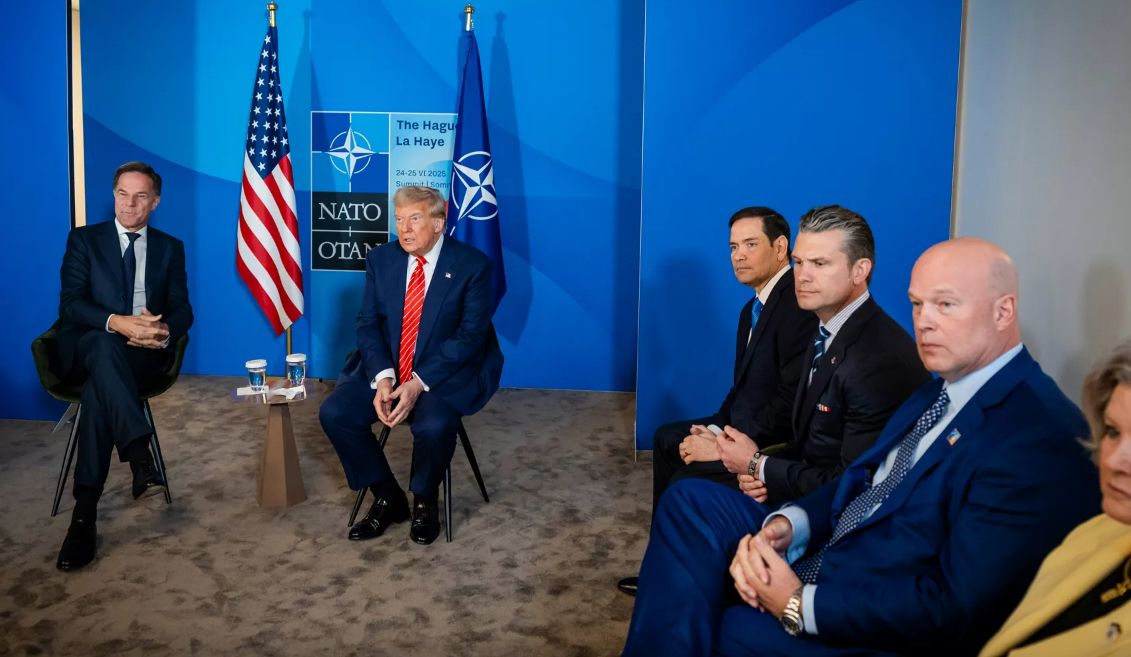
President Trump is trying to resurrect certain aspects of the old European political order that would enable the European nations to provide for their own defense.
The “collapse” Holborn wrote about was the collapse of the European “political order,” which began during the First World War and culminated in the Second World War. The result of those two global wars moved Europe from the center of world affairs to their periphery. Eighty years later, even after the collapse of the Soviet Union in 1991, Europe remains at the world’s geopolitical periphery. In fact, with the rise of China and India, Europe has never been less important in world affairs than it is today. Europe was a prize — perhaps the most important prize — during the Cold War between the United States and the Soviet Union. Today, the struggle for control of the Indo-Pacific dominates global politics. If Russia hadn’t invaded Ukraine, Europe would have largely vanished from the world’s headlines.
Europe’s major countries’ leaders and their Atlanticist supporters in the United States will not accept Europe’s lessened geopolitical importance in the 21st century, which is why NATO not only survived the end of the Cold War but also expanded its geographical reach. Russia’s aggression against Ukraine revived Europe’s geopolitical significance in the minds of Europe’s leaders and the Atlanticists in the U.S., who equate Russia’s threat today with the Soviet threat during the Cold War. But the threat is not the same — not by a long shot.
Europe today has the economic and demographic capacities to defend itself against Russia, but it lacks the will to do so. For eighty years, Europe has hired-out its defense to the United States, which, for the most part, willingly accepted its role as the primary defender of Western Europe. During the Cold War, especially in its early years — when Holborn wrote The Political Collapse of Europe — this, arguably, was a geopolitical necessity for the United States. It is not a geopolitical necessity today.
President Trump is trying — against substantial bureaucratic and Atlanticist resistance — to transform America’s European protectorates into allies. He is trying to do the same thing in the Middle East and to a lesser extent in Asia. Trump’s policies in this regard are to some extent reminiscent of the Nixon Doctrine, which helped to provide the wherewithal for our allies in the Middle East and Asia to defend themselves against potential aggressors.
Nixon during the early 1970s was responding to the endless and unpopular war in Southeast Asia and conflicts in the Middle East, just as Trump is responding to the endless and unpopular wars in Iraq and Afghanistan. Nixon, however, still had a Cold War to wage against the Soviet Union, which is why he refrained from applying the doctrine to Europe, engineered the opening to China, and forged détente with the Soviet Union. Trump is waging a Cold War against China, which is why he is attempting to get out of the protectorate business in Europe and the Middle East, improve relations with Russia, while seeking to avoid a kinetic war with China.
Holborn, to be sure, was an Atlanticist who insisted that Europe needed the protection of the United States to survive against potential Soviet aggression. But that was in 1951. Seventy-four years later, with the Soviet threat gone and a Europe fully capable of defending itself against Russia, the geopolitical situation has changed. Russia cannot even conquer Ukraine, let alone all of Western Europe. The United States has greater interests to protect in the Indo-Pacific than in Europe and should expend its limited resources accordingly.
Holborn in The Political Collapse of Europe pronounced the pre-1914 European political system “dead and beyond resurrection.” President Trump is trying to resurrect certain aspects of the old European political order that would enable the European nations to provide for their own defense. For America’s sake, as well as for Europe’s sake, let’s hope he succeeds.
READ MORE from Francis P. Sempa:
No Tears for the End of the American Empire
Sam Tanenhaus Puts Most Liberals to Shame
Please Don’t Bring Back the Neocons
![Scott Bessent Explains The Big Picture Everyone is Missing During the Shutdown [WATCH]](https://www.right2024.com/wp-content/uploads/2025/11/Scott-Bessent-Explains-The-Big-Picture-Everyone-is-Missing-During-350x250.jpg)