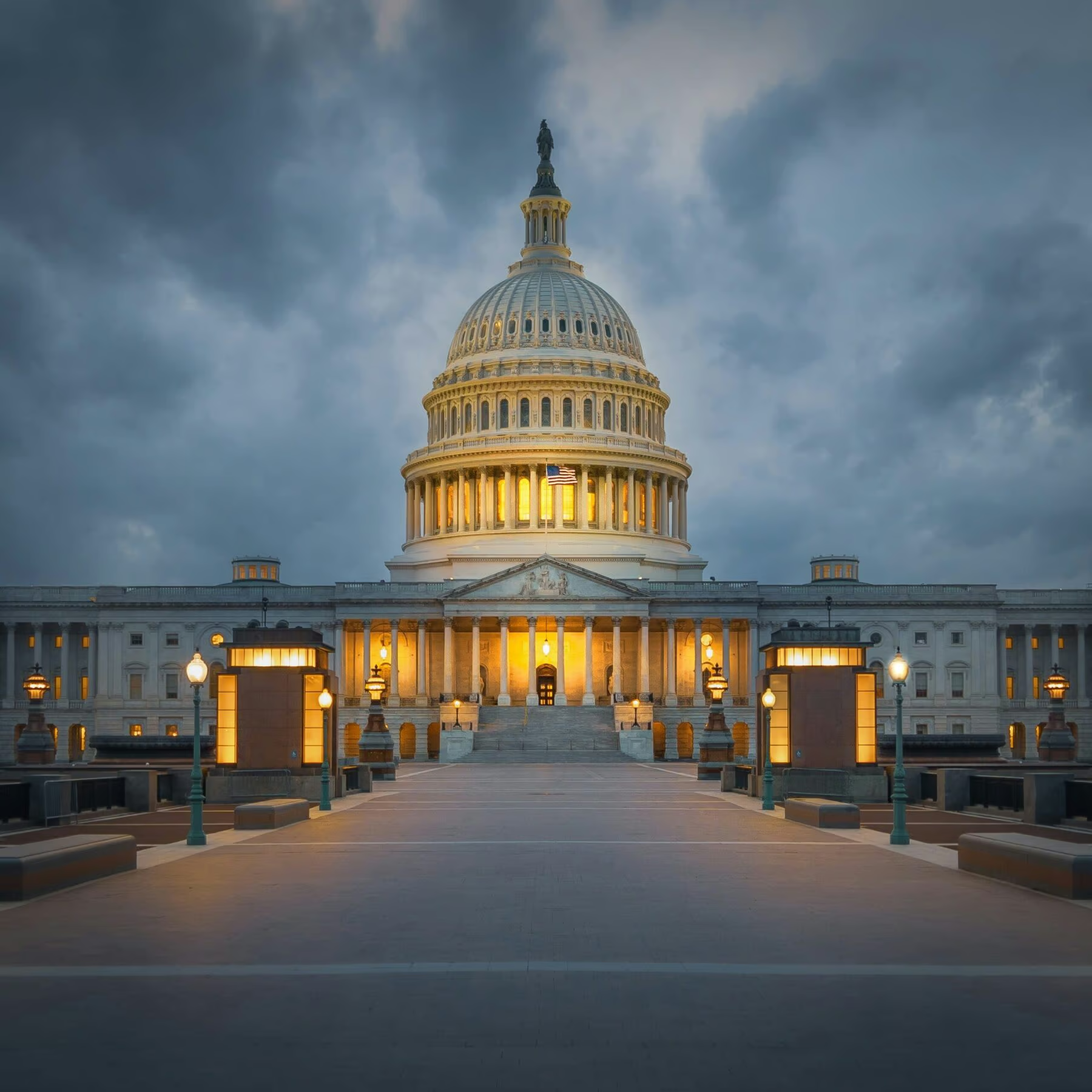
Conservative demands to abolish the filibuster, like earlier lamentations over the continued existence of the pesky debt limit, strongly indicate that, yes, we do indeed live in bizarro times and alternative-dimension America.
The drive to stop legislation and shrink government that animated previous generations of conservatives not merely disinterests the current crop but stands athwart their designs. (RELATED: Trump’s Right: Nuke the Filibuster)
David Catron, my American Spectator colleague, urges Republicans to jettison the filibuster before Democrats do it when they inevitably gain power. (RELATED: The Filibuster Must Be Euthanized Now)
“If the Republicans in the Senate squander this opportunity to keep an obsolete relic of the 18th century like the filibuster on life support,” he writes, “they deserve to be consigned to a lengthy sojourn in the political wilderness.”
Intact families, hard money, and the 10th Amendment rank among the many “obsolete relics” that deserve a comeback rather than consignment to the political wilderness.
Intact families, hard money, and the 10th Amendment rank among the many “obsolete relics” that deserve a comeback rather than consignment to the political wilderness. Why not exile remote votes by proxy or $2 trillion deficits to the past rather than the filibuster?
This might be John Thune’s Harry Reid moment were the Senate majority not on record as wisely opposing the president’s aim. “I know where the math is on this issue in the Senate,” Thune told reporters last month, “and it’s not happening.” (RELATED: The Case for the Filibuster: A Check on Zeitgeist Impulses)
Remember when the Democratic leader in the Senate, a man with less foresight than Thune, invoked the “nuclear option” in 2013? How did that work out for him?
The next year, Republicans trounced Democrats in the midterm elections to retake both Houses of Congress and give the party its largest majorities in more than eight decades. They used the gift Reid bequeathed to them to later place Neil Gorsuch, Brett Kavanaugh, and Amy Coney Barrett on the U.S. Supreme Court.
Thanks, stupid!
Surely Chuck Schumer, or more likely whoever replaces him, offers similar appreciation to Donald Trump and company for their political duncery once Democrats again win control of the Senate.
Yes, the Constitution did not create the filibuster. Parliamentarians did. So, it holds no legally protected position the way the Electoral College or free trade between the states does. But conservatives rashly discard more than two centuries of tradition at the risk of becoming liberals.
And here, Trump’s populist instincts, which serve him so well on strong borders, an America First foreign policy, eliminating lefty government boondoggles, and so much else, fail him.
America does not suffer from too much stalled legislation. It suffers from too many bills enacted.
Barry Goldwater, not exactly a populist but quite a good conservative, understood this better than most. He famously told readers of The Conscience of a Conservative: “My aim is not to pass laws, but to repeal them. It is not to inaugurate new programs, but to cancel old ones that do violence to the Constitution, or that have failed their purpose, or that impose on the people an unwarranted financial burden.”
The honorable tradition of conservatives acting as human stop signs, euphoniously repeating the most powerful word (“no”) in the English language, seems lost on much of the MAGA crowd.
If not Goldwater’s philosophical argument, then consider recent history.
The DREAM Act remains just that because of the existence of the filibuster.
Brady United headlines an item on its website: “The Filibuster Is Killing Us.” The group cites “universal background checks,” “a federal assault weapons ban,” and a “ban on large capacity magazines” as gun-control measures killed by the filibuster.
The Roosevelt Institute posted “The Filibuster Strikes Again: How It Inhibited Workers’ Rights in the 117th Congress” in 2023. The author cites the Paycheck Fairness Act and the Protecting the Right to Organize Act as legislation blocked by the filibuster.
Why give progressives the tool to turn Washington, D.C., into a state, pack the U.S. Supreme Court, or ban red meat, single-family homes, or any other of their more far-out proposals that strike more of them as less far out a decade or two from now?
The appeal of erasing the filibuster seems obvious. In 2025, one party convincing even a few members of the other party to deviate from the group strikes as an uphill Everest climb. That seems not the fault of the filibuster but ourselves.
Somehow, before mean tweets became common, heckling at the State of the Union obligatory, and the reductio ad Hitlerum reflexive, politicians convinced members of the other party to support their measures. A larger percentage of Republicans voted for the Civil Rights Act of 1964 than did Democrats, and Dan Rostenkowski, Thomas Foley, and Steny Hoyer all voted in favor of the Kemp-Roth tax cuts during Ronald Reagan’s first year in office.
Rather than abolish the Senate filibuster, politicians may ponder how best to abolish the internal filibusters that now inhabit nearly all members of Congress and inhibit (which is mostly to the good) the passage of legislation.
READ MORE from Daniel J. Flynn:
Billboard’s Affirmative Action Greatest Rock Bands List
Epstein Files Law Passed During Week of JFK Assassination Anniversary Seems Like a Sign





![Donald Trump Slams Chicago Leaders After Train Attack Leaves Woman Critically Burned [WATCH]](https://www.right2024.com/wp-content/uploads/2025/11/Trump-Torches-Powell-at-Investment-Forum-Presses-Scott-Bessent-to-350x250.jpg)



![Kamala Comes Unglued, Makes Bogus Claim About Her Landslide Loss to Trump [WATCH]](https://www.right2024.com/wp-content/uploads/2025/10/Kamala-Comes-Unglued-Makes-Bogus-Claim-About-Her-Landslide-Loss-350x250.jpg)