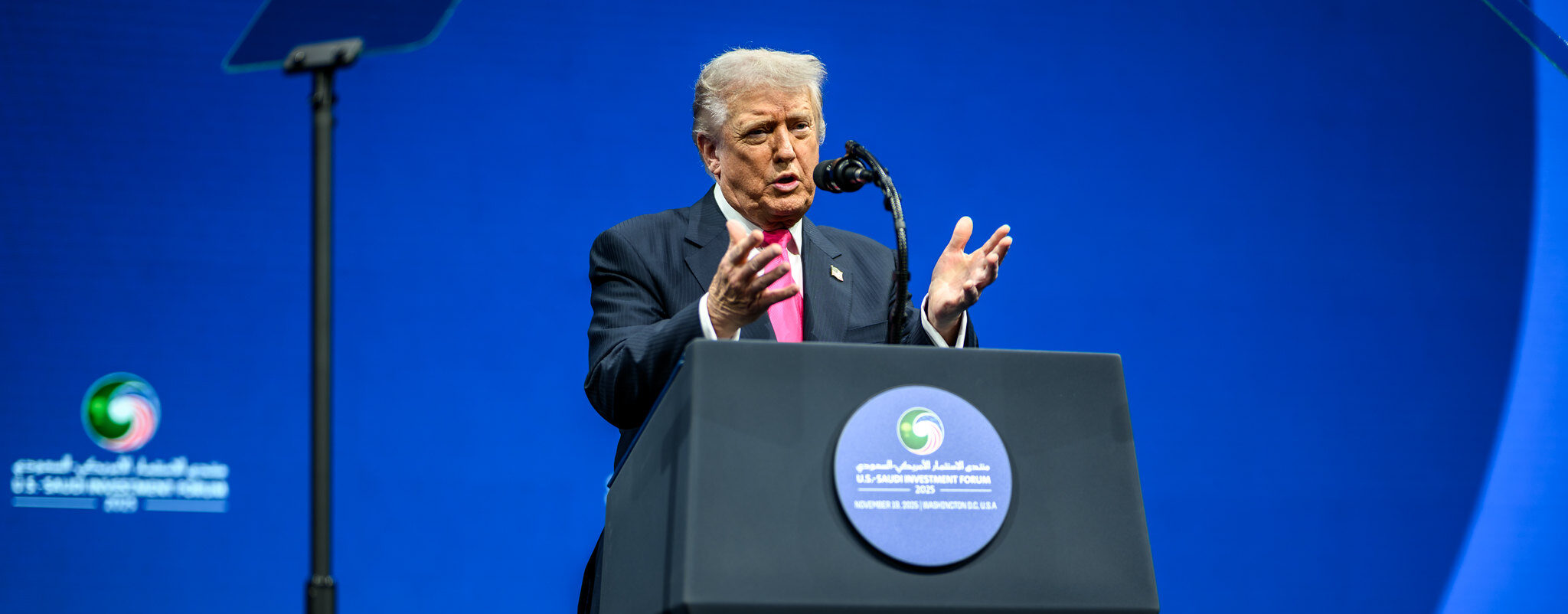
President Donald Trump has been talking about sending millions of taxpaying Americans $2,000 from the revenue that has flowed into the Treasury from the tariffs that Trump has raised. What the president is doing is politically clever and economically irresponsible.
Ever since Mr. Trump became a serious presidential candidate in 2016, it has been clear that he is neither a traditional Republican nor a conventional conservative. He is rightly described as a populist, and as such, his strategy is exactly what we would expect of a presidential candidate in today’s democratic system: to gain popularity with voters. (RELATED: The Answer to Republicans’ ‘Affordability Problem’? Unleash Supply.)
A populist will assiduously avoid pursuing unpopular policies, even when such policies might be necessary for the economic well-being of the country.
A populist will assiduously avoid pursuing unpopular policies, even when such policies might be necessary for the economic well-being of the country. Foremost among such policies would be shrinking the national debt. Anyone who is not a financial illiterate knows that government debt cannot rise indefinitely without destabilizing our financial system, but any politician who pushes for the major spending cuts necessary to reduce the debt will alienate voters and be punished at the ballot box. Trump knows this, and so, in spite of some pious pronouncements about reducing the national debt, the debt has risen from the previous year in four of the five years that Trump has been president. Yes, when Trump replaced Barack Obama in the White House, the budget deficit went up (from $585 billion in 2016 to $665 Bn, $779 Bn, $984 Bn, and finally $3,123 Bn in 2020 when COVID messed up everything). Preliminary figures indicate a 2.8 percent decrease in the deficit in 2025 compared to Joe Biden’s last year, although that improvement could be erased if Trump’s tariffs are nullified by the Supreme Court and all those revenues have to somehow be refunded. On the positive side, there have been a number of highly publicized spending cuts under Trump this year, but the dollar total has been modest. (RELATED: The Forces Fueling America’s 45-Year Debt Addiction)
Before the Trump loyalists call for burning me in effigy, let me credit our president for some much-needed economic sanity. The differences between Trump’s economic policies and those of the Biden administration are significant: Mr. Trump has championed supply-side tax cuts and gotten rid of harmful suffocating regulations; he has saved us from the U.N.’s socialistic wealth-transfer scheme masquerading as climate policy; he has scuttled DEI’s un-American quota nonsense in favor of good old-fashioned meritocracy; he has served notice to American universities that they should not take government subsidies for granted; he has stopped the ruinous, ridiculously costly flood of illegal immigration into our country.
That being said, there are still serious shortcomings in the president’s economic policies. He simply is not a budget hawk, or at least, he has no stomach for making deficit- and debt-reduction a core pillar of his policies. This is not a new development. In his first term, in the summer of 2019, he made a quiet deal with then-Speaker Nancy Pelosi to suspend the debt ceiling for two years — long enough to get him through to the election without having to fight for deficit reduction. In making this deal, Trump consented to a $320 billion spending increase over previously negotiated ceilings. (RELATED: America’s Trade Deficits Are Not Innocuous)
Another indication of how uncommitted the president is to deficit reduction occurred during his presidential campaign in 2024. Trump proposed eliminating taxes on Social Security benefits. While I personally would benefit from such a policy, I oppose it as fiscally irresponsible. We all know that the Social Security System faces serious funding shortfalls within the next decade. Taxes on Social Security benefits are earmarked for the Social Security and Medicare trust funds, so to reduce that source of income into the funds at a time when they already are underfunded is fiscally reckless. It is no different from when President Obama reduced Social Security withholding from paychecks by 2 percent to increase working Americans’ take-home pay. Reducing the government revenues that fund a vitally important government program that is chronically underfunded only exacerbates the problem. Why did Trump propose this? To curry favor with voters, of course, just like Obama did. Sad. (RELATED: A 50-Year Mortgage Is a Financial Narcotic)
Perhaps I am being too cynical, but I see Trump’s current tactic of dangling $2,000 checks before Americans as a political maneuver, skillfully played. Trump and the Republican Party are hurting at the polls as more and more Americans fret about the cost of living. What better time to propose giving them $2,000? Trump has put himself in a can’t-lose situation. If the Supreme Court disallows the Trump-imposed tariffs on the plain-as-day constitutional grounds that trade policy and “imposts and duties” on imports are congressional prerogatives, then the president can tweet to millions of American taxpayers, “You would all have an extra $2,000 except but for that nasty Supreme Court, which has kept me from helping you.” (Of course, Mr. Trump will use more colorful language and more capital letters than I did, but you get the point.) And if the tariffs are allowed to stand, Trump looks like Santa Claus (to the envy of Democrats who want to monopolize the Santa Claus role of government). (RELATED: Aristotle on a Balanced Budget Amendment)
In regard to the national debt, however, Trump’s tantalizing talk about $2,000 handouts is as economically unwise as it is politically clever. It is proof that reducing the national debt is a low priority for him. Like St. Augustine, who prayed, “give me chastity, but not yet,” Trump may indeed like the idea of spending reductions, but not so much as to give up the political gain of using government funds to buy popularity. Once again, the debt “can” would be kicked further down the road.
The bottom line is that our populist president’s debt reduction talk is not backed up by serious debt reduction action. The ultimate blame for our ongoing national debt fiasco, of course, lies not with Trump, but with the American voter. Too many Americans are so addicted to the concept of a Santa Claus government that they won’t elect anyone as president who is serious about significantly shrinking the federal government.
READ MORE from Mark W. Hendrickson:
Abusing Border Patrol Agents: Echoes of Vietnam


![Donald Trump Slams Chicago Leaders After Train Attack Leaves Woman Critically Burned [WATCH]](https://www.right2024.com/wp-content/uploads/2025/11/Trump-Torches-Powell-at-Investment-Forum-Presses-Scott-Bessent-to-350x250.jpg)