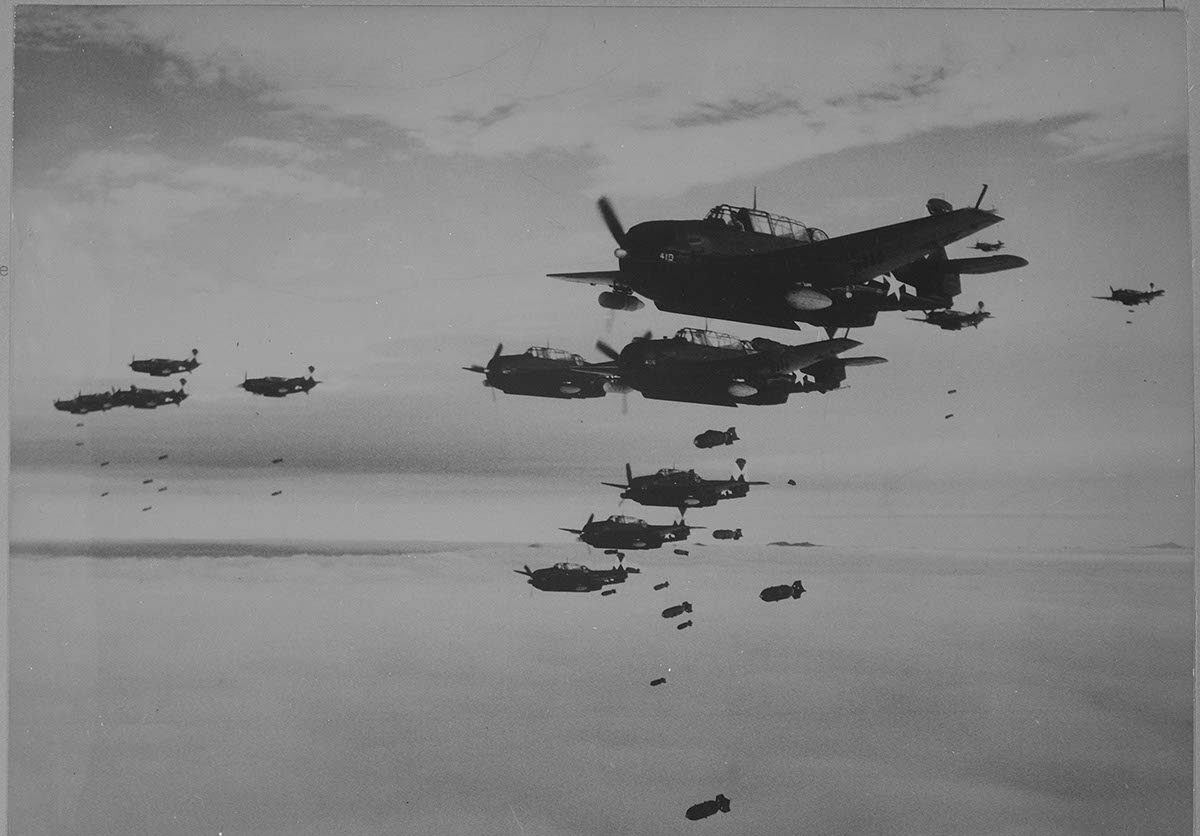
Since the earliest days of aviation the seductive siren call of airpower supremacy has fascinated military aviators — particularly in the Air Force — and politicians. Beginning with Italian military theorist Giulio Duhet, airpower enthusiasts argued that bombing alone could win wars and save lives thus avoiding the carnage of WW I. Duhet advocated terror bombing that included the use of poison gas on enemy cities. Italians believed that his theories were vindicated in the 1930s when the Italian Air Force (Regia Aeronautica) had considerable success in suppressing Somali rebels and the British had similar experiences in a tribal revolt in Iraq.
Also during that time, U.S. Army Air Corps planners were refining Duhet’s theories. Rather than terror bombing, they believed that industrial nations such as Japan and Germany could be defeated by taking out key war manufacturing and strategic transportation nodes, and that the United States and it’s allies could defeat the Axis powers with airpower alone. They were forced to resort to the firebombing of German and Japanese cities due to the inaccuracy of “dumb” bombs, even with the invention of the legendary Norden Bomb Sight.
Now that airpower alone has failed to bring the Iranians to their knees, the administration appears to be seriously considering an amphibious assault on Kharg Island.
Even after D-Day, airpower advocates believed that they could win the war alone. The postwar Strategic Bombing Survey proved otherwise. The Germans and Japanese were more resilient than the planners believed. The development of atomic weapons proven at Hiroshima and Nagasaki provided the airpower advocates a fresh line off attack. Air delivered nuclear weapons would make war unthinkable. However, Korea and Vietnam disproved that notion.
Undeterred, the airpower advocates pushed ahead. As air-delivered precision guidance ordnance matured, the air advocates believed that they now had the tools that they had lacked in WWII to get the job done. Led by the brilliant Colonel John Warden, they planned to exploit weapons a quantum leap more precise than bombs used in Vietnam. Although these new weapons were not decisive in Desert Storm, they were superstars. Heartened, the airpower advocates doubled down.
The UN sponsored war with Serbia over Kosovo paid off for the Air Force during the Clinton Administration. After a short air campaign, the Serbs gave in and opted for peace. Airpower advocates believed they had been vindicated. The problem was that the Serb leadership proved to be uniquely fragile. It was essentially a corrupt kleptocracy that had become a “for profit” business. Knowing this, the Air Force planners targeted key financial and economic nodes. Fearing bankruptcy, the leadership gave in. It seemed that system-based nodal targeting had allowed airpower to finally become dominant.
Unfortunately, our adversaries had been taking notes. ISIS and the Taliban have become much more decentralized, and less prone to nodal vulnerability. As we are finding, Iran has created civilian and military leadership systems that are complex, adaptive, and much less vulnerable to nodal targeting than was the Maduro regime in Venezuela. I am sure that the Chinese have adopted a similar philosophy.
When I was a freshman at the Embry-Riddle Aeronautical University in 1967, one of our required courses was “History of Aviation.” Although a retired Air Force officer, our professor had not drunk the “airpower uber alles” Kool Aid. He told us that although air superiority — and better air supremacy — would be critical to victory in future wars, A balanced combined arms approach would be key to victory. I bought into that approach and was delighted when I joined the Marines Corps to find out that its philosophy matched mine. It was a good fit.
Unfortunately, somewhere along the line in the past six years, the Marine Corps bought into the cult of precision guided missiles. In doing so, its leadership discarded the balanced combined arms approach adopting a precision missile oriented strategy and divested itself of many of the systems that had made it expert in combined arms and amphibious operations.
Now that airpower alone has failed to bring the Iranians to their knees, the administration appears to be seriously considering an amphibious assault on Kharg Island that the previous Marine Corps commandant believed would never happen again. If that happens, the marines will likely need many of the discarded combined arms capabilities. In that case, the fluttering sound you hear may well be the chickens coming home to roost.
READ MORE from Gary Anderson:
We Should Learn From the Present War, the Chinese Will
What Next After the Bombing Stops?
What to Watch for in Operation Epic Fury
Gary Anderson is a retired Marine Corps Colonel who authored Beyond Mahan, a Proposed Naval Strategy for the 21st Century.




![Kamala Comes Unglued, Makes Bogus Claim About Her Landslide Loss to Trump [WATCH]](https://www.right2024.com/wp-content/uploads/2025/10/Kamala-Comes-Unglued-Makes-Bogus-Claim-About-Her-Landslide-Loss-350x250.jpg)




![CNN's Kaitlan Collins Fact-Checks Rep. Jasmine Crockett Over False Trump Ballroom Claim [WATCH]](https://www.right2024.com/wp-content/uploads/2025/10/1761954330_CNNs-Kaitlan-Collins-Fact-Checks-Rep-Jasmine-Crockett-Over-False-Trump-350x250.jpg)