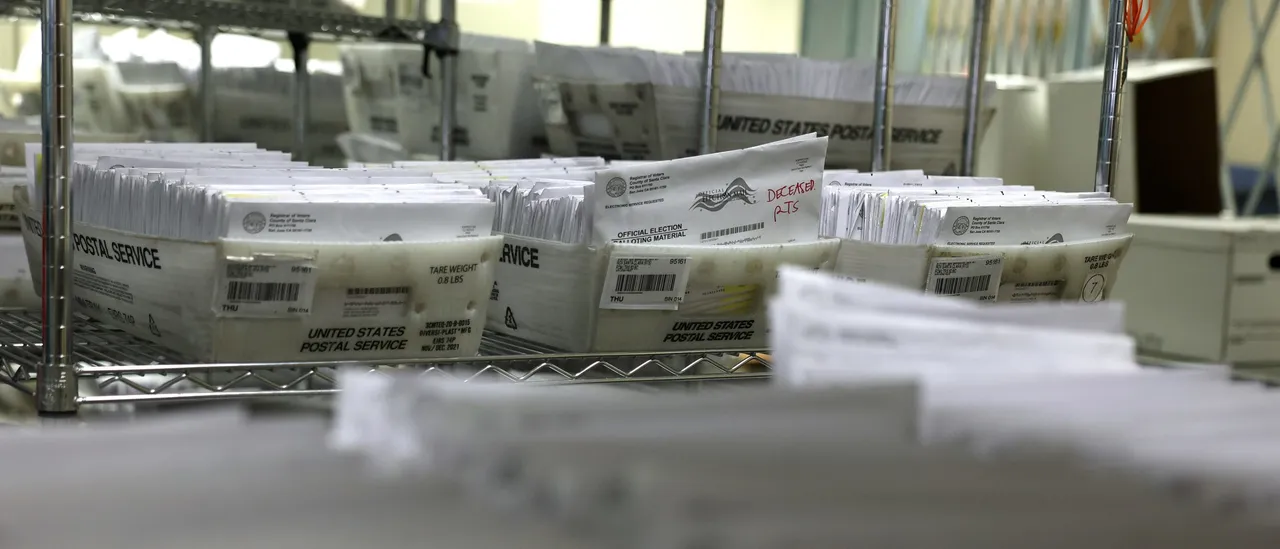
The Supreme Court indicated Monday it may restrict laws in 14 states allowing mail-in ballots received after polls close to count.
During oral arguments for Watson v. Republican National Committee (RNC), multiple justices questioned the reasoning of a Mississippi law which allows mail-in ballots received up to five days after the close of polls to count, as long as they have been postmarked by Election Day. The Court is expected to rule on the case by the end of June, the Associated Press (AP) reported, and its decision has the potential to affect not just Mississippi but the other 13 mostly blue states that have similar late ballot deadline laws on the books. (RELATED: Supreme Court Seems Open To Taking Away Key Election Rule Beloved By Dems)
In addition to Mississippi, the states that allow postmarked non-military ballots cast within the U.S. to be received after Election Day include Alaska, California, Illinois, Maryland, Massachusetts, Nevada, New Jersey, New York, Oregon, Texas, Virginia, Washington state and West Virginia, according to the National Conference of State Legislatures (NCSL). Three U.S. territories — Guam, Puerto Rico and the U.S. Virgin Islands — also have laws allowing such late ballots to count.
While Mississippi, the state the Watson case centers on, allows postmarked ballots to count if they are received up to five business days after Election Day, most of the other 13 states that allow late mail-ins have even more lenient laws, per the NCSL.
Texas has the earliest deadline of the late ballot states at 5 p.m. on the day after Election Day. Virginia and Massachusetts meanwhile have deadlines on the third day after polls close at noon and 5 p.m., respectively.
Texas has the earliest deadline of the late ballot states, ending at 5 p.m. on the day after Election Day. The states with the two next earliest, Virginia and Massachusetts, have deadlines on the third day after polls close, at noon and 5 p.m., respectively.
Nevada’s deadline for ballots postmarked by Election Day is at 5 p.m. on the fourth day after the close of polls. However, the state’s law also specifies that ballots with “unclear postmarks received by the third day following the election are deemed to have been postmarked on or before Election Day,” according to the NCSL.
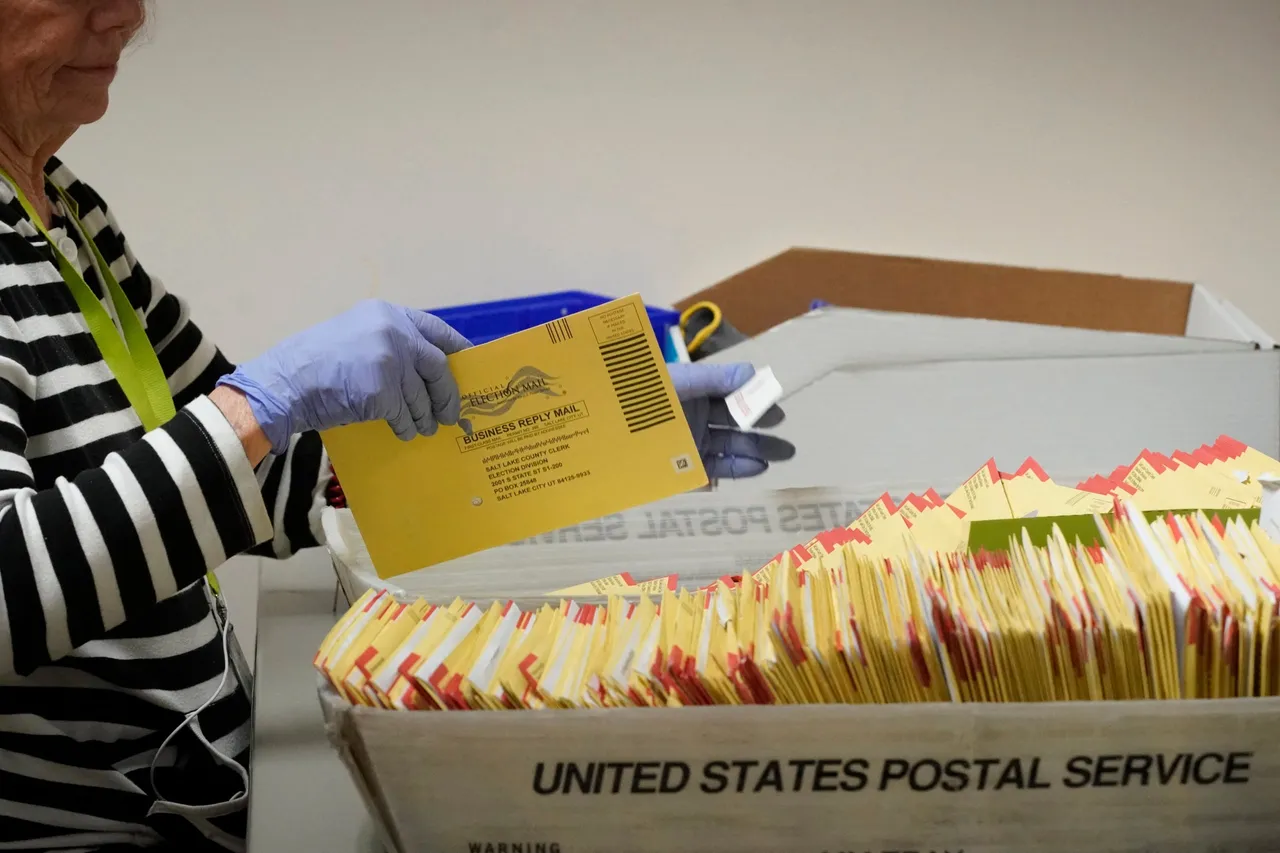
An election worker processes a container of mail-in ballots from the postal service to be processed at the Salt Lake County election offices in Salt Lake City, Utah, on November 4, 2024. (Photo by George Frey / AFP)
Nevada is one of eight mostly Western states — and one of three with post-Election Day deadlines — that conduct universal mail-in voting, often referred to as “all-mail voting,” a system in which each registered voter automatically receives a ballot in the mail, well ahead of Election Day, without needing to apply for one. Voters in these states still have the option to vote in person in lieu of filling out and returning their ballots.
Postmarked mail-in ballots in West Virginia can be received at any time before the state’s canvass — during which election returns are compiled and its results are validated — which starts five days after polls close.
In New Jersey, mail-in ballots postmarked by Election Day must be received by six days after polls close. However, the Garden State also allows for un-postmarked ballots to count as long as they arrive within two days of the election, per the NCSL.
California, New York and Oregon all have mail-in ballot deadlines of one full week after Election Day. However, four states currently allow ballots received after a week following the close of the polls to count. California, like neighboring Nevada, is also a universal mail-in voting state that sends ballots to all registered voters by default.
California, New York, and Oregon all have mail-in ballot deadlines of one full week after Election Day. However, four states currently allow counting of ballots received more than a week after polls close. California, like neighboring Nevada, is also a universal mail-in voting state that sends ballots to all registered voters by default.
Alaska and Maryland have deadlines set ten days after Election Day. Illinois, meanwhile — a state with a long history of alleged voter fraud in close elections — has a deadline of two weeks after polls close.
The state with the farthest out deadline is Washington state, which like Nevada and California is an all-mail voting state. The Pacific Northwest state allows late-arriving ballots to count up to three weeks after polls close — the day before elections are certified in the state — as long as they are postmarked by Election Day.
All three of the universal mail-in voting states with late deadline laws do not require voters to present photo ID to receive a ballot.
“Policies like those in California, Illinois, and Washington that allow ballots to arrive weeks after Election Day do significant damage to voter confidence in elections,” Jason Snead, Executive Director of Honest Elections Project Action, told the DCNF in a statement. “The Supreme Court has an opportunity to uphold federal law and significantly enhance public trust in voting by requiring mail ballots to be received by Election Day.” (RELATED: Election Policy Supreme Court Set To Debate Is Literally An 80-20 Issue, Poll Shows)
This morning, SCOTUS heard arguments in Watson v. Republican National Committee – a case concerning whether mail-in ballots can be counted up to 5 days after Election Day. pic.twitter.com/2YcCuwLi7f
— Honest Elections Project (@honestelections) March 23, 2026
Federal U.S. law establishes one set Election Day that’s defined as “The Tuesday next after the 1st Monday in November, in every even numbered year.”
Nine of the 14 states that currently allow mail-in ballot deadlines after Election Day voted for failed Democratic nominee Kamala Harris in the 2024 presidential election.
Only one state, Louisiana, notably does not allow mail-in ballots received on Election Day and instead mandates that that they be received by 4:30 p.m. on the day before. according to the NCSL. All other 35 states have a mail-in ballot deadline of Election Day.
Notably, the NCSL lists only one state, Louisiana, that does not allow mail-in ballots accepted on Election Day. Instead, it mandates they be received by 4:30 p.m. the day before. All 35 other states have a mail-in ballot deadline of Election Day.
Four states — Kansas, North Dakota, Ohio and Utah — previously allowed postmarked ballots received after Election Day to count toward elections, but they all changed their laws in 2025 and instituted Election Day deadlines, per the NCSL.
The aforementioned laws apply to civilians living within the United States. A majority of states — 28 in total — including most in the South, allow post-Election Day ballot return deadlines for military and overseas voters, according to the NCSL.
State laws allowing ballots to be received and count after polls close are widely unpopular, a new poll suggests.
Over eight in 10 U.S. voters said that mail-in ballots should not be received after Election Day and six in 10 further stated that late-arriving ballots should not count, a survey released Friday conducted by CRC Research for the Honest Elections Project found.
During Monday oral arguments for the Watson case, Justice Brett Kavanaugh appeared to draw attention to the possibility that states allowing late ballot return deadlines can potentially pave the way for voter fraud.
“If the apparent winner the morning after the election ends up losing due to late-arriving ballots, charges of a rigged election could explode,” the justice, widely considered a swing vote on the Court, told the Solicitor General of Mississippi, who was defending his state’s law. “If you have to have a deadline, which you acknowledged, and having a deadline of November 3 rather than November 10 for receipts doesn’t disenfranchise anyone, why wouldn’t it make more sense to take account, in some respect, of that concern as we think about how the text and history fit together?”
All content created by the Daily Caller News Foundation, an independent and nonpartisan newswire service, is available without charge to any legitimate news publisher that can provide a large audience. All republished articles must include our logo, our reporter’s byline and their DCNF affiliation. For any questions about our guidelines or partnering with us, please contact licensing@dailycallernewsfoundation.org.





![Kamala Comes Unglued, Makes Bogus Claim About Her Landslide Loss to Trump [WATCH]](https://www.right2024.com/wp-content/uploads/2025/10/Kamala-Comes-Unglued-Makes-Bogus-Claim-About-Her-Landslide-Loss-350x250.jpg)