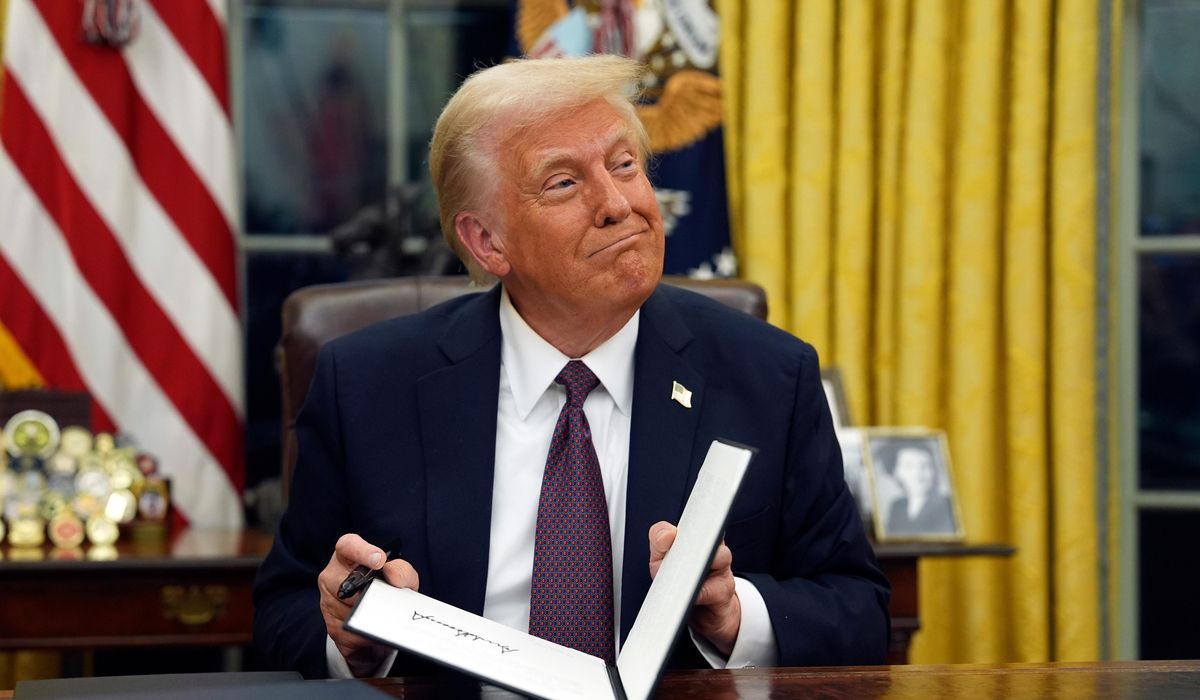
If Ronald Reagan was the “Great Communicator,” then President Trump is the “Big Editor,” trying to shape the way the country thinks about the issues he cares about by changing how Americans talk about them.
It was just a few days into the administration that the Department of Homeland Security told its employees to ditch the Biden team’s preferred terms, such as “undocumented” and “noncitizen,” allowing them to return to the old standby “illegal alien” to describe those in the country without firm legal permission.
At the Department of Health and Human Services, officials quickly revived the term “Unaccompanied Alien Child” to refer to illegal immigrant children who came across the border without a parent.
The Defense Department is now the War Department, at least inside the administration — and to those on the outside who hope to curry favor.
Mr. Trump, of course, ordered the government to rename the body of water between Florida and Texas the Gulf of America.
Governmentwide, the Biden team’s preferred term “gender” is on the way out, replaced with the more traditional “sex” on American passports, immigration forms and decisions about where to place prisoners.
Mr. Trump’s personal speech has long been a subject of fascination.
Researchers at the University of California, Los Angeles, crunched the words the president used from 2015 to 2024 and concluded that his use of “violent vocabulary” had increased.
He is also fond of inserting himself into speech.
That includes renaming the Kennedy Center in Washington to the Trump-Kennedy Center, his plans for a “Trump Class” series of battleships, and branding a new immigration visa for wealthy foreign investors as the Trump Gold Card.
Janet McIntosh, a professor of anthropology at Brandeis University and author of “Language in the Trump Era,” said word choices can control the framing of an issue.
Describe crime as a “beast ravaging a city,” and people support policing and jail. Characterize it as a virus or disease, and they will be more inclined to want to “treat” it with social programs and community aid.
Mr. Trump, she said, wants to frame the issues “to encourage Americans to harden their hearts against those he considers outsiders.”
“His administration’s word preferences are part of a broader climate he is establishing that will probably affect some people’s willingness to disregard the suffering of those groups,” she said. “When the word choices are widely adopted and happen within the context of broader changes in an administration’s stance, there could be incremental effects on some folks’ willingness to circle the wagons around a narrower vision of what America is or should be.”
Some of the changes have been dictated by agency chiefs.
At the Justice Department’s Executive Office for Immigration Review — the immigration courts — the acting director sent a memo on Jan. 29 revoking the Biden-era directive forbidding the use of “illegal” and “alien.” Sirce Owen said the Biden decision was a “questionable policy choice” at the time and didn’t make sense given that the law, from which the judges frequently quoted, uses the term alien.
“EOIR is not an Orwellian language police,” Ms. Owen wrote.
At other times, the Trump changes are formal attempts to police the language in the government’s voluminous regulatory code.
Agencies looking to update regulations are also using the opportunity to alter the “gender” language inserted by the Biden administration and replace it with the “sex” designation that the administration says is more accurate.
Rachel N. Morrison, director of the Administrative State Accountability Project at the Ethics and Public Policy Center, has submitted formal comments to several agencies in support of the project.
“Using the term ‘sex’ instead of ‘gender’ provides clarity, improves the quality and utility of information collected, protects sex-based rights, and reflects biological reality, not subjective self-perception,” she told The Washington Times.
Some of the names serve as a form of virtue signaling for those looking to show which side of the aisle they support. Trump supporters were quick to adopt the “War Department” label, while his opponents resist.
That’s nothing new, of course.
For years after Congress renamed Washington National Airport to honor Ronald Reagan, locals who weren’t fans of the 40th president refused to use his name. Indeed, the local Metro system resisted for years and updated its maps and signs only after threats from Congress.
The Biden administration was just as focused on language as the Trump team.
When they ditched terms such as “illegal” and “alien,” Biden officials declared it a major statement.
“Sometimes language is so very, very important,” Biden White House press secretary Jen Psaki said. “We issued a directive that the term ‘illegal aliens’ should not be used unless one is citing to the particular statutory language that exists. But we should refer to those individuals as ‘noncitizens’ to reflect that their lawful presence, or their unlawful presence in the United States, does not define their dignity as individuals.”
Homeland Security Secretary Alejandro Mayorkas, meanwhile, chided members of Congress for calling the border surge an “invasion.”
“That is a term that I find to be offensive,” he said.
When asked whether he would characterize the border as a “crisis,” he lost interest in labels.
“I am not focused on language,” he insisted.
The Biden lexicon led to some bizarre outcomes, including Border Patrol agents in court documents and at least one U.S. attorney’s office referring in press releases to an oxymoronic “undocumented citizen.”
The Trump terms can sometimes get officials into trouble.
Homeland Security’s penchant for labeling most illegal immigrants it references as “criminal aliens” drew a rebuke this month from Judge Beryl Howell, who said it was a misreading of the law.
Being in the country without authorization is a civil offense, she said.
“Consequently, viewing all immigrants potentially subject to removal as criminals is, as a legal matter, plain wrong,” she wrote in an opinion ordering Immigration and Customs Enforcement to curtail warrantless arrests in the nation’s capital.
![Donald Trump Slams Chicago Leaders After Train Attack Leaves Woman Critically Burned [WATCH]](https://www.right2024.com/wp-content/uploads/2025/11/Trump-Torches-Powell-at-Investment-Forum-Presses-Scott-Bessent-to-350x250.jpg)


![Kamala Comes Unglued, Makes Bogus Claim About Her Landslide Loss to Trump [WATCH]](https://www.right2024.com/wp-content/uploads/2025/10/Kamala-Comes-Unglued-Makes-Bogus-Claim-About-Her-Landslide-Loss-350x250.jpg)