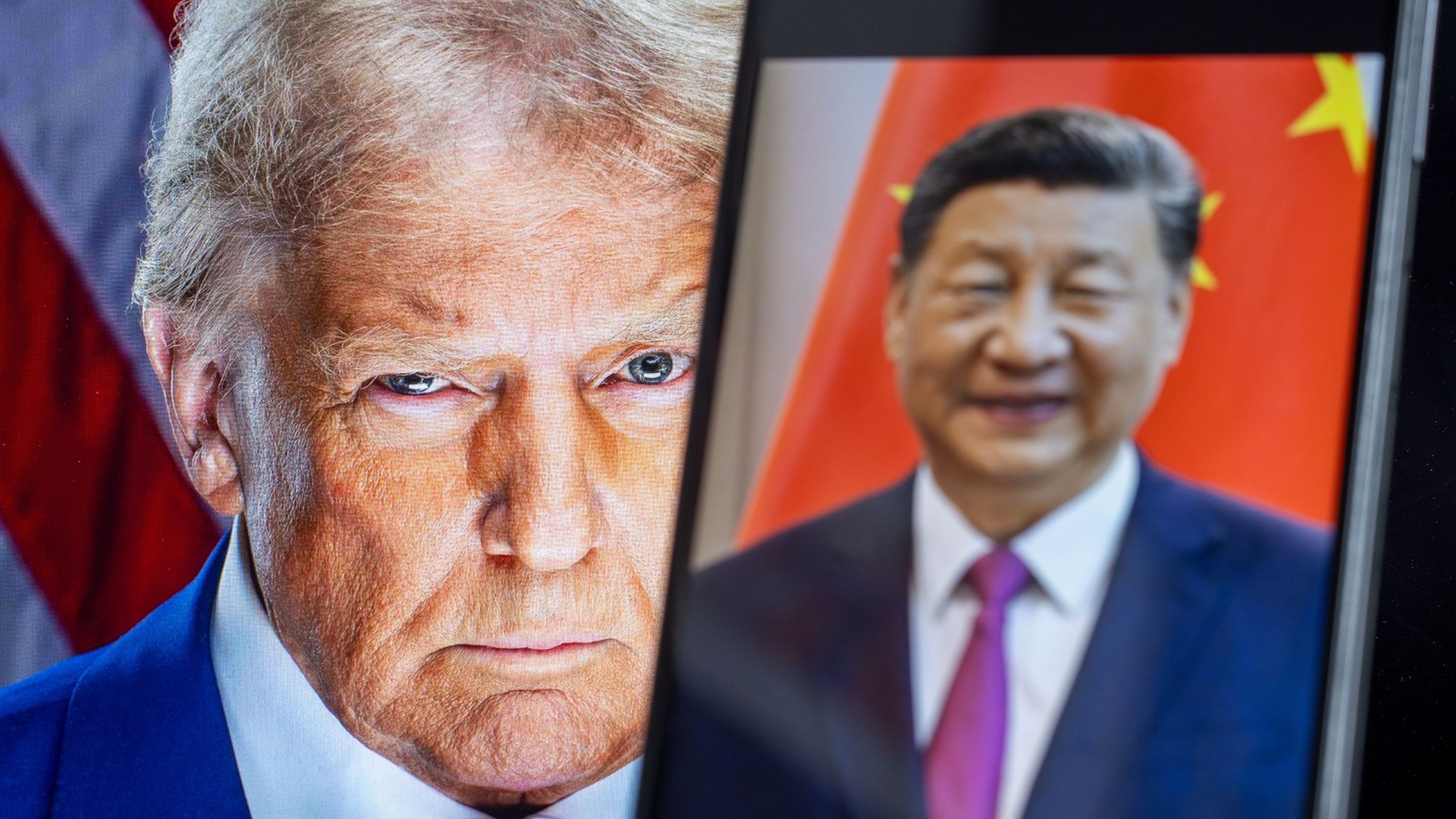
A recent interview between journalist Tiffany Meier and China analyst Gordon Chang focused on how geopolitical shifts in the Middle East could affect China’s political and economic stability, particularly as President Donald Trump continues a strategy aimed at weakening Beijing’s global alliances.
Meier opened the discussion by raising questions about whether developments in Iran could ripple outward and destabilize China’s leadership structure.
“Welcome back. I’m Tiffany Meyer. Could the collapse of the Iranian regime spell doom for Communist China? President Trump’s strategy has been systematically cutting off the Chinese regime’s lifelines, first Venezuela, now Iran and Cuba on the horizon,” Meier said.
“Joining us now is leading China analyst Gordon Chang. He’s the author of the book’s plan red China’s project to destroy America and the Coming Collapse of China. Gordon, thank you so much for joining us. Great to have you here. Now there are reports that China’s leadership was caught off guard by these strikes, including from professors and government advisors inside Beijing. First big picture, what are the implications for China’s political apparatus following these strikes in Iran?”
Here’s What They’re Not Telling You About Your Retirement
Chang responded by pointing to internal fears within China’s ruling establishment about unrest and political upheaval.
“The problem for the Chinese regime is that the Chinese people can see what’s going on in Iran with all of those protests. And if the regime fails, then I think you’re going to see Beijing very worried,” Chang said.
“They were very worried when the Soviet Union fell. They were very worried during the Jasmine revolution, all of these quote, unquote, color revolutions, really, really, just get the Chinese regime where it lives. And Xi Jinping has talked about this in secret communist party meetings, especially the one in December of 2012 where he talked about the defense of communism.”
This Could Be the Most Important Video Gun Owners Watch All Year
Meier then shifted the discussion to energy markets and China’s dependence on oil flowing through the Strait of Hormuz, which has become a focal point in the region.
“I want to get into that. But first, in terms of economic impacts, reports say China gets about half of its oil through the Strait of Hormuz, buying nearly all of Iran sanctioned oil. We’ve seen China halt diesel and gas exports, and now there are reports of tankers declaring themselves Chinese to not get hit. How significant is this straight to China economically, especially if this goes on for a while?” Meier asked.
Chang said China’s economy is already under pressure and could face additional strain if energy disruptions persist.
“The Chinese economy is eroding fast, and at the same time, you have this hit on energy,” Chang said.
“So for instance, in the last few days, we know that gasoline prices spiked 11.0% but more important for the Chinese economy, the diesel prices soared 13.5% and this is going to get worse if the strait remains essentially closed. Now, China can get a ship here or two through the Strait, but what it really needs is a continuous lifeline, and that’s not going to be resumed for quite some time.”
Meier also asked about political instability inside China, noting reports of leadership purges and economic concerns.
“On top of the economic woes, there have been massive purges across China’s leadership, with the top generals essentially wiped out now, with Chinese leaders in the midst of their biggest political meetings this week, what signs are of instability? Are you looking out for here?” she said.
Chang pointed to economic signals from Beijing that suggest concern about future growth.
“I think the most important thing is when you look at what they’re saying about the economy, because that is driving all of a lot of the problems inside Beijing right now, and they’re signaling that they expect the economy to decline in 2026,” Chang said.
“Their growth target is 4.5 to 5% that compares with the growth target for last year of 5.0 which is what They, in fact, reported, but they didn’t grow that fast. Tiffany, we don’t know exactly what the Chinese economy did last year, but it looks like one or 2% growth, if that, and it could very well have been a contraction, because we’re seeing price deflation, and deflation is an economy killer, and we’re seeing probably 20% overall unemployment, and that is a real indication of failure at a time when they need a lot of money in order to retire the debt that they’ve accumulated, especially since 2008.”
The conversation also turned to information warfare and China’s response to U.S. actions.
“Definitely a lot to watch for. They’re here at home, though we’ve seen China ramp up the information war following the strikes in Iran with pro CCP network. So funding protests against the strikes. Why is the CCP trying to control the information realm? What’s at stake here for the CCP?” Meier asked.
Chang argued the Chinese leadership sees the situation as a threat to its survival.
“Ultimately, the regime sees its survival at stake, and they do not want this war to continue,” Chang said.
“So they’re trying to stir up the American populace against President Trump. Because President Trump, if he continues the bombing, can actually do a lot of damage to not only the Chinese economy, but the Chinese regime itself. So they see that probably close to being an existential threat for them, and that means they’ll do everything, including riling up the American populace against Trump in order to make sure that they can continue their rule of China.”
The interview also addressed Chinese activity in Latin America, which Meier said has raised concerns in Washington.
“Gordon, a new report by the House Select Committee of China’s warns that China is using Latin America as the launch pad for military space operations, noting at least 11 Chinese linked sites across Argentina, Venezuela, Bolivia, Chile and Brazil, including ground stations and telescopes that serve dual use military purposes tied to China’s military. How has the CCP leverage dual use tech or the guise of scientific research to mask its military buildups?” Meier asked.
Chang said China has built a network of strategic facilities across the region.
“Well, they haven’t tried very hard to mask what they’re doing there and matter of fact, China was able to establish those ground stations, and just because the United States was not opposing them,” Chang said.
“And in addition to that, those ones mentioned by the House Select Committee, you have about four listening posts, at least four listening posts in Cuba, and perhaps a military base there, as well as reported by The Wall Street Journal. So that’s even closer to the United States, and that’s directed direct, directly at the US. Those ground stations that are reported by the House Select Committee, those are looking at space, but the ones in Cuba are looking at phone traffic in the US itself.”
The discussion concluded with Meier asking how recent geopolitical moves could influence upcoming talks between Trump and Chinese leader Xi Jinping.
“And Gordon looking ahead. How do all of these recent moves impact the expected high stakes talks between Trump and Xi in April?” Meier asked.
Chang said recent developments may shift the balance of leverage.
“Yeah. Great question. I think that it gives President Trump a lot more leverage against Xi Jinping,” Chang said.
“The Chinese last year were really confident and they wanted Trump to come because they thought they could push him around when he was in the Chinese capital. But I’m not so sure that they want Trump there now, because Trump is triumphant, and they probably don’t want him parading through Beijing when he’s on a roll and where the Chinese look a little bit weak and incompetent.”
WATCH:
![Donald Trump Slams Chicago Leaders After Train Attack Leaves Woman Critically Burned [WATCH]](https://www.right2024.com/wp-content/uploads/2025/11/Trump-Torches-Powell-at-Investment-Forum-Presses-Scott-Bessent-to-350x250.jpg)