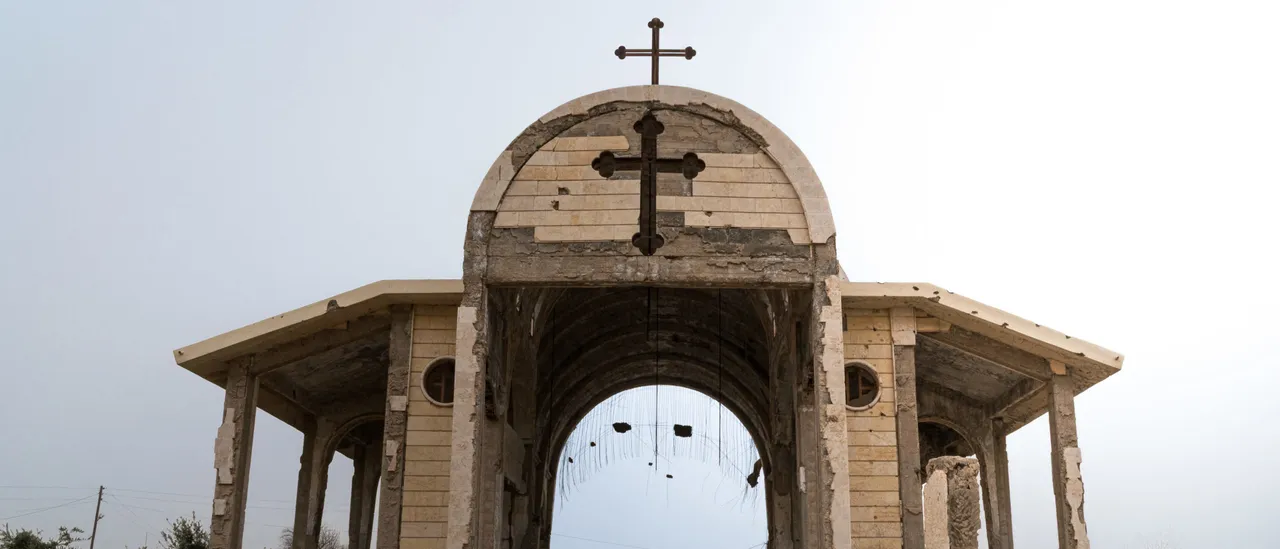
While Christians around the world prepare to celebrate Easter, the Middle East — the very place Jesus once walked — is again consumed by war. From Gaza to American and Israeli-led attacks on Iran that have escalated into a broader regional war, the events in the lands that birthed Christianity remind us of humanity’s need for redemption.
Many in the West have grown distant from faith, and Easter is often reduced to a cultural holiday rather than a declaration of truth. But foreign fragility and national anxiety point to something deeper: a world searching for meaning, justice, and peace, yet unable to secure them on its own.
Too many of us look to the government, cultural institutions, and even technological progress to give our lives stability and purpose. Sadly, time and again, these solutions fall short and are unable to address the deeper fractures within human nature. The unrest we witness abroad increasingly mirrors a quiet unrest at home.
Easter is the beating heart of the hope-filled Christian faith, a celebration of the risen Savior, Jesus Christ. He alone stands victorious over sin, inviting all who believe in Him to find salvation from physical and spiritual death. Even in the midst of war and uncertainty, the message of Easter is not abstract — it is urgent: repent, believe in Him, and be saved. The risen King and Lord promises rest to each of us; “Come to me, all who labor and are heavy laden, and I will give you rest.”
But a war-torn Easter also stands as a stark warning that the time to accept His offer is limited, and the consequences of rejecting the great gift of His salvation are eternal separation from His kingdom and irreparable loss of fellowship with God.
Long before the birth of Christ, the prophet Isaiah understood this duality. He says, “Seek the LORD while He may be found; call upon Him while He is near.” The message is both hopeful and sobering. God has drawn near, but the opportunity to respond is not indefinite.
The Apostle Paul echoes this same urgency in the New Testament after Jesus’ resurrection. Speaking to the deeply religious Athenians — so religious they even had an altar to an unknown God — Paul declares that God is not distant or unknowable but is revealed in the incarnation of Jesus Christ, His death, and resurrection. (RELATED: ‘All Glory To My Lord And Savior, Jesus Christ’: High Point’s Chase Johnston Gives Iconic Postgame Speech After Upset)
This is what makes Easter more than a tradition or seasonal reflection. It is a moment that confronts each of us with a joyful invitation, a dire warning, and ultimately, a choice.
This is not a distant or theoretical choice, but a present and personal one that requires more than acknowledgment of historical events or agreement with philosophical ideas. Easter confronts each person with the question of where they will place their trust, either in earthly leaders and institutions, in shifting circumstances or in a risen Savior whose promise is unchanging.
In a moment when global instability is rising and confidence in institutions is falling, many are searching for answers in politics, power, or ideology. But the events unfolding in the Middle East — and the unease felt far beyond it — point to the limits of those solutions. They cannot ultimately heal what is broken in the human heart.
As war again ravages the very land where Jesus lived, died, and rose again, we must understand that it’s not power or politics that will ultimately solve this geopolitical crisis or answer the deepest needs of the human heart. The message of Easter cuts through the noise of conflict and uncertainty. God has drawn near and He sent Jesus Christ to make a way for reconciliation.
The only question now is whether we will believe it.
Dr. David Murphy is Dean of the School of Behavioral and Social Sciences at Colorado Christian University and a fellow at the Centennial Institute.
The views and opinions expressed in this commentary are those of the author and do not reflect the official position of the Daily Caller.


![Kamala Comes Unglued, Makes Bogus Claim About Her Landslide Loss to Trump [WATCH]](https://www.right2024.com/wp-content/uploads/2025/10/Kamala-Comes-Unglued-Makes-Bogus-Claim-About-Her-Landslide-Loss-350x250.jpg)